AI development services built on context and accountability
Algoryte delivers AI transformation as one connected stack, with models, data and infrastructure engineered together, from strategy to systems running in production for businesses and enterprises.
Algoryte is an AI development company that takes businesses from AI strategy to systems in production. Our AI development services cover AI consulting and transformation, AI automation, generative AI, enterprise AI, LLM fine-tuning, RAG, MCP, agentic AI, AI agents, multi-agent systems and MLOps, built in your cloud, grounded in your data and measured against a baseline.
what are AI services?
AI services are the consulting, engineering and operations work that puts artificial intelligence to use inside a business: deciding where AI fits, building the models, agents and integrations, and running them reliably once they are live. Every business approaches AI from a different starting point. Some are exploring their first use case; others are scaling systems already in production. Deciding what to build, and when, matters as much as building it, and that is where our work begins.
what are AI development services?
AI development services design, build, integrate and maintain custom AI systems for a business. The systems we build are grounded in your data, your rules and your tools, with the visibility and controls your teams need to trust them. Technology changes quickly, so we keep our builds technology-agnostic and adopt better models as they arrive, without a rebuild.
Our work spans AI consulting, AI automation, generative AI, enterprise AI, LLM fine-tuning, RAG, MCP, agentic AI, AI agents and multi-agent systems, and MLOps, LLMOps and AI model maintenance.
algoryte AI development services at a glance
what we do
AI strategy, development, integration and operations, from first use case to organization-wide adoption
services
AI consulting and transformation, AI automation, generative AI, enterprise AI, LLM fine-tuning, RAG, MCP, agentic AI, AI agents, multi-agent systems, MLOps
process
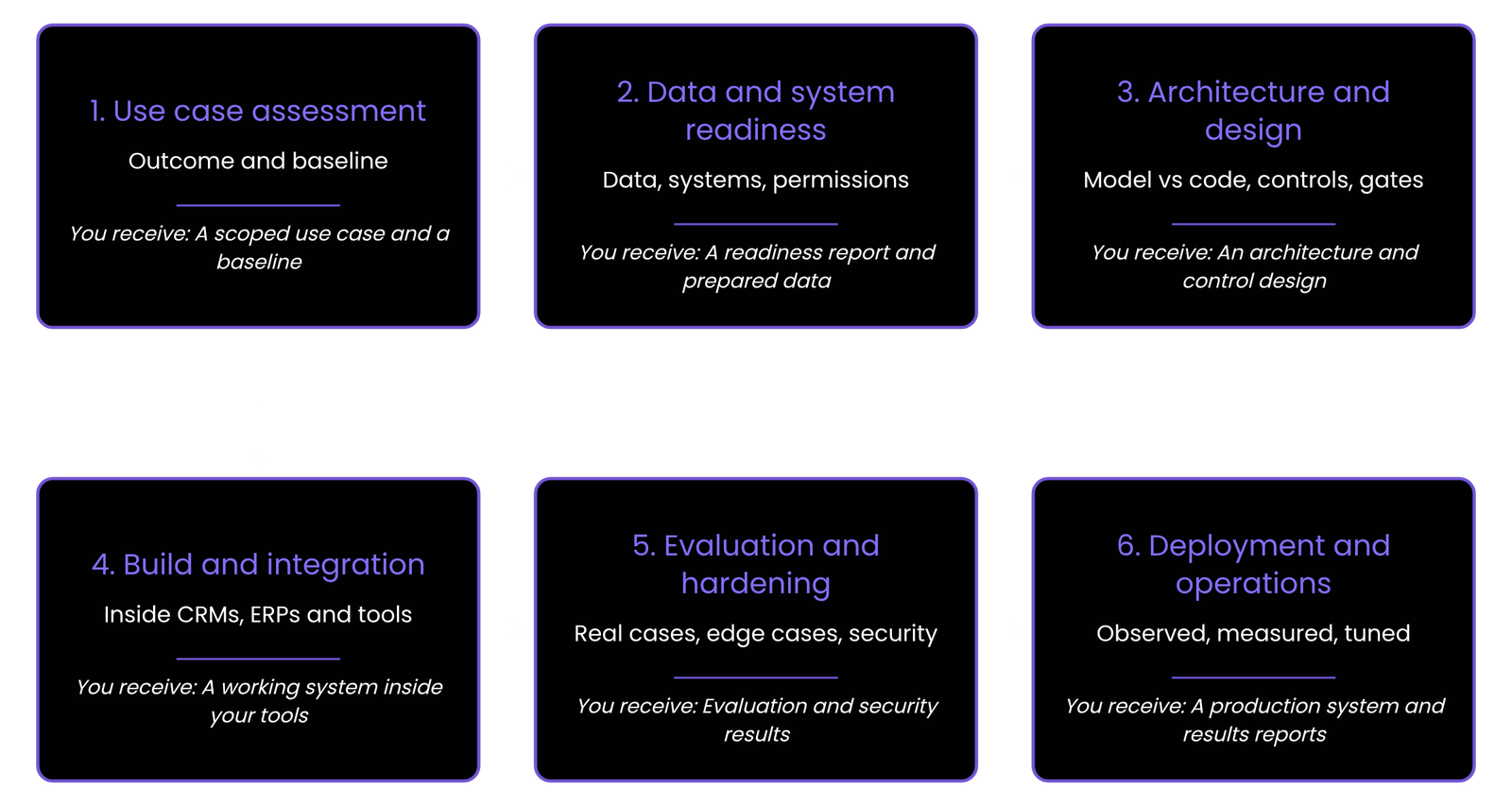
Use case assessment, data and system readiness, architecture and design, build and integration, evaluation and hardening, deployment and operations
where it runs
Your cloud (AWS, Microsoft Azure, Google Cloud and others) or on-premises, under your access controls
how results are measured
Against a baseline set before the build: hours, cost per case, error rate and turnaround
engagement models
Dedicated AI teams, project-based delivery, fractional support or sprint-based engagements
regions served
United States, United Kingdom, Middle East and North Africa, Central Europe and Asia
why your business should adopt AI
why businesses adopt AI
reason
what changes
A level playing field
Capabilities that once required large teams and long budgets are now within reach of organizations of any size
Capacity without added headcount
Systems carry high-volume, repeatable work, so a rising workload no longer requires proportional hiring
Consistency at scale
Every case is processed against the same rules and standard, whatever the volume or the hour
Faster decisions on current data
Analysis that took days runs against live data, so decisions use current information
Ready for what comes next
Modular systems absorb better models and new capabilities as they arrive, without a rebuild
our AI services
Each service has its own page with the full scope, process and FAQs. Together they form one connected stack.
Figure 1: How Algoryte's AI services fit together as one stack, from strategy to the platforms AI runs on, with operations alongside every layer.
strategy
AI consulting and AI transformation
AI consulting that lays the groundwork for AI transformation: AI maturity evaluation, data landscape assessment, use case prioritization, build vs buy vs partner guidance, responsible and explainable AI, human oversight and AI governance. We guide you from the first assessment to organization-wide adoption, keeping strategy and guardrails aligned.
automation and agents
AI automation
AI automation that runs your operations end to end. We build in two tiers: AI-powered workflows, where models read documents, classify requests and score records along a set path, and agentic automation, where an agent plans the steps and adapts as conditions change. Every build is measured against the baseline it replaced.
agentic AI
Agentic AI that takes a goal and finishes the work across your systems, with the operating layer production needs: scoped permissions, encoded rules and exceptions, approval gates, action logs and ongoing agent operations.
AI agents
AI agents that own a job and deliver on it: task, workflow, customer-facing, monitoring, copilot and voice agents, each with its own identity, scoped permissions and audit trail, tested against the behaviors its role requires.
multi-agent systems
Multi-agent systems for workflows that have outgrown a single agent: supervisor, hierarchical, pipeline, peer or marketplace arrangements, with an orchestration layer, shared context and failures contained within each agent's boundary.
generative AI
generative AI solutions
Generative AI solutions embedded in your products and operations: language and vision models, predictive analytics and generative systems built to your brand's standards, turning existing software and scattered knowledge into AI-native applications.
generative AI engineering
Generative AI engineering around the model: custom input and output layers, secure orchestration, multi-format generation across text, image, voice and video, and an inference stack tuned for throughput, latency and observability in your private cloud.
LLM fine-tuning and customization
LLM fine-tuning that trains models on your data for domain knowledge and voice, task specialization, performance and cost, and safety and privacy, from data engineering through training, evaluation, deployment and monitoring.
data, integration and platforms
enterprise AI
Enterprise AI engineered into your cloud platforms (Microsoft, AWS, Google, IBM, Huawei and Alibaba), your own applications and the SaaS your teams run on, deployed in your cloud under your identity and access controls.
RAG
RAG development that grounds LLM answers in your own data: ingestion, chunking, hybrid retrieval, reranking and cited synthesis, deployed as hybrid, graph, agentic, corrective or multimodal architectures with role-based access and continuous evaluation.
MCP
MCP development that gives your LLMs one standard way into every system you run: servers, tools, resources and prompts, access control, gateways, serverless hosting and migration of existing APIs. Models can change without rebuilding the connections.
MLOps, LLMOps and AI model maintenance
Running AI after launch: deployment pipelines, monitoring of quality, drift, latency and cost, retraining and prompt updates, model upgrades and incident response, so systems keep performing as your data and the models change.
which AI service do you need?
Start from the outcome you want. This guide points to the service that usually leads.
Every Algoryte build follows six steps, whichever service leads.
Figure 2: Algoryte's six-step AI development process, used by every service from assessment to operations.
why choose algoryte for AI development
built for production
An AI system in production depends on more than its model. We engineer the parts that decide whether a system survives real use: the runtime, the context, the guardrails and the observability around the model.
the right mechanism for the problem
Every call to a language model adds cost and latency. We use AI for the steps that need language, judgment or perception, and keep the rest on deterministic code.
human oversight by design
Approval gates, escalation paths and scoped permissions sit where your business needs them, so people keep authority over decisions that carry risk while automation handles routine work.
technology- agnostic by design
We build on the architecture that fits your case. Models, frameworks and tools stay swappable, so the system improves as technology advances.
measured against a baseline
We set the baseline before the build, such as hours, cost per case and error rate, and report the live system against it in the metrics your business already uses.
AI development by industry
The AI we build most often in each industry.
AI for banking & financial services
Document processing
Fraud and risk scoring
Relationship manager copilots
Compliance assistants
AI for insurance
Claims intake and triage
Underwriting support
Policy Q&A
AI for healthcare
Prior authorization support
Clinical documentation
Patient intake and scheduling
AI for retail & e-commerce
Product content
Demand forecasting
Customer service agents
Semantic search
AI for manufacturing
Predictive maintenance
Visual inspection
Supplier document processing
AI for logistics & supply chain
Shipment exception handling
Document extraction
ETA prediction
AI for real estate
Lead qualification
Lease extraction
Tenant request routing
AI for SaaS & software
In-product copilots
Support deflection
Churn prediction
MCP servers for your platform
AI for games & interactive entertainment
Player support
Community moderation
Content generation pipelines
AI for blockchain & Web3
On-chain data agents
Smart contract review support
Treasury workflows with approval
engagement models for AI development
dedicated AI teams
Full-time engineers and specialists inside your team, from architecture through deployment, staying on as your AI footprint grows.
Best for: Long-running AI programs
project-based AI delivery
A defined scope, timeline and deliverables, from first assessment to a system running in your environment.
Best for: One use case from start to production
fractional AI support
Part-time specialists for live systems: monitoring, retraining, guardrail tuning and keeping performance and cost on baseline.
Best for: Systems already in production
sprint-based AI engagements
Short cycles aimed at one outcome: a proof of concept, a new integration, a performance fix or a pre-production reliability check.
AI development services design, build, integrate and maintain custom AI systems for a business: automations, AI agents, retrieval over company knowledge, fine-tuned models, generative AI features and the integrations that connect them to existing software. At Algoryte they start with a use case assessment and a baseline, and end with a system in production that is measured against it.
2. How are enterprises using AI today?
Enterprises use AI in three broad patterns: adding intelligence to software they already run, automating processes that span several systems, and deploying agents that carry out defined work end to end. The common thread is integration with existing data and systems. Most programs start with one workflow, prove it against a baseline and expand from there.
3. How do you choose an AI development services partner?
Choose an AI development partner on a few checkable things: whether they assess your processes and data before proposing a build, whether they can explain which steps need AI and which do not, whether they work inside your existing systems and cloud, and whether they measure results against a baseline. Ask how they handle security, human oversight and ownership of the code. If you need a strategy first, Algoryte can start at the assessment stage.
4. What are common pricing models for AI development services?
AI development services are usually priced in four ways: dedicated teams billed monthly per engineer, project-based delivery with a fixed scope and timeline, fractional support billed for allocated part-time hours, and sprint-based cycles priced per cycle. The right one depends on whether the work is a defined build, ongoing engineering or a single bounded outcome. Running costs for models, compute and infrastructure sit separately from engineering fees.
5. What are the top challenges when adopting AI services?
The top challenges in adopting AI are rarely the models. Data sits scattered across systems in inconsistent formats, processes were never mapped, and no baseline exists to measure improvement. Security and access boundaries are often decided late, which makes retrofitting expensive. Most of this is resolved before any build, by assessing the workflow, preparing the data and defining where human approval is required.
6. How do you evaluate the ROI of AI investments?
Evaluating AI ROI starts with a baseline recorded before the build: hours spent on the workflow, cost per case, error rate and turnaround time. Once live, the system is measured against the same numbers, along with the completion rate without human intervention and the share of cases escalated to a person. Reporting in metrics the business already tracks keeps the assessment grounded in operational results.
7. How long does it take to build a custom AI solution?
A first custom AI solution typically reaches production in six to sixteen weeks. Adding AI to an existing workflow or building a single agent sits at the shorter end; systems that connect several platforms, need significant data preparation or operate under strict compliance sit at the longer end. A proof of concept can be ready in two to four weeks.
8. Should we build custom AI or buy an off-the-shelf tool?
Buy when an off-the-shelf tool covers the workflow well and your data can safely live in it. Build when the workflow is specific to your business, needs to act across your own systems, or gives you an advantage competitors cannot buy. Many programs combine both: bought tools for common tasks and custom AI where the process is yours alone. Our consulting work makes this call per use case.
9. What are managed AI services?
Managed AI services are ongoing operations for AI systems that are already live: monitoring quality, drift, latency and cost; retraining models and updating prompts; upgrading to better models; and responding to incidents. Algoryte provides them as MLOps and LLMOps through fractional support or a dedicated team.