Algoryte’s RAG development services build retrieval augmented generation pipelines that answer from your documents, databases and live systems, with a citation for every claim. We cover ingestion and parsing, chunking, embeddings, hybrid retrieval, reranking, cited generation, access control, evaluation and monitoring, delivered as a project or as RAG as a service that we run for you.
what is retrieval augmented generation (RAG)?
Retrieval-augmented generation (RAG) is an architecture in which a system retrieves relevant passages from a document or data collection at query time and supplies them to a language model, so the model answers from that material and cites it. No retraining is needed, so answers stay current as the source documents change.
LLMs can bring you better results if they have your enterprise data with all the context and real-time updates – that’s where RAGs play their magic.
what are RAG development services?
RAG development services design, build and run the retrieval pipeline behind an AI assistant, search experience or agent. Algoryte’s RAG development services cover the full pipeline: ingestion, chunking, embeddings, vector and hybrid retrieval, reranking, and answer generation with citations, with user access controls, data governance, evaluation and monitoring around it.
We deliver RAG two ways: as a build that your team owns and runs, or as RAG as a service, where we host, monitor and tune the pipeline in your cloud and you consume the answers.
RAG development services & RAG as a service at a glance
What it is
Retrieval augmented generation pipelines that answer from your own data with citations
Document repositories, cloud drives, wikis, ticketing systems, databases and live APIs
Where it runs
Your cloud on AWS, Microsoft Azure or Google Cloud, under your identity and access controls
Delivery
Project-based build, sprint-based improvement, dedicated team, or RAG as a service run by us
How quality is measured
Retrieval precision and recall, answer faithfulness to sources, citation accuracy, latency and cost per query
Fine-tuning shapes behavior and RAG supplies knowledge, so the two often work together. MCP can feed live system data into a RAG pipeline, and LLM fine-tuning can teach the model to use retrieved passages well.
why do enterprises need RAG?
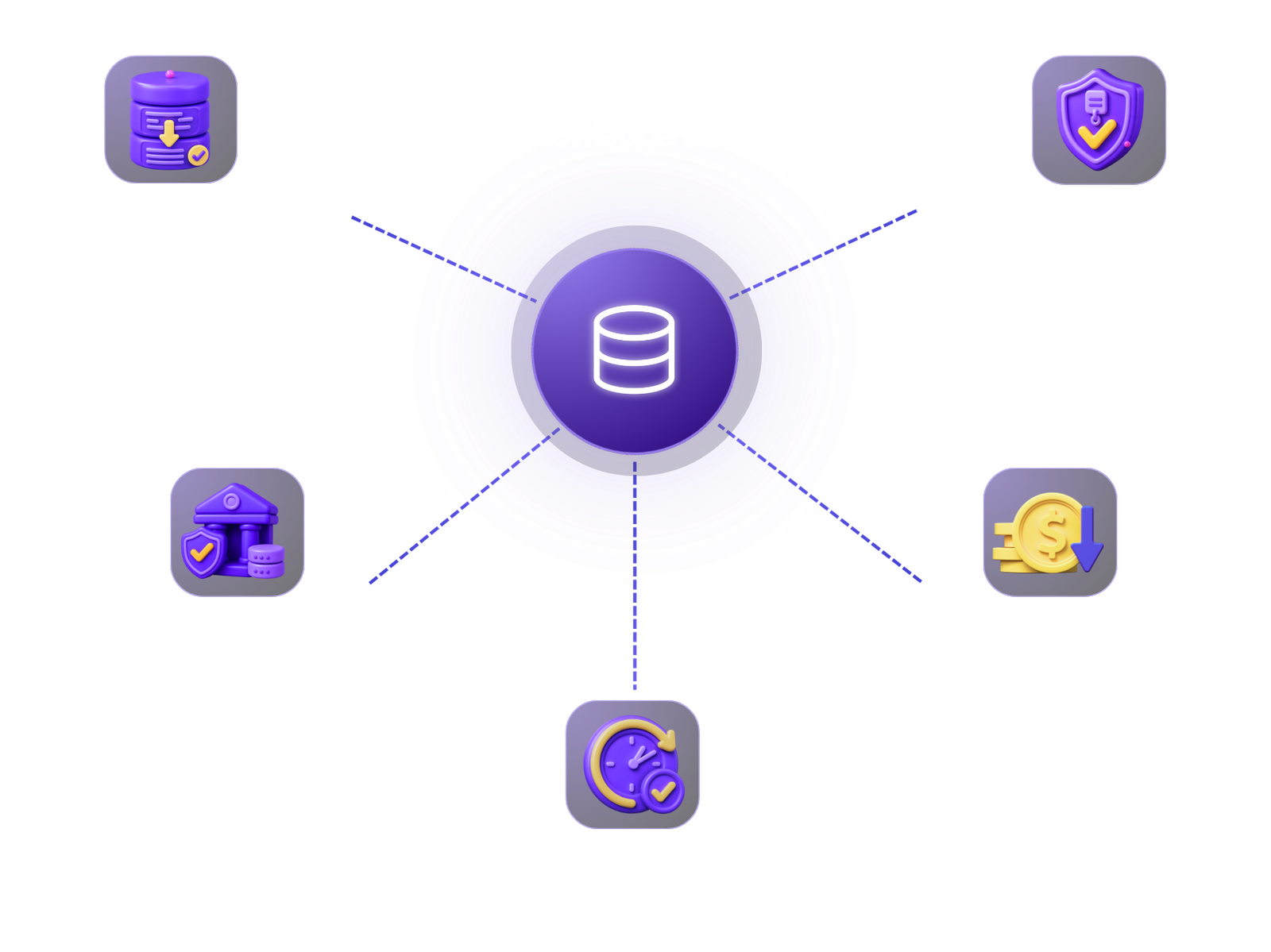
Your insightful corporate data serves no strategic purpose when left scattered across disconnected systems. RAG unifies these fragmented files into a secure knowledge base – turning hidden institutional intellect into a distinct competitive advantage through context-aware answers:
Figure: RAG brings scattered company data into one secure knowledge base, giving AI answers proprietary context, verifiable precision, access control, lower cost and current information.
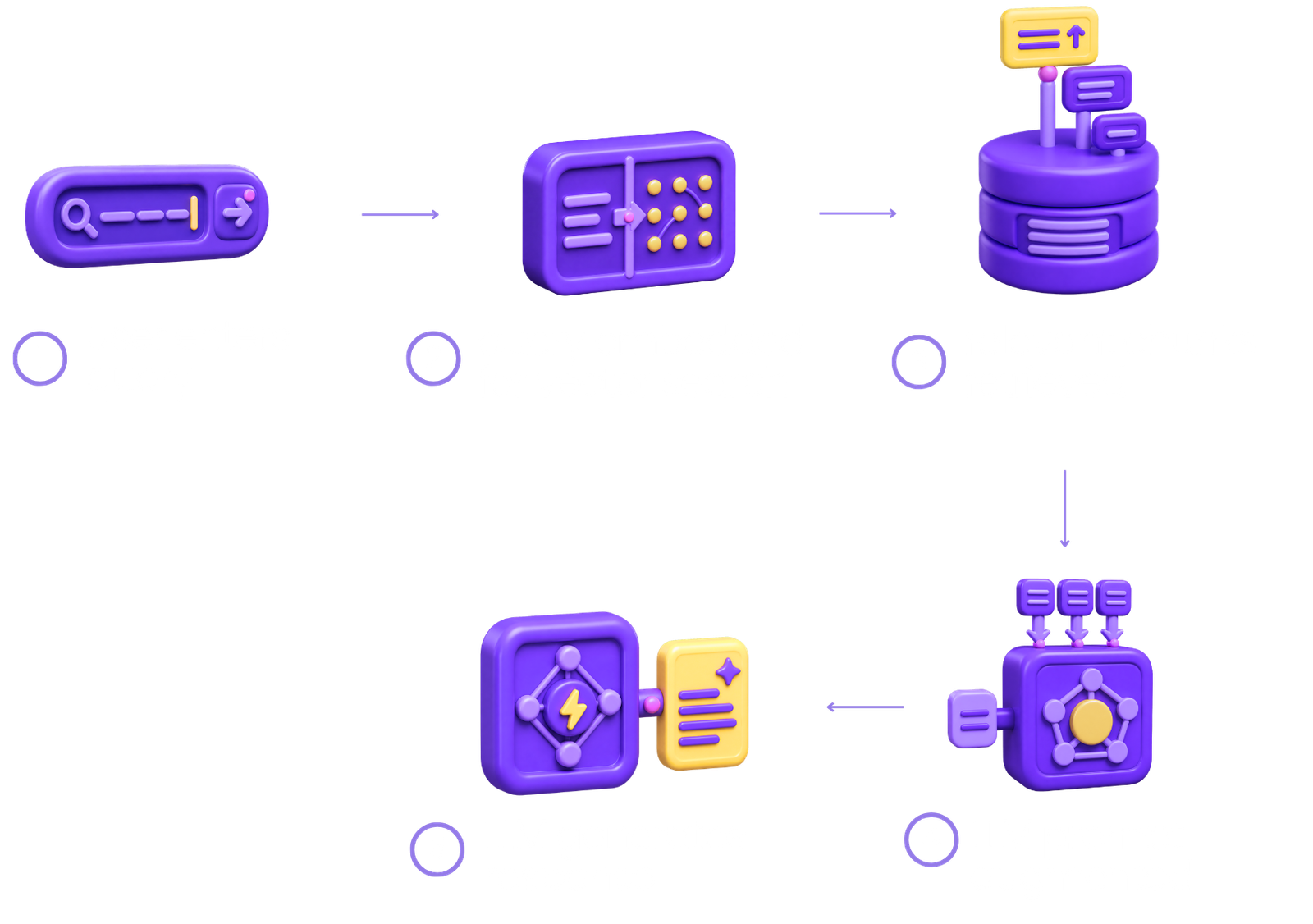
how does a RAG workflow work?
Figure 1: How a RAG workflow answers a question in five steps, from the user's query to a cited response.
two - phase enterprise RAG pipeline
Algoryte deploys production-ready, scalable RAG infrastructure synchronized for complex enterprise data environments:
knowledge ingestion
& parsing
data extraction
Continuous ingestion, cleaning, and de-duplication from internal repositories, cloud drives, and APIs – spanning complex layouts.
objectives
Reduce information discovery times to seconds
Fewer wrong answers from outdated data
Accelerated team onboarding with preserved knowledge
context-aware indexing
Precise text chunking, including optimized fragment size and overlap, followed by data embedding and high-performance vector database indexing.
objectives
Prevent broken context from split paragraphs
Maximize semantic search accuracy via high-performance vector mapping
Minimize database storage costs through optimized token usage
dynamic retrieval, reranking & synthesis
query evaluation
Real-time intent analysis and structural guardrails that convert user inputs into multi-pronged searches.
objectives
Block irrelevant or malicious prompts before they reach the database
Break complex, multi-part questions into targeted search plans
Route queries to the correct database based on user intent
optimized retrieval
Hybrid data store queries driven by tailored embedding model selection, exact similarity thresholds, and metadata filters.
objectives
Find alphanumeric codes and conceptual meanings simultaneously
Enforce role-based access controls on specific data fragments
Drastically reduce retrieval latency across massive enterprise data sets
algorithmic reranking
Automated ranking layers that filter and feed highly curated context directly to the LLM.
objectives
Cut through data clutter by sending only the most relevant text to the AI
Reduce AI hallucinations caused by conflicting or low-quality documents
Lower LLM computing costs by minimizing prompt size
response synthesis
& citation auditing
Real-time generation of the final answer using the curated context, applying strict compliance templates and mapping direct and verifiable citations to the source documents.
objectives
Guarantee that every assertion is backed by an auditable reference
Enforce professional, authoritative tone constraints free of AI-style clichés
Prevent the generation of text when the retrieved context lacks the answer
RAG vs fine-tuning,
long context prompting
RAG, fine-tuning, long-context prompting and MCP solve different problems, and most production systems combine two or more of them.
RAG compared with fine-tuning, long-context prompting and MCP
Approach
What it changes
Best for
Limits
RAG
What the model can see at answer time
Large, changing knowledge bases where answers need citations
Answer quality depends on retrieval quality
Fine-tuning
How the model behaves: tone, format, domain skill
Consistent style, specialist tasks, smaller and cheaper models
Knowledge is frozen at training time; retraining needed as facts change
Long-context prompting
How much text fits into one request
A few long documents analyzed at once
Cost and latency grow with every token; no access control per passage
MCP (Model Context Protocol)
How the model connects to tools and live systems
Actions and live lookups across your software
A connection standard; it does not rank or ground knowledge on its own
our RAG as a service development process
scope & strategy mapping
Aligning your existing data assets to define the project’s technical scope and success metrics before configuration begins.
pipeline engineering & data preparation
Cleaning raw content, establishing the offline ingestion pipelines, and configuring the metadata schemas required to make the unstructured data highly searchable.
interface integration & guardrails
Connecting the retrieval engine to the existing UI to deliver a natural-language chat experience, with appropriate user permissions and operational guardrails defined by your organization’s hierarchy.
compliance & governance review
Auditing system behaviors against internal regulatory policies and data privacy standards to verify strict data isolation and security controls before handling live corporate queries.
enterprise evaluation & deployment
Before launch, benchmarking for real-world edge cases against a rigorous validation dataset, while refining retrieval thresholds and prompt engineering post-launch to match the growth of your knowledge base.
tailored RAG architectures for complex use cases
Algoryte designs and deploys the specific RAG framework required to solve your unique data complexity and operational needs:
hybrid RAG (keyword + semantic precision)
Combining deep vector semantics with keyword indexing – making it the essential framework for complex technical documentation, compliance-heavy text, and highly specific data catalogs.
graph RAG (deep entity relationship mapping)
Building interconnected knowledge networks and structured database lookups for root-cause analysis across highly cross-referenced enterprise research libraries.
agentic RAG (autonomous
multi-step reasoning)
We build autonomous setups using dedicated retrieval subagents to plan multi-step investigations, formulate sub-queries, and search multiple data sources sequentially. These subagents evaluate initial findings, refine follow-up queries, and filter out database noise – delivering only clean, high-signal information to the primary LLM.
Engineering self-correcting retrieval pipelines with automated evaluation loops and algorithmic reranking – built specifically for mission-critical operations.
multimodal RAG
(cross-media retrieval)
Embedding and searching across diverse formats – allowing users to find conceptual meaning and extract precise facts from financial charts, engineering schematics, video logs, audio transcripts, and complex dashboard images.
why choose algoryte for RAG development
data engineering for each industry
Data preparation and engineering for RAG development vary significantly across industries. We understand these unique nuances, so we build our entire architecture to map precisely to your operational requirements. Our engineers build tailored RAG systems that thoroughly comprehend the distinct context, exact-match strings, and deep entity relationships across your various enterprise data sources.
accurate & auditable AI answers
Enterprise-grade security and compliance make RAG systems dependable. That’s why we ensure data architecture meets strict data governance standards, where every generated claim is backed by a verifiable document – making the system safe to present to customers, regulators, and auditors.
continuous optimization & human-in- the-loop
A RAG system that is accurate at launch can drift as the underlying data changes. Our RAG engineers integrate continuous evaluation pipelines and human-in-the-loop feedback mechanisms that allow outputs to be flagged, graded, and refined – ensuring the system constantly learns from real-world edge cases.
industries we serve
RAG for healthcare
Clinical decision support through rapid retrieval of medical literature and treatment protocols
Patient chart summarization and history extraction from multi-source electronic health records
Medical billing code and insurance policy compliance checking to reduce claim denials
Patient-facing health assistants for symptom navigation and medication FAQs
RAG for finance & fintech
Automated equity research and market sentiment analysis from vast financial filings
Credit risk assessment and loan document auditing via automated background retrieval
Regulatory compliance and anti-money laundering documentation review for audit readiness
Customer portfolio Q&A and personalized financial advice generation from policy documents
RAG for legal businesses
Case law discovery and precedent retrieval from judicial opinion databases
Contract analysis and risky clause detection against firm or regulatory playbooks
Deposition transcript and evidence discovery review for trial preparation
Statutory compliance checking for cross-border and regional jurisdictions
RAG for retail & e-commerce
Semantic product discovery matching natural language customer queries to extensive inventories
Customer support assistants handling complex order policies, returns, and troubleshooting
Supplier contract and procurement document auditing for supply chain teams
Product manual and technical specification extraction for internal merchant support
RAG for manufacturing
Equipment maintenance and troubleshooting extraction from legacy technical manuals
Safety protocol and OSHA compliance document retrieval for factory floor operations
Supply chain bottleneck analysis through bill-of-materials and vendor document search
Quality assurance standard operating procedure verification during product testing
RAG for real estate
Contract and lease document review and clause extraction
Property listing search with detailed retrieval from large databases
Market report summarization for agents and investment teams
Market report summarization for agents and investment teams
RAG for saas product companies
Technical documentation and API reference search for developer-facing products
Customer success knowledge bases to accelerate support ticket resolution
Product feature and release note summarization for internal sales enablement
User onboarding and feature discovery assistants driven by product documentation
RAG for logistics
Customs regulation and international trade document retrieval by shipping lane
Fleet maintenance logs and vehicle manual extraction for depot operations
Vendor contract and service level agreement auditing for supply chain managers
Routing protocol and safety guideline search for logistics dispatchers
RAG for blockchain
Automated smart contract security reviews and vulnerability detection by retrieving past audit reports and known exploit signatures
Protocol documentation and developer knowledge bases for natural language search and retrieval across complex SDKs and APIs
Governance proposal analysis and historical voting insights gathered from decentralized forums, DAOs, and parameter change logs
our engagement models for RAG development
resource augmentation/ work-for-Hire for RAG
Full-time technical talent embedded directly intoyour existing team to handle large-scale engineering pipelines, core architecture build-outs, or ongoing system development.
part-time RAG support
Fractional technical support allocated for routine maintenance, minor feature adjustments, localized data integration, or steady-state system oversight.
sprint-based
LLM fine-tuning assistance
Time-bound, high-velocity engineering cycles used to solve specific performance bottlenecks, accelerate feature rollouts, or execute targeted technical upgrades.
end-to-end RAG development
A structured, end-to-end engagement with a defined scope, timeline, and final deliverables – spanning anything from initial discovery to a fully realized deployment.
Retrieval-Augmented Generation is an AI architecture that connects an LLM to external, secure data sources in real time. Standard LLMs rely entirely on static historical training data, meaning they cannot access your private business files or live market updates. The architecture executes this connection through three core mechanisms:
Retrieval: The system converts an incoming user query into a vector embedding and compares it against stored document embeddings, using semantic search to find matches based on meaning and context rather than static keywords.
Augmentation: The system instantly injects these retrieved data fragments directly into the prompt at runtime, shifting the AI's reliance away from its static pre-training data to the up-to-date information in your database.
Generation: The AI assistant synthesizes a precise final response using the contextually relevant data retrieved from the vector database.
2. How is RAG different from fine-tuning?
RAG is different from fine-tuning because fine-tuning changes the model itself by training it on your data, so it learns new skills, tone, or domain behavior, whereas RAG leaves the model as it is and feeds it your information at the moment it answers, so it can reference facts it was never trained on. Fine-tuning is the better fit for changing how the model behaves, while RAG is the better fit for keeping it current and grounded in your data. Many systems use both, with fine-tuning shaping behavior and RAG supplying the knowledge.
3. Will RAG stop my AI from hallucinating?
RAG reduces hallucinations sharply, though it does not erase them. By making the model answer from retrieved sources and citing them, RAG removes most of the guessing that causes made-up answers. We also add grounding rules so the system holds back when it cannot find solid evidence, which closes off the riskiest cases.
4. Do RAG systems only use vector databases?
RAG systems do not only use vector databases; while vector search is the main engine, it is rarely the only one. Strong systems often pair it with keyword search for exact matches and use knowledge graphs or direct database queries when answers depend on relationships or live structured data. We choose the mix that fits your content and the kinds of questions your users ask.
5. How does RAG handle complex PDFs (tables, charts, and scanned images)?
RAG handles complex PDFs with tables, charts, and scanned images by replacing standard text-dumping, which completely fails when documents are packed with mixed media, with a visual-first ingestion pipeline. If you just strip the text, your tables turn into a jumble of random numbers, and your charts disappear entirely. To prevent this, we build a visual-first ingestion pipeline. We use specialized layout tools and OCR to read flat scans and make hidden image text fully searchable. Instead of breaking tables apart, we isolate them entirely and convert them into clean data structures that the AI can actually read. For charts and graphs, we use vision models to write text summaries of the trends they show. Finally, we chunk the data by actual sections and chapters, not arbitrary character counts, so your tables and visual summaries stay grouped with the text they belong to.
6. How does a RAG pipeline work when data updates every 5 minutes?
A RAG pipeline works when data updates every 5 minutes by using a time-aware, self-healing data pipeline so the system avoids constantly serving outdated information. Instead of constantly overwriting your files, we append precise timestamps and version tags to all incoming data. When a user asks a question, the system filters for both relevance and recency - automatically prioritizing what happened in the last five minutes and deprioritizing older data. We also build live event feeds that update your databases instantly. If the system ever detects a tiny sync delay or a lag in the data update, it can automatically bypass the database entirely and pull fresh, real-time facts directly from a live API source.
7. What is the difference between RAG and MCP?
The difference between RAG and MCP is that RAG is a data architecture used to search, chunk, and inject company knowledge into an LLM, whereas MCP is an open-standard communication protocol that acts like a USB port for AI. While RAG dictates how your system locates relevant facts, MCP standardizes how the AI securely connects to external tools, enterprise APIs, and data repositories without requiring custom, one-off integrations. In production, they work together - MCP handles the secure data transmission layer, making it much easier to pipe information into a RAG architecture that filters and optimizes that context for the model.
8. How do you scale a RAG architecture for high traffic?
To scale a RAG architecture for high traffic when thousands of users query the system simultaneously, we address the bottleneck where it usually shifts - database read latency and LLM rate limits - by implementing a multi-tiered caching strategy (caching both semantic vector results and final LLM responses) to intercept repeat questions before they hit the database. We also deploy distributed vector databases with read-replicas, use asynchronous event-driven pipelines, and set up load balancers across multiple LLM API instances to ensure sub-second response times during peak demand.