Algoryte designs and builds multi-agent systems: teams of specialized AI agents that split a broad workflow by role and work through defined handoffs, shared context and one orchestration layer. Each system runs in a shadow deployment against your team's real results before it goes live, and failures stay contained at the agent where they happen.
what is a multi-agent system?
A multi-agent system (MAS) is a group of AI agents that work on one workflow together, each specialized for part of it. An orchestration layer routes work between the agents, they share a common view of the task, and checkpoints between them catch errors before they spread. The result is a team that carries a process too broad for any single agent.
what are multi-agent systems development services?
Multi-agent systems development services cover designing, building and running coordinated teams of AI agents: deciding whether a workflow needs a team at all, choosing the architecture, building each specialist agent, engineering the orchestration and shared context between them, and testing and monitoring the system as a whole.
Some workflows outgrow what a single agent can handle: dozens of tools, varied decision types and more context than one agent can hold. Stretching one agent across all of it produces slow, inconsistent output, and coordinating separate automations by hand becomes impractical. Multi-agent systems solve this through division of labor. Each agent is specialized for its task and works with the others through defined handoffs and shared context. Algoryte builds these systems for enterprise operations where coordinated agent teams carry entire processes without conflicts or dropped steps.
Building a single agent for one role is covered on our AI agent development page, and the governed operating layer that lets agents run whole workflows unattended is covered under agentic AI development.
multi-agent systems development at a glance
What it is
Design, build and operation of coordinated teams of specialized AI agents for one workflow
Architecture patterns
Supervisor and worker, hierarchical, pipeline, peer collaboration and marketplace
Core layers
Orchestration, specialist agents, shared state and communication, tools and business systems
Communication
Shared context stores, message queues, MCP for tools and the Agent2Agent (A2A) protocol between agents
Safety
Checkpoints between agents, scoped permissions per agent, approval gates and termination conditions
Path to production
Evaluation and red-teaming, then a shadow run against your team's real results
Engagement models
Dedicated team, project-based delivery, fractional support or sprint-based work
single agent or multi-agent system?
Use a single agent when one role can own the work. Move to a multi-agent system when the workflow spans many tools, decision types and stages, or when parts of it can run in parallel. More agents also mean more orchestration, cost and failure points, so our readiness assessment recommends a team only where it pays for itself.
single AI agent compared with a multi-agent system
Single AI agent
Multi-agent system
Scope
One role, one workflow
A process too broad for one agent
Tools and decisions
A handful of tools, one type of decision
Dozens of tools and several decision types
Context
Fits in one agent's context
More than one agent can hold reliably
Parallel work
Steps depend on each other
Independent parts can run at the same time
When something fails
The whole task stops
Contained at the failing agent's checkpoint
Cost and complexity
Lower: one agent to build and run
Higher: orchestration, shared state and system-level tracing
multi-agent systems we build: five architecture patterns
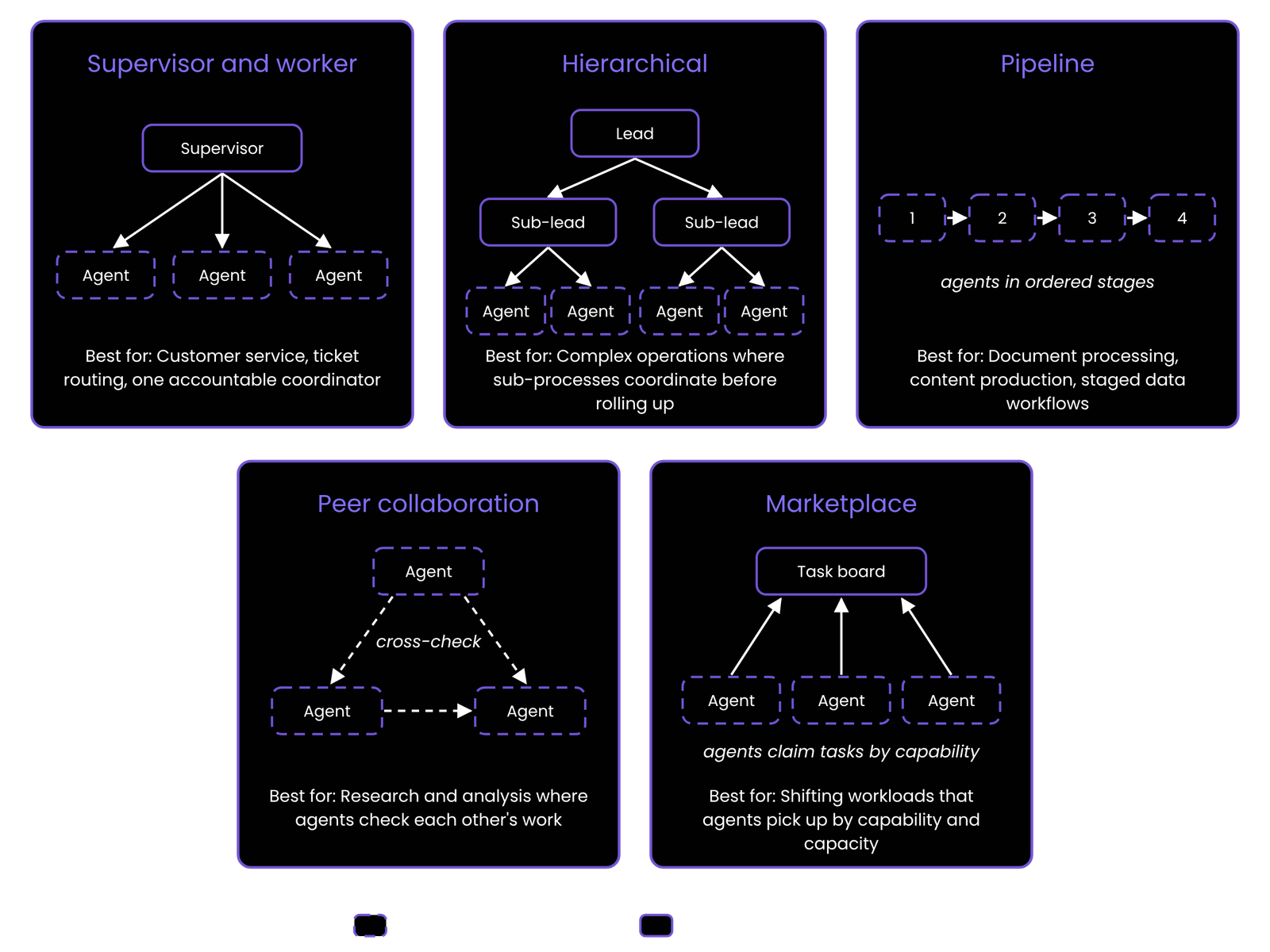
Every workflow has a structure, and the agent system should match it. These are the five architecture patterns we build, and where each fits best.
Figure 1: The five multi-agent architecture patterns Algoryte builds, and the kind of workflow each one fits.
multi-agent architecture patterns and where each fits
Pattern
How it works
Best for
Example
Supervisor and worker
A central orchestrator routes tasks to specialized agents and owns the outcome
Customer service operations, ticket routing and workflows where one accountable coordinator matters
A support supervisor routing billing, technical and account cases to specialist agents
Hierarchical
Sub-processes get their own coordinating agent, and a top-level agent directs across them
Complex enterprise operations where sub-processes need their own coordination before rolling up
Month-end close with separate payables, receivables and reporting teams
Pipeline
Agents work in ordered stages, each transforming the work and passing it forward
Document processing, content production and data workflows with clear stage gates
Contract intake: extract, check, summarize and file
Peer collaboration
Agents work as equals, reviewing and cross-checking each other's output
Research, analysis and any work where verification between agents raises accuracy
A research agent and a fact-checking agent producing one brief
Marketplace
Agents take on tasks based on capability and current capacity
Dynamic workload distribution, where demand shifts and the system balances itself
Back-office queues where agents pick up cases as they free up
how a multi-agent system works
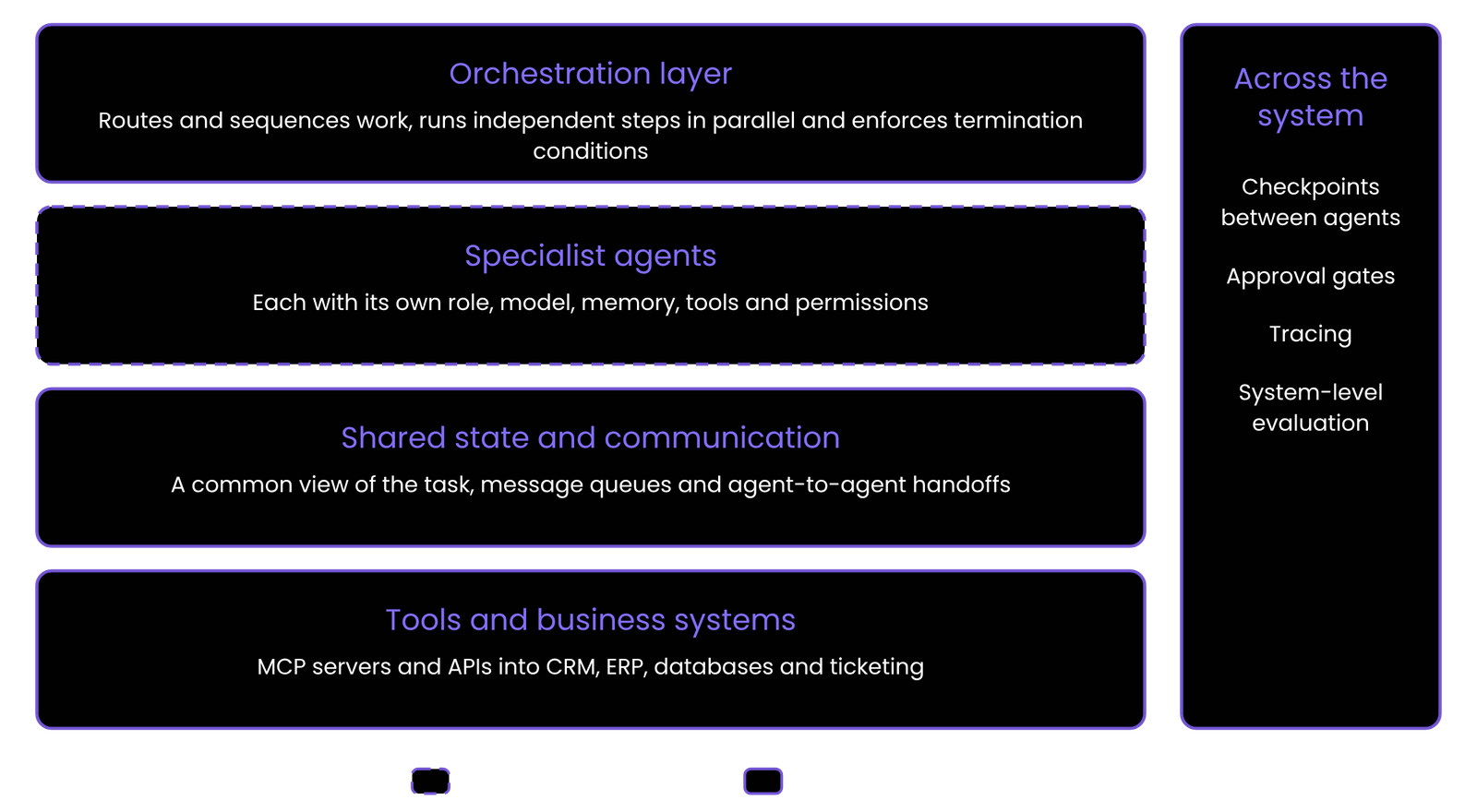
A multi-agent system works in four layers: an orchestration layer that routes and sequences work, specialist agents that each own one part of it, a shared state and communication layer that keeps them in sync, and the tools and business systems they act on.
Figure 2: How a multi-agent system is put together: orchestration on top, specialist agents in the middle, shared state and tools underneath.
the four layers of a multi-agent system
Layer
What it does
What we build
Orchestration
Decides which agent acts when, runs independent steps in parallel and stops loops
Routing and sequencing on deterministic graph frameworks, with a termination condition for every agent
Specialist agents
Each one owns one part of the workflow
Agents built on our four-layer agent architecture: engagement, reasoning, system access and context
Shared state and communication
Keeps every agent working from the same view of the task
Shared context stores, message queues and agent-to-agent handoffs, over A2A where agents span platforms
Tools and systems
Where the work gets done
MCP servers and secure APIs into your CRM, ERP, databases and ticketing
our multi-agent systems development services
multi-agent consulting and readiness assessment
Assessing whether your workflow needs a team of agents or a single one, and what your systems and data are ready to support. You get a recommended topology and a build path.
custom multi-agent system design and development
Designing and building the complete system, from how the workflow splits into roles to how many agents it needs and how they operate as one coordinated whole.
multi-agent orchestration
Engineering the layer that runs the team: task routing, chaining, handoffs, parallel execution and the decision logic for which agent acts when.
specialist agent development
Building each agent in the team for its specific role, with its own reasoning, memory, tools, permissions and RAG-grounded knowledge where the role needs it.
shared context and inter-agent communication
Designing how agents exchange information and hold a common view of the task, including the Agent2Agent (A2A) protocol where agents run on different platforms, so work passes between them without loss, duplication or conflict.
single-agent to multi-agent migration
Extending an existing agent into a coordinated team when its workflow has outgrown it, keeping what already works while splitting the load.
multi-agent evaluation and system observability
Testing and monitoring at the system level by tracing work across agents, evaluating the outcomes the team produces together and catching coordination failures early.
our multi-agent system development process
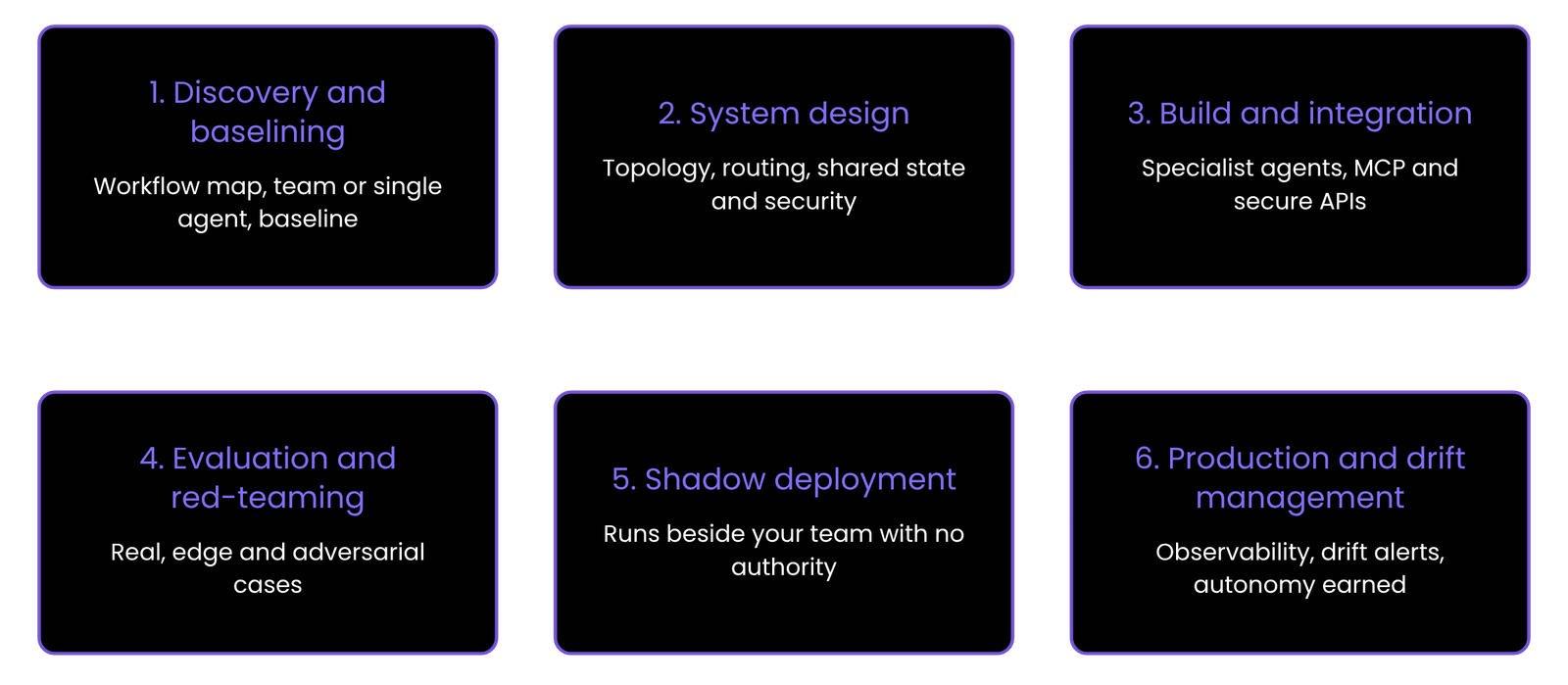
We build multi-agent systems in six steps, and nothing gets authority over real outcomes until it has matched your team's results in a shadow run.
Figure 3: Algoryte's six-step process for building a multi-agent system, including a shadow run against your real results before go-live.
why choose algoryte for multi-agent system development
designed around the goal
We design every system backward from the outcome it must deliver, and we judge it the same way: by how correctly and completely it reaches the goal, never by how much the agents did. Evaluation, orchestration and every termination condition trace back to that outcome.
built for concurrency
We build systems where independent work runs at the same time and dependent steps wait only for what they need: an approval, a result or a decision. Nothing queues behind unrelated tasks, which shortens total completion time on broad workflows.
failure isolation by design
We contain every agent's failures at its own boundary. A bad output is caught at the checkpoint between agents before it flows downstream, so one error costs you one task, never the day's entire queue.
loop-safe agent orchestration
Unstructured agent teams can fall into loops, delegating work back and forth while burning compute. We build on deterministic graph frameworks that keep execution on defined paths, with termination conditions for every agent, so work always moves toward the goal.
systems thinking first
We design the whole before the parts. Every agent is built on the same four-layer architecture of engagement, reasoning, system access and context, and the coordination layer above them is designed around the end outcome, never assembled agent by agent as an afterthought.
full ownership and transparency
We hand over documented agent behaviors, source code ownership and complete observability, including decision logs, tool call records and dashboards, with training and maintenance if you want us to stay involved.
multi-agent system examples by industry
These example systems show how a multi-agent team splits real work in each industry. Every one keeps a person on the decisions that need one.
multi-agent systems for retail & e-commerce
Example system: Order exceptions system
An intake agent classifies each issue (delay, damage or wrong item)
A policy agent checks eligibility against return rules
An inventory agent confirms stock for replacements
An orchestrator resolves the case or routes it for approval
Human checkpoint: Refunds above a set limit wait for a person
multi-agent systems for marketing & creative operations
Example system: Campaign operations system
A research agent pulls performance data across channels
An analysis agent flags underperforming segments
A content agent drafts variant copy for testing
A coordinator sequences the rollout
Human checkpoint: Every variant ships only after human sign-off
multi-agent systems for real estate
Example system: Listing and leads system
A document agent processes property records and disclosures
A market agent runs comparable pricing in parallel
A lead agent qualifies inquiries and books viewings
An orchestrator keeps each listing's file current across portals
Human checkpoint: Pricing and offers stay with agents and brokers
multi-agent systems for healthcare
Example system: Patient intake system
One agent verifies insurance eligibility
Another checks referral and prior-authorization requirements
A scheduling agent books against provider availability
A supervisor assembles the complete file for staff review
Human checkpoint: Clinical decisions stay with clinicians
multi-agent systems for banking & financial services
Example system: Loan processing system
A document agent extracts and validates files
A verification agent checks records against source systems
A risk agent scores the case in parallel
An orchestrator compiles a decision-ready file
Human checkpoint: Approval authority stays with the credit team
multi-agent systems for insurance
Example system: Claims handling system
An intake agent captures the first notice of loss
A coverage agent checks the policy
A fraud-signal agent screens the claim in parallel
A coordinator prepares the adjuster's file
Human checkpoint: Payouts are approved by an adjuster
multi-agent systems for logistics & supply chain
Example system: Shipment exceptions system
A tracking agent watches carrier feeds
A rerouting agent compares alternative carriers and costs
A customer agent drafts delay notices
An orchestrator decides which cases need a planner
Human checkpoint: Changes to customer commitments need approval
multi-agent systems for manufacturing
Example system: Maintenance coordination system
A monitoring agent reads equipment alerts
A diagnostics agent matches them to maintenance history
A parts agent checks stock and raises orders
A scheduling agent books the work around production plans
Human checkpoint: Line stoppages are decided by supervisors
multi-agent systems for cybersecurity
Example system: Security operations system
A triage agent deduplicates alerts
An investigation agent traces activity across logs
An enrichment agent adds threat intelligence
A coordinator assembles the incident timeline
Human checkpoint: Containment runs only after analyst approval
multi-agent systems for legal & professional services
Example system: Contract review system
An intake agent classifies the contract
A clause agent compares terms against your playbook
A risk agent flags deviations
A summary agent prepares the review memo
Human checkpoint: A lawyer approves every redline
multi-agent systems for education
Example system: Admissions system
A document agent checks application completeness
A records agent verifies transcripts and prerequisites
A communication agent handles applicant queries and reminders
A coordinator moves each file through review without letting any stall
Human checkpoint: Admission decisions stay with staff
multi-agent systems for SaaS & software operations
Example system: Support operations system
A triage agent classifies and deduplicates tickets
A diagnostics agent investigates against logs and known issues
A resolution agent drafts fixes or workarounds
An orchestrator escalates anything new to engineers with the investigation attached
Human checkpoint: Engineers review fixes before release
multi-agent systems for games & interactive entertainment
Example system: Live operations system
A telemetry agent watches player and economy metrics
A support agent handles account and purchase issues
A moderation agent screens community reports
A coordinator flags events for the live-ops team
Human checkpoint: Bans, refunds and economy changes need a person
multi-agent systems for blockchain & Web3
Example system: Compliance and audit operations system
An ingestion agent monitors smart contract telemetry and ledger transactions
A risk agent flags anomalies and compliance edge cases
A reporting agent compiles audit-ready evidence logs
A coordinator routes flagged reports to compliance officers
Human checkpoint: Financial execution stays off-agent
engagement models for multi-agent systems development
dedicated multi-agent engineering team
Full-time AI systems architects and orchestration engineers join your team to design topologies, build specialist agents and run inter-agent communication.
Best for: A growing multi-agent program
project-based multi-agent delivery
Milestone-based delivery from workflow mapping and role design to a deployed system running in production.
Best for: One workflow from idea to production
fractional multi-agent support
Part-time engineering for live systems: tuning agent decision logic, adjusting tool permissions, updating shared context schemas and keeping the system healthy.
Best for: Live systems that need ongoing care
sprint-based multi-agent optimization
Short cycles aimed at one outcome: removing an orchestration bottleneck, hardening checkpoints between agents, fixing loops or improving throughput.
Best for: A defined fix with a clear finish line
one workflow, a team of agents, built around your goal.
A multi-agent system is a setup where several AI agents work on one workflow together, each specialized for a part of it. The agents coordinate through defined handoffs and shared context, with an orchestration layer routing work between them and keeping the process moving toward its goal. This structure suits workflows that are too broad for a single agent to handle well, spanning many tools, decision types and stages, because each agent stays sharp within its role while the system carries the process end to end.
2. What is the difference between an AI agent and a multi-agent system?
An AI agent is a single system that reasons, uses tools and acts toward a goal on its own: one worker owning one workflow. A multi-agent system coordinates several such agents on work no single agent should own; the workflow is split across specialists, and an orchestration layer manages routing, handoffs and shared state between them. The practical difference shows at scale: a single agent stretched across a broad process slows down and loses consistency, while a multi-agent system divides the load and runs independent parts in parallel. Which one fits depends on the workflow, and that is the first question a readiness assessment answers.
3. What is multi-agent orchestration?
Multi-agent orchestration is the layer that coordinates the agents in a multi-agent system: it decides which agent acts when, routes tasks and context between them, runs independent work in parallel, and stops the run when the goal is met or a termination condition is reached. Good orchestration keeps agents from looping or duplicating work, and it is where most of a multi-agent system's reliability is won or lost.
4. What are examples of multi-agent systems?
Common examples of multi-agent systems in business include a loan processing system where document, verification and risk agents prepare a decision-ready file; a support operations system where triage, diagnostics and resolution agents handle tickets; and an order exceptions system where intake, policy and inventory agents resolve returns within policy limits. In each, an orchestrator coordinates the specialists and a person keeps the decisions that need judgment.
5. How do agents in a multi-agent system communicate?
Agents in a multi-agent system communicate through a shared state store that holds the common view of the task, through messages passed by the orchestration layer or a message queue, and, when agents run on different platforms or vendors, through the Agent2Agent (A2A) protocol. Agents reach tools and business systems through the Model Context Protocol (MCP). In short, MCP connects an agent to tools, and A2A connects agents to each other.
6. Which metrics are crucial for evaluating the effectiveness of a multi-agent system?
The metrics that matter for a multi-agent system work at the system level: goal completion rate, correctness of actions taken, time to completion against your baseline, cost per completed task, coordination failures (dropped handoffs, duplicated work and loops) and escalation quality, meaning whether the right cases reached a person. Individual agent accuracy matters less than how the agents perform together, so we define the baseline and these metrics before anything is built.
7. How do you achieve scalability in large-scale multi-agent deployments?
Scalability in large multi-agent deployments comes from architecture decisions made before the system grows: an orchestration layer that routes work without becoming a bottleneck, shared state designed for many agents reading and writing at once, and permissions scoped so new agents join without widening what existing ones can reach. Built this way, scaling means adding agents and workflows to the same foundations instead of rebuilding them. The readiness assessment sets how far the system needs to grow, and the topology is chosen to carry it.
8. What are the best practices for securing multi-agent systems against cyber threats?
The core practices for securing multi-agent systems are to scope each agent's permissions to its role, secure the communication and shared state between agents so messages cannot be intercepted or injected, place approval gates before sensitive actions, log every action for a complete audit trail, and deploy in your own cloud environment to keep data under your control. Inter-agent trust needs special attention: each agent should verify what it receives instead of assuming another agent's output is safe. These controls are hard to retrofit, so we build them in at the design stage.
9. How long does it take to build a multi-agent system?
A first multi-agent system typically takes three to six months from discovery to production, depending on the number of agents, the systems they connect to and how long the shadow deployment runs before results consistently match your team's. Discovery and design take three to five weeks, build and evaluation six to twelve weeks, and the shadow run continues until the comparison holds. Extending an existing agent into a team is usually faster.
10. How much does multi-agent system development cost?
Multi-agent system development cost depends on the number of specialist agents, the architecture pattern, the systems they integrate with, how strict the checkpoints and approval gates need to be, and how long the shadow run lasts. Running costs come from model usage across all agents, shared infrastructure and monitoring, which is why routing fixed rules through deterministic code matters even more here than for a single agent. We price the readiness assessment first, and it often shows whether a single agent would do the job for less.