Algoryte builds custom AI agents that read context, reason through complex problems and act toward your business goals, carrying rule-bound, high-volume work at machine speed so your people stay on the work that needs them.
Algoryte is an AI agent development company that designs, builds and runs custom AI agents for specific roles in your business. Each agent works inside your CRMs, ERPs and internal tools under its own identity and permissions, hands decisions that need a person to your team, and is evaluated on every run after launch.
what is an AI agent?
An AI agent is software that owns a task: given a goal, it reasons through the steps, uses tools and data across your systems, and keeps working until the job is done or a person needs to decide. A chatbot answers questions and stops. An AI assistant helps a person do the work. An AI agent is the one you hand the work to.
what are AI agent development services?
AI agent development services are the work of designing, building, integrating and running custom AI agents for defined roles in a business: choosing the role, designing how the agent reasons and remembers, connecting it to your systems with scoped permissions, testing it against real cases and keeping it reliable after launch.
Business operations are full of repetitive tasks, scattered data and process delays. Algoryte engineers custom AI agents that take ownership of the jobs you assign them: they reason through structured and unstructured information, work across your software, carry tasks end to end and escalate to your human-in-the-loop checkpoints when needed. Built on foundation models, orchestration frameworks, retrieval pipelines and tool-calling architectures, our agents run as secure digital coworkers inside your business environment.
This page covers building agents for individual roles. When a process needs several agents working together, see multi-agent systems development; when a whole workflow needs a governed operating layer to run unattended, see agentic AI development.
AI agent development services at a glance
What it is
Design, build, integration and operation of custom AI agents for specific business roles
Agent types
Task, workflow, customer-facing, research and analysis, monitoring and response, copilot and voice agents
Architecture
Four layers: engagement, reasoning, system and context
Integrations
CRMs, ERPs, databases, ticketing and internal APIs through MCP and secure interfaces
Controls
Its own identity per agent, scoped permissions, approval gates, an audit trail and continuous evaluation
Starting point
A scoped proof of concept on real cases before the full build
Engagement models
Dedicated engineers, project-based delivery, fractional support or sprint-based work
how can businesses benefit from AI agents?
Businesses benefit from AI agents by handing off rule-bound, high-volume work that keeps skilled people away from decisions. The gains show up in five places:
faster cycle times
Work moves as soon as it arrives, at any hour, without waiting in a queue.
fewer manual errors
Agents apply the same rules and checks to every case.
people on higher-value work
Staff spend their time on judgment, relationships and exceptions.
capacity that scales
Volume spikes are absorbed without matching increases in headcount.
every action on record
Each step an agent takes is logged under its own identity.
AI agent vs chatbot vs AI assistant
A chatbot answers, an AI assistant helps a person do the work, and an AI agent does the work itself, within the role and limits you set.
AI agent compared with a chatbot and an AI assistant
Chatbot
AI assistant (copilot)
AI agent
What it does
Answers questions from a script or knowledge base
Drafts, suggests and summarizes for a person
Owns a task from start to finish
Who drives the work
The user, one question at a time
The person, with AI help
The agent, within its role
Acts in your systems
No
Rarely, and only after approval
Yes, through scoped tools and APIs
Memory
The current conversation
The current session and documents
Procedural, semantic and episodic memory
Best for
Common questions with fixed answers
Speeding up a person's own work
Repeatable work you want taken off your team
AI agents we build
We build seven types of AI agents, defined by the job each one owns. Most businesses start with one type and add others as trust in the first agent builds.
task agents
One focused job that consumes time every day, such as document intake, data extraction or report generation, taken over completely.
workflow agents
An entire process handed over, from the trigger to the finished outcome, with every step in between carried by the agent.
customer-facing agents
Inquiries resolved with real actions, such as account lookups, order changes or refunds, with escalation to your team built in.
research and analysis agents
Information gathered, verified and compiled from approved sources into a decision-ready answer.
monitoring and response agents
Systems, data and transactions watched around the clock, with the agent acting or alerting your team when something crosses a set limit.
copilot agents
An agent that prepares, drafts and suggests alongside your team, while every decision stays with them.
voice agents
Callers speak to an agent that understands, resolves and routes, handling the conversation end to end.
types of AI agents we build, from least to most autonomous
Agent type
What it owns
What it decides on its own
Example
Copilot agent
Preparation and drafts for a person
Nothing: it suggests and a person decides
Drafting replies and proposals inside your CRM
Research and analysis agent
A question that needs evidence
What to search and how to compile it
A competitor brief built from approved sources
Task agent
One repeatable job
Each case within its rules; exceptions go to a person
Invoice data extracted and posted to the ERP
Customer-facing agent
Customer inquiries that need an action
Resolutions within policy limits
Order changes and refunds under a set amount
Voice agent
Phone conversations
How to resolve or route each call
An after-hours appointment line
Monitoring and response agent
A watch on systems, data or transactions
Actions on set thresholds; alerts on the rest
Stock levels that trigger reorders
Workflow agent
A whole process from trigger to outcome
Every step, with approval gates on risky actions
Employee onboarding across HR, IT and payroll
AI agents for every business function
These are the AI agents businesses ask us for most, grouped by the team that uses them. Each one is built for your data, systems and rules, and any of them can be combined into a larger workflow.
AI agents for sales
Lead qualification agent
Lead enrichment agent
CRM hygiene agent
Meeting prep agent
Follow-up agent
Proposal and RFP agent
AI agents for marketing
Campaign monitoring agent
Content drafting agent
SEO research agent
Social listening agent
Audience segmentation agent
AI agents for customer support
Ticket triage agent
Order and refund agent
Knowledge base agent
Voice support agent
Customer onboarding agent
AI agents for finance and accounting
Invoice processing agent
Expense audit agent
Reconciliation agent
Collections agent
Financial reporting agent
AI agents for HR and recruiting
Resume screening agent
Interview scheduling agent
Employee onboarding agent
HR policy agent
Payroll query agent
AI agents for IT and service desk
Service desk agent
Access request agent
Incident triage agent
Device provisioning agent
AI agents for operations and supply chain
Inventory monitoring agent
Purchase order agent
Supplier follow-up agent
Shipment tracking agent
Demand forecasting agent
AI agents for procurement
Vendor onboarding agent
Quote comparison agent
Contract renewal agent
Spend analysis agent
AI agents for legal and compliance
Contract review agent
Compliance monitoring agent
Regulatory research agent
Audit evidence agent
KYC agent
AI agents for software engineering
Code review agent
Test generation agent
Documentation agent
Release notes agent
On-call triage agent
AI agents for data and analytics
Text-to-SQL agent
Report generation agent
Data quality agent
Market research agent
AI agents for leadership and admin
Meeting summary agent
Inbox triage agent
Scheduling agent
Board pack agent
our AI agent development services
AI agent consulting and strategy
Assessing where an agent can take real work off your team and defining the role it should own. You get a scoped use case, the requirements behind it and a build path.
AI agent architecture and design
Designing how the agent thinks and acts before it is built: its reasoning approach, memory, decision logic and tool access, all on the four-layer architecture we use for every production agent.
custom AI agent development
Building the agent for its role: the right model for the task, grounded in your data through RAG, with the permissions and integrations its job requires.
AI agent integration
Connecting the agent to your CRMs, ERPs, databases and internal APIs through MCP and secure interfaces, so it works inside your stack from the start.
agent testing and reliability engineering
Running the agent through unstructured inputs, edge cases and failure states before production. Decision logic, escalation paths and output consistency are checked against real cases, and nothing goes live until it passes.
AI agent lifecycle management
Keeping the agent sharp after launch: tracking performance, retuning or retraining when behavior drifts, and updating it as your business rules change.
how we build AI agents: the four-layer architecture
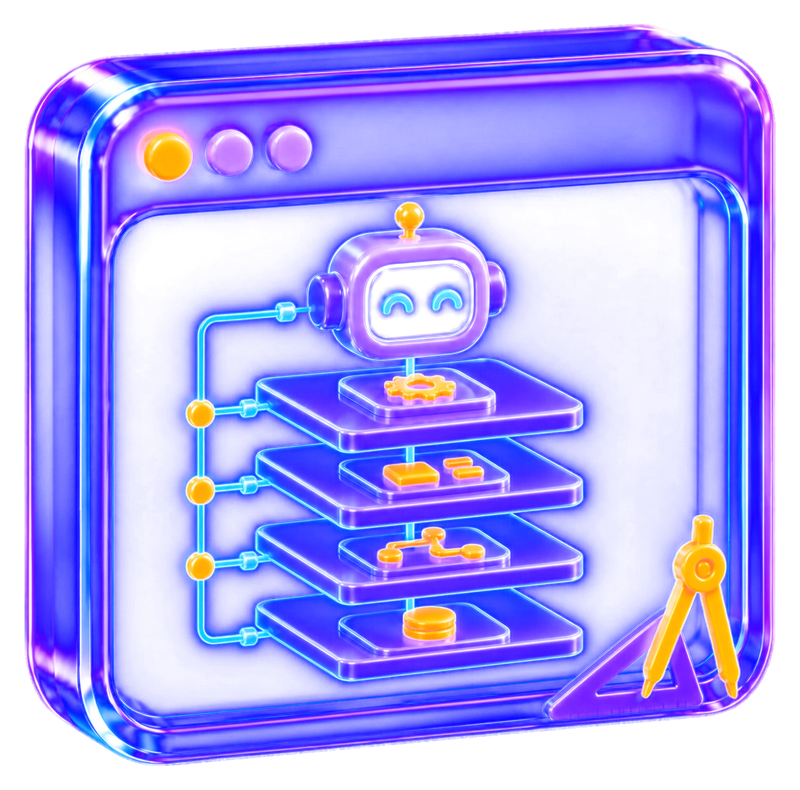
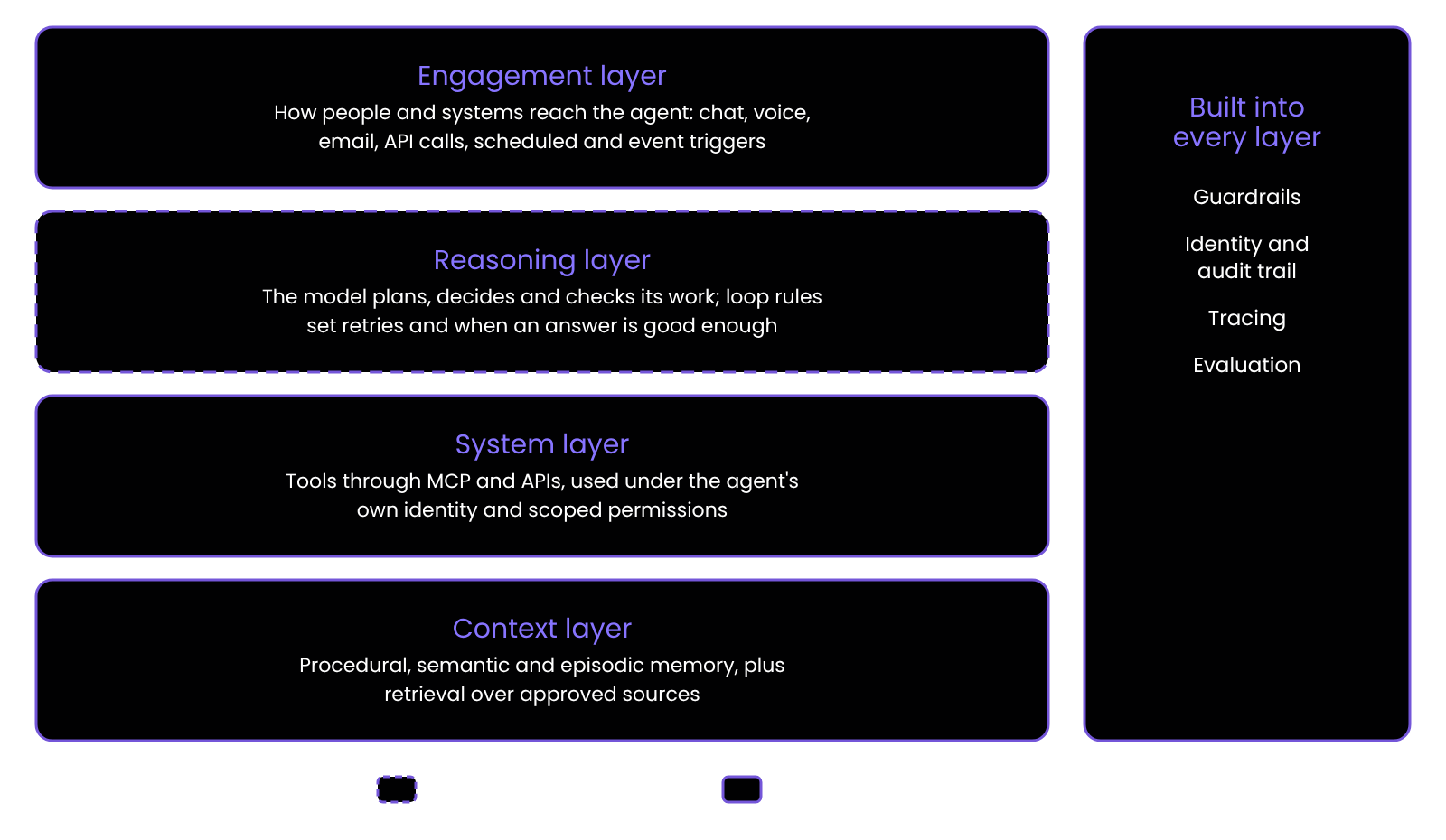
Every production agent we build runs on four layers. Keeping them separate makes each part testable, and lets the model, tools or memory change without a rebuild.
Figure 1: The four-layer architecture behind every production agent Algoryte builds: engagement, reasoning, system and context.
the four layers of an AI agent
Layer
What it handles
What we decide here
Engagement
How people and systems reach the agent
Channels (chat, voice, email, API), triggers and handoff to a person
Reasoning
How the agent plans and decides
Model choice, instructions, where the model reasons and where deterministic code runs, retry and stop rules
System
What the agent can do
Tools through MCP and APIs, the agent's identity, permissions and approval gates
Context
What the agent knows and remembers
Retrieval sources, memory design and data freshness
the three types of agent memory
Memory type
What it stores
Example
Procedural
How to do the job: steps, rules and tool usage
The refund policy and the order of checks before a refund
Semantic
Facts about your business and domain
Product catalog, price lists and policy documents
Episodic
What happened in past runs and conversations
A customer's previous tickets and how they were resolved
our AI agent development process
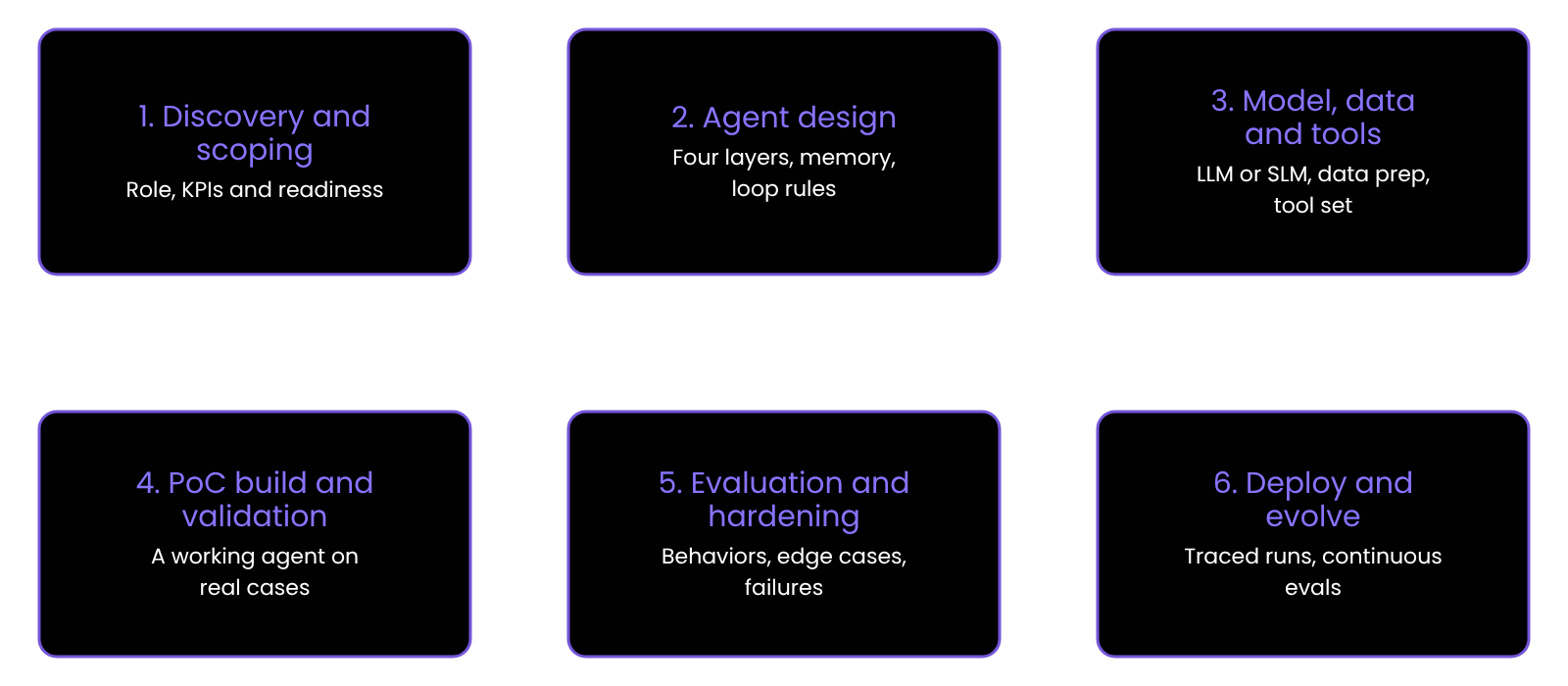
We build agents in six steps, with a working proof of concept on real cases before the full build.
Figure 2: Algoryte's six-step AI agent development process, from scoping the role to a traced agent in production.
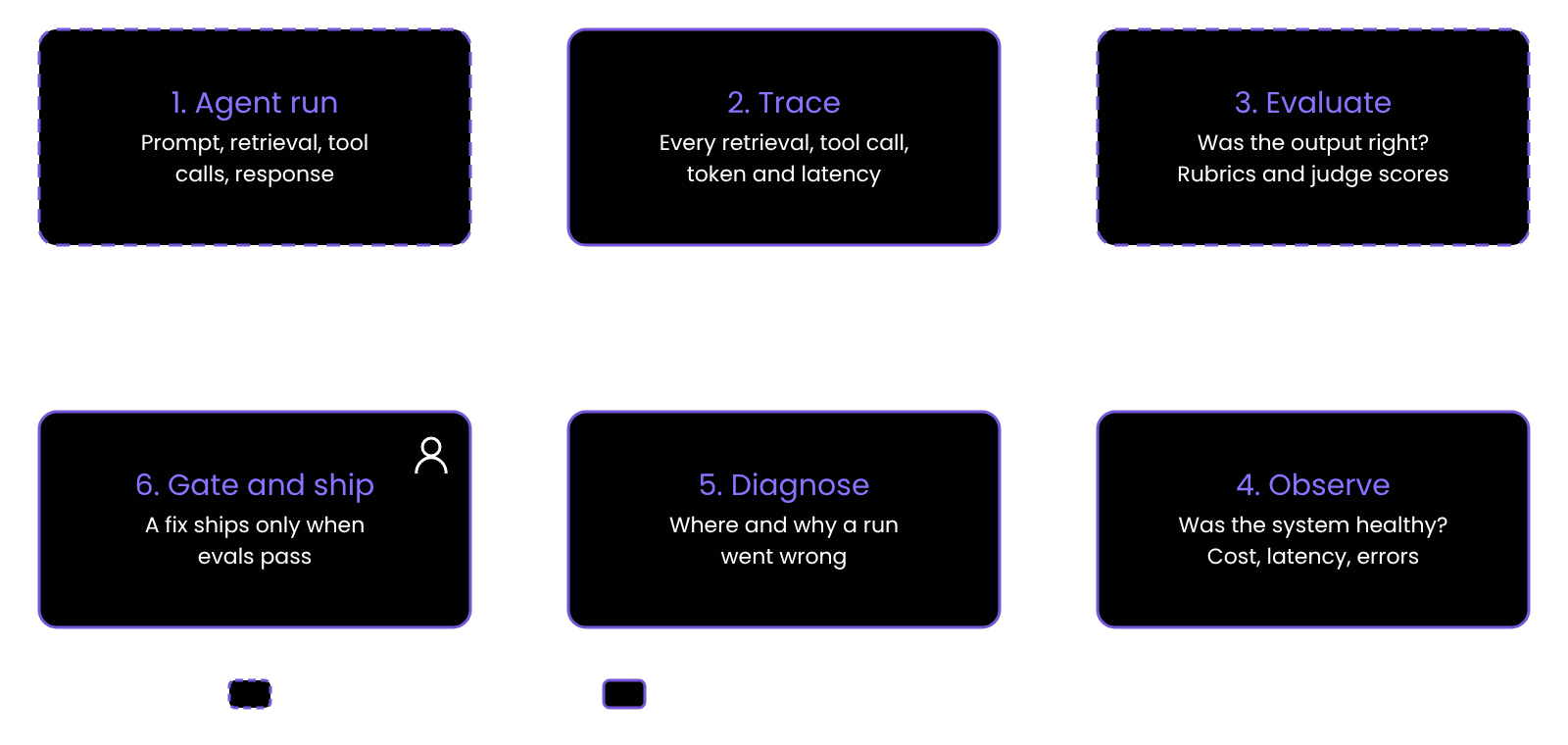
Figure 3: How a live agent is kept reliable: every run is traced, scored and checked for health, and a fix ships only after it passes evaluation.
After launch, every change follows the same loop: trace the run, score it, check system health, find the cause, and ship the fix only when its evaluations pass.
why choose algoryte for custom AI agent development
engineered around the model
The model is only one part of a production agent. We engineer everything around it: the runtime, context, guardrails and observability that decide whether an agent survives real use. Many prototypes stall before production because that engineering was never done; ours is built in from the start.
iterative retrieval
We build retrieval as a loop. Our agents plan a query, try a source, check what came back and try again when the first pass falls short. When the answer is not in your sources, the agent says so, and its answers point to the sources they came from.
an identity of its own
Every agent we deploy gets its own identity, with scoped permissions, role assignments and an audit trail of its actions. An agent cannot reach beyond the access it was given, and your compliance team always knows which agent did what, and when.
judged by behavior
We evaluate agents against the specific behaviors their role requires: asking when information is missing, verifying before acting and confirming what was done. An agent that appears to finish a task but skips the right steps does not pass.
elastic by design
We build agents on a modular architecture. Models stay swappable as better ones arrive, capacity scales with load, and new tools join without a rebuild, so the agent improves with the technology instead of aging with it.
AI agents by industry
We build AI agents for regulated and fast-moving industries alike. Each agent works within your industry's rules, with a person holding the decisions that need one.
AI agents for banking & financial services
Loan document extraction and validation into decision-ready credit files
Audit-ready compliance reports across accounts and jurisdictions
Transaction anomaly flags with evidence attached
KYC and customer onboarding checks
Human checkpoint: Credit decisions and fraud cases stay with an analyst
AI agents for insurance
First notice of loss intake and claim triage
Policy comparison and coverage checks
Underwriting submission preparation
Renewal reminders and quote follow-ups
Human checkpoint: Claim payouts and underwriting decisions are signed off by staff
AI agents for healthcare
Insurance eligibility checks and prior authorization files
Scheduling against clinicians' calendars with follow-ups and reminders
Patient intake and referral paperwork
Claim status tracking
Human checkpoint: Every clinical decision stays with clinicians
AI agents for retail & e-commerce
Returns and order exceptions within policy limits, after checking eligibility and stock
Inventory monitoring across channels with reorders before stockouts
Inquiries that need account lookups and order changes
Product catalog enrichment
Human checkpoint: Refunds and exceptions above policy limits need approval
AI agents for logistics & supply chain
Shipment tracking with proactive delay notices
Carrier quote comparison and booking
Freight and customs document checks
Supplier follow-ups on late orders
Human checkpoint: Rebooking that affects a customer commitment needs approval
AI agents for manufacturing
Maintenance work orders raised from equipment alerts
Supplier and purchase order follow-ups
Quality inspection report compilation
Production schedule updates from order changes
Human checkpoint: Line stoppages and quality holds are decided by supervisors
AI agents for real estate & property management
Lead qualification and viewing scheduling
Tenant requests routed to maintenance
Lease data extraction and renewal tracking
Listing description drafts
Human checkpoint: Lease terms and pricing stay with agents and managers
AI agents for legal & professional services
Contract review against your playbook with clauses flagged
Client intake and conflict-check preparation
Research summaries from approved sources
Time entry and billing narrative drafts
Human checkpoint: Legal advice and filings are reviewed by a lawyer
AI agents for cybersecurity
Alert triage, duplicate removal and escalation of real incidents with context
Tracing suspicious activity across logs and building the incident timeline before an analyst opens it
Containment actions under approval
Human checkpoint: Containment runs only after analyst approval
AI agents for SaaS & software companies
Customer onboarding and in-app support
Ticket triage and bug report reproduction
Release notes and documentation updates
Churn-risk monitoring from product usage
Human checkpoint: Account credits and roadmap commitments stay with the team
AI agents for games & interactive entertainment
Player support for account and purchase issues
Live-ops monitoring of in-game economies and events
Community moderation queues
QA agents that run test scripts and log bugs
Human checkpoint: Bans, refunds and economy changes need a person
AI agents for education & e-learning
Admissions and enrollment requests across systems
Student support for schedules, fees and records
Course material and quiz drafts for instructor review
Grant and deadline tracking
Human checkpoint: Grades and admissions decisions stay with staff
AI agents for blockchain & Web3
On-chain activity monitoring with anomalous transactions flagged
Smart contract scans against known exploit patterns before release
Treasury and liquidity tracking across protocols
Human checkpoint: Treasury moves and contract deployments need sign-off
engagement models for AI agent development
dedicated AI agent engineers
Full-time engineers work as part of your team, owning agent builds from design through deployment and staying on as you add agents for new roles.
Best for: A growing agent program
project-based AI agent delivery
A defined scope and timeline: an agent designed, built, evaluated and running in production, with the option to start from a proof of concept before committing to the full build.
Best for: One agent from idea to production
fractional AI agent support
Part-time specialists for agents already live: performance tracking, retuning when behavior drifts, refining evaluation rubrics as the role evolves and keeping the audit trail clean.
Best for: Live agents that need ongoing care
sprint-based AI agent work
Short cycles with one deliverable: a proof-of-concept agent, a new tool integration, a pre-production reliability check or a fix for an underperforming agent.
Best for: A defined change with a clear finish line
1. What are AI agents, and how do they differ from AI chatbots and AI assistants?
An AI agent is software that owns a task: given a goal, it reasons through the steps, uses tools and data across your systems, and works until the job is done. A chatbot answers questions and stops there. An assistant helps a person do the work by drafting, suggesting and summarizing, but the person still drives. An agent is the one you hand the work to. The practical test: if it acts only when prompted, it is assisting; if it carries the task to completion, it is an agent.
2. What is custom AI agent development?
Custom AI agent development is the work of building an agent for a specific role in a specific business, with its model, grounding data, permissions and integrations all shaped by the job it will own, unlike off-the-shelf agents configured from templates. An AI agent development company typically starts with AI agent consulting: assessing which work an agent should take over, what your systems are ready to support and what the role requires before anything is built. The result is an agent that operates inside your stack, under your rules and against your metrics.
3. What are examples of AI agents for business?
Common examples of AI agents for business include lead qualification agents that score and enrich inbound leads, customer support agents that process refunds within policy, invoice processing agents that extract and post invoice data, resume screening agents, IT service desk agents that handle access requests, and monitoring agents that watch inventory or transactions and act when a threshold is crossed. Each one owns a defined job in one team's workflow and hands exceptions to a person.
4. What are the main types of AI agents?
The standard classification runs by how agents decide: simple reflex agents respond to inputs with fixed rules, model-based agents keep an internal memory of state, goal-based agents plan steps toward a defined objective, utility-based agents weigh options and pick the highest-value one, and learning agents improve through experience. Modern LLM-based agents blend several of these at once: they plan toward goals, hold memory and learn from feedback. In practice, we build by role (the job the agent owns), and the deciding mechanism follows from what that job requires.
5. How long does it take to build a custom AI agent?
A focused AI agent typically reaches a working proof of concept in four to six weeks and production in two to four months, depending on how many systems it connects to and how strict its controls need to be. A task agent working in one system with a clean API sits at the short end; a customer-facing or voice agent spanning several systems sits at the long end. Every build starts with a scoped proof of concept, so you see results on real cases early.
6. How much does AI agent development cost?
AI agent development cost depends on the agent's role, the number of systems it connects to, the channels it works in such as chat, email or voice, how strict the evaluation and controls need to be, and expected volume. Running costs come from model usage per run, hosting and monitoring; routing simple steps through deterministic code keeps them down. We price a scoped proof of concept first and give a firm estimate for the full build once it has run on real cases.
7. What are common challenges when deploying AI agents at scale?
The most common challenges when deploying AI agents at scale are retrieval that returns wrong or stale context, agents running without their own identities so their actions cannot be audited, no evaluation against the behaviors the role requires, and quality drifting silently after a model update. Costs also creep when every step runs through the model instead of deterministic code. All of these are architecture decisions, which makes them cheap to fix in design and expensive to retrofit in production.
8. What are the security considerations for AI agent development?
There are four core security considerations for AI agent development: scope each agent's permissions to its role and nothing beyond it, give every agent its own identity with a full audit trail, place approval gates before sensitive actions, and guard the tool boundary. Documents and tool outputs the agent reads can carry hidden instructions, so they are screened before the agent acts on them. Deploying in your own cloud keeps data inside your perimeter. Security is designed into the agent's architecture from the first sprint.
9. How do you measure whether an AI agent is performing well?
An AI agent's performance is measured against its role. Before the build, we set the workflow's baseline: hours, errors, cost per case and other parameters. Once live, the agent is scored on task completion, correctness of actions and the specific behaviors its job requires: asking when information is missing, verifying before acting and escalating what needs a person. An agent that technically finishes but skips those steps does not pass.
10. Can AI agents work with our existing software and tools?
Yes, AI agents can work with your existing software and tools. Agents connect to your CRMs, ERPs, databases and internal APIs through MCP and standard interfaces, operating inside the stack you already run. Nothing gets replaced; the agent joins your systems the way a new team member would, with the access its role needs and no more.