






creating a complete system for a handyman marketplace
Client: FixTman, a nationwide handyman and installation marketplace
Scope: System architecture, proprietary CRM, admin dashboard, internal staff web application, technician and customer mobile apps, brand guidelines and UI/UX
Stack: Node.js, Next.js, PostgreSQL, Flutter, Firebase, Twilio, Stripe, DigitalOcean with AWS load balancing
what is a handyman
marketplace?
A handyman marketplace is a platform that connects homeowners who need home repair, assembly or installation work done with independent technicians who complete it, handling booking, scheduling, pricing and payment in one system rather than through a single company’s own crew. Unlike a traditional handyman company, the marketplace itself does not employ the people doing the work. It coordinates them.
what is FixTman?
FixTman is a nationwide US handyman and installation marketplace connecting homeowners with vetted independent technicians for services including TV mounting, furniture assembly, appliance installation and smart home setup. Its technicians are independent vendors rather than employees, which makes FixTman a two-sided marketplace: demand on one side, supply on the other, and an operations team holding the two together.
how did we build
FixTman's marketplace
platform?
Algoryte built FixTman as one connected system rather than a single app:
a proprietary CRM for lead management and job allocation, an internal staff web application, an admin dashboard, and two Flutter mobile apps, one for technicians and one for customers, all running on a Node.js and PostgreSQL backend architected to scale. Each part is covered in detail below.
the problem at hand
FixTman was generating leads from several different sources, and those leads were not being properly managed or categorized once they arrived. Job allocation was mostly manual, so matching a job to an available technician depended on staff effort rather than on the system.
Two further gaps compounded it. The real-time location of technicians could not be seen, which left both the office and the customer without an answer to the most common question in field services. Customer reviews and technician ratings were not managed anywhere, so the quality signal a marketplace runs on was being lost.
the solutions
Algoryte provided
admin dashboard and controls
Leadership needed a single view of the operation before anything else could be improved.
We built an admin dashboard that surfaces the health of the business in one place: total leads received, jobs allocated and completed, technician ratings, customer reviews and customer demographics, among other insights. Alongside the reporting sits the control layer, where an administrator manages internal staff members and governs who can act on what.
the internal staff web application
The operations team works in a browser all day, so their application was built as the working surface of the whole system.
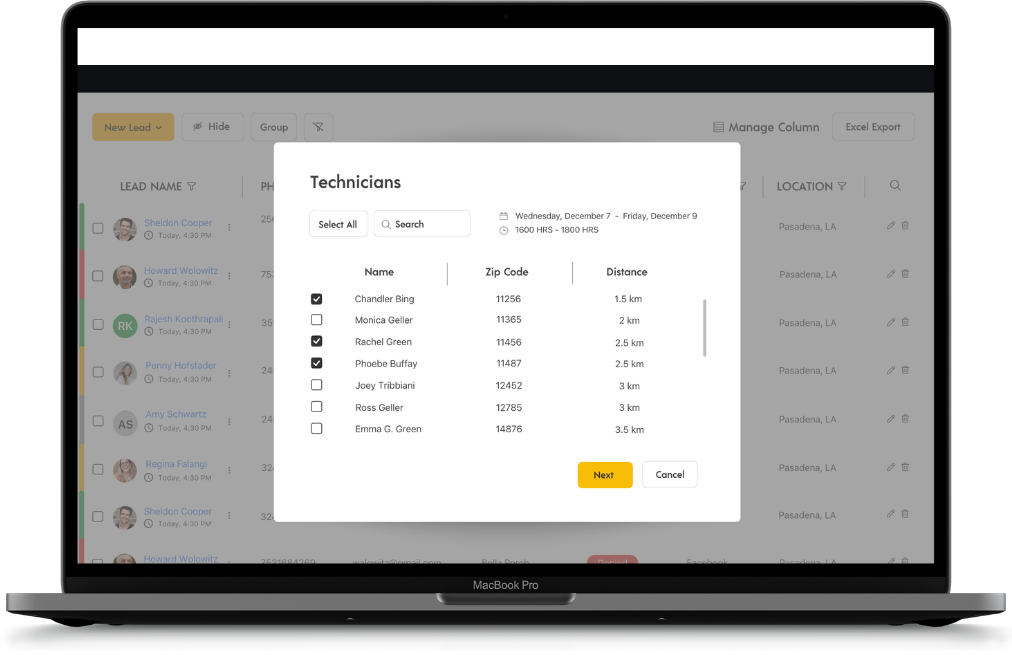
From it, staff manage leads arriving from every source in a single interface, onboard new technicians, and categorize those technicians by availability status, the area they work in, and the services they provide. Job allocation and re-allocation controls let staff assign work and move it when circumstances change. Scheduling and rescheduling run from the same screen when a customer asks for a different slot, and staff can generate payment links for any additional costs that come up once a technician is on site.
the proprietary CRM
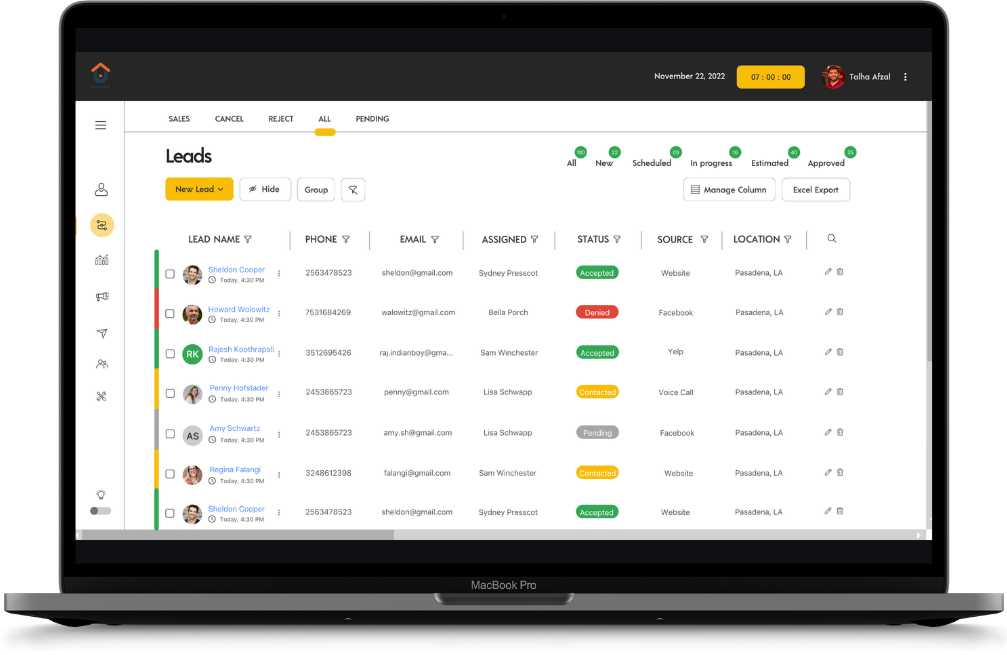
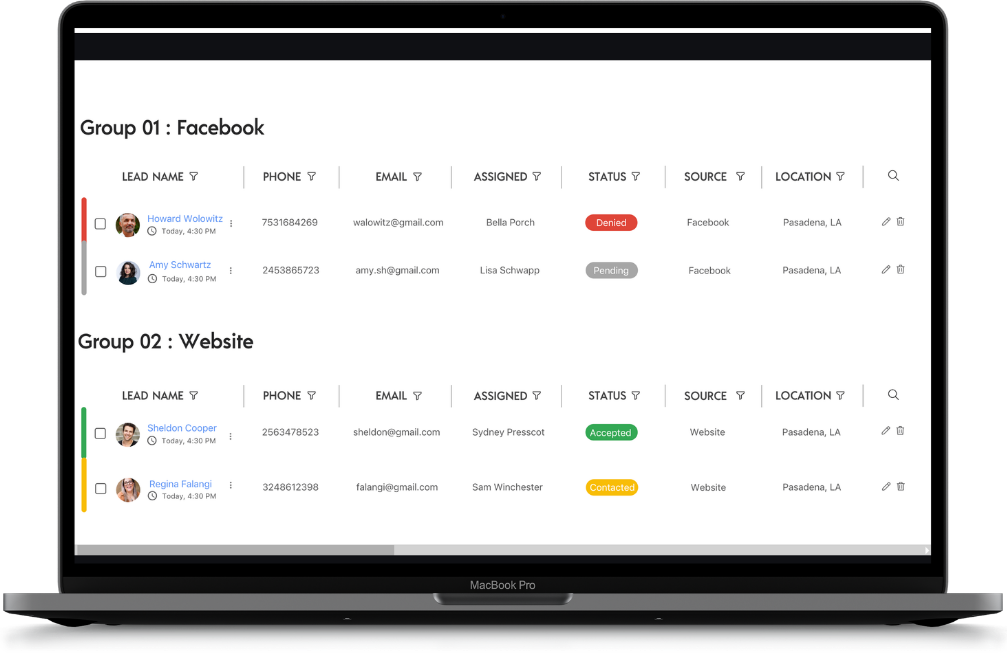
FixTman’s CRM is a proprietary system that consolidates leads from every source into one pipeline, then carries them through categorization, assignment and communication without leaving that interface.
The client asked for something deliberately simple. Their internal team needed to be productive quickly, so we designed the CRM to keep the learning curve short and built it around the client’s own requirements and expertise rather than a generic sales pipeline.
The core of it is lead consolidation. We integrated APIs from the platforms FixTman was already receiving leads through, including Facebook and Yelp, so that every enquiry lands in one interface where it can be categorized, assigned, and tracked. That single change turned a scattered inbound stream into a managed pipeline.
Communication was built into the same flow. Twilio’s API sends SMS updates to technicians and customers at each meaningful point in a job’s life, and push notifications carry the same events into the mobile apps, so nobody has to be logged in to know that a job has been offered, accepted, rescheduled or completed.
the backend
FixTman’s backend is the infrastructure layer connecting leads, technicians, jobs and payments into one system, built on Node.js and PostgreSQL for the coordination a marketplace depends on.
The backend was designed with scalability of operations in mind, since a marketplace’s cost of growth is largely the cost of coordination.
We built it on Node.js with PostgreSQL as the database. A relational core suits a data model where leads, technicians, services, areas, jobs and payments all reference each other, and where reporting depends on those relationships holding. The internal staff web application and admin dashboard run on Next.js, which gives fast server-rendered views over the dense tables operations work in. The platform is deployed on DigitalOcean behind an AWS load balancer.
The system was architected to accommodate future updates rather than to serve only the launch feature set, which is what allows the roadmap below to be additive instead of a rebuild.
the mobile apps
Both mobile apps were developed simultaneously in Flutter for iOS and Android.
The technicians’ app:
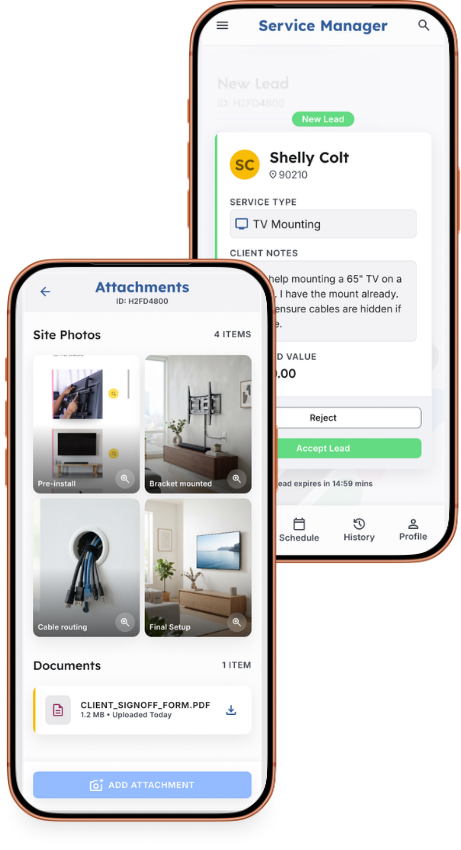
A dashboard shows upcoming and completed jobs, and technicians manage their own availability and add or remove the services they offer, whether that is assembly,carpentry, electrical work, or plumbing.
Each job carries its full detail, and technicians add comments and progress updates with pictures directly against it. Real-time location sharing with staff and customers closes the visibility gap that started the project.
The customers’ app:
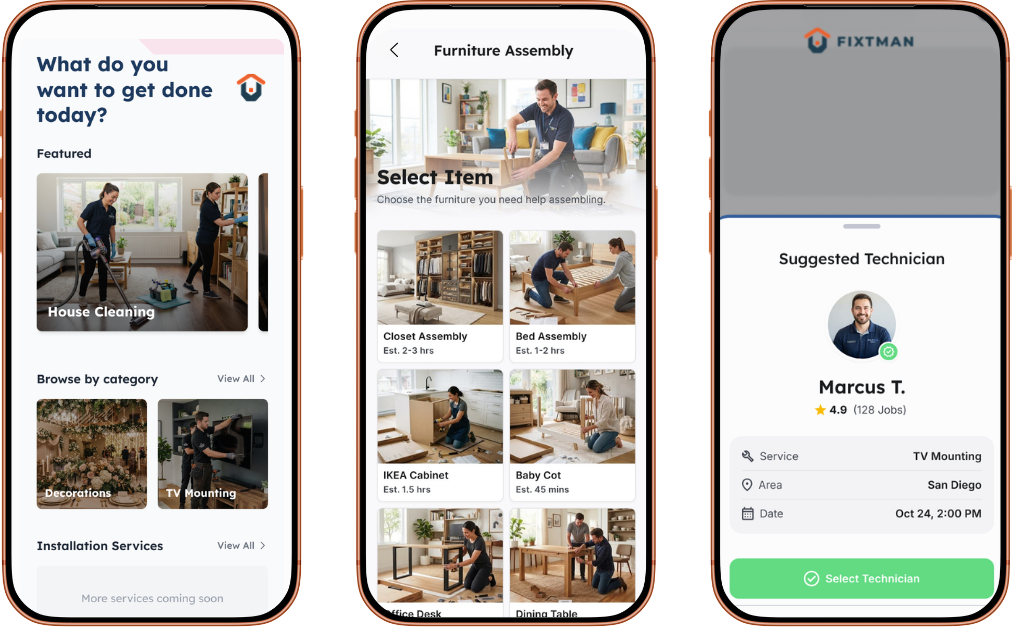
A dashboard leads with the choice of handyman service, and customers can see the reviews and ratings of technicians working in their area before committing to the technicians recommended by FixTMan for their job. Booking includes rescheduling and cancellation, real-time location updates show the technician on the way, and payment is handled through an integrated gateway supporting card payments and PayPal.
UI/UX and brand guidelines
With the system defined, the design team stepped in to make a multi-role platform feel like one product, and make each surface suit the person using it.
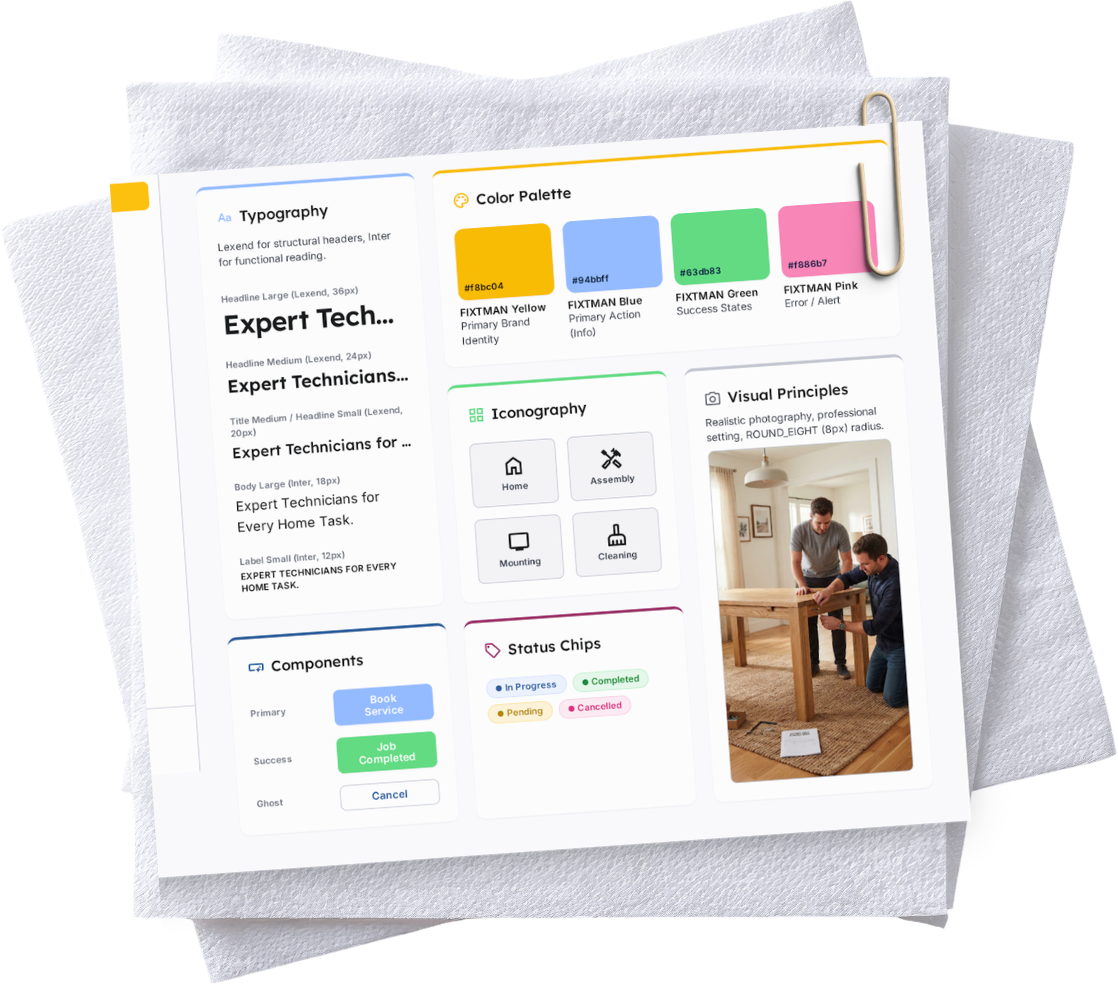
We built the brand guidelines outward with just the existing logo. Its burnt orange and deep navy became the working palette, with navy carrying structure and headings and orange reserved for the primary action on any given screen. A geometric sans handles headlines and holds up at small sizes on low-end hardware, and we wrote the rules against real interface problems, including button states, photography treatment and how the mark sits over a dark image, so the guidelines were usable by developers rather than decorative.
From that language we designed the complete UI/UX of the system. The customer app is image-led, because people recognise a job before they can name it, and it strips the path from opening the app to a confirmed booking down to its shortest form. The technicians’ app puts everything needed to judge a job on one screen and reduces the response to a single action. The internal surfaces run on their own visual register, with dense tables, colour-coded status states and scannable rows, because staff live in those screens all day and need reading speed ahead of brand impression.
what comes next?
The architecture was built to extend, and two additions are planned. A customer service bot inside the mobile apps will handle routine questions, and automation of job allocation and re-allocation driven by the chat with customers will take the last manual step out of matching work to the right technician.
the outcome
FixTman now runs its leads, its technicians, its bookings and its payments through one connected system. Leads from every source arrive in a single managed pipeline. Technicians hold their own availability, services and job history, and both the office and the customer can see where they are. Ratings and reviews are captured and visible, which turns quality into something the marketplace can act on.
Got a marketplace
that's outgrown its spreadsheets?
FAQs
How long does custom CRM development typically take from start to finish?
Algoryte scopes CRM builds in phases, so the team is usually working with a functional core system early rather than waiting on one large release at the end. Exact timelines depend on the number of integrations, user roles and workflows involved, which is why each build is scoped individually before a date is committed to.
What is the process for developing a proprietary customer relationship management tool?
Algoryte builds CRM systems around how the client's team actually works instead of a generic sales pipeline. The process starts with consolidating records from every source the client already uses into one interface, then layers in categorization, assignment and communication once that core is in place, so each stage is usable on its own rather than waiting on the full system.
What are the steps to launch an on-demand services platform?
Algoryte builds the coordination layer first: the CRM, admin dashboard and internal staff tools, so operations can run leads, vendors and job allocation through one system from day one. The customer and vendor-facing apps are built in parallel once that foundation is in place, with brand and UI/UX design applied across the platform rather than treated as a final step.
Can I hire a team to build a custom on-demand app for my business?
Yes. Algoryte builds CRMs, admin systems and mobile apps for marketplace and on-demand businesses as one connected system, covering the backend, staff tooling, and the customer and vendor-facing apps together rather than as separate projects.
What tech stack does Algoryte use for custom CRM development?
Algoryte chooses the stack based on what the data model and scale require rather than a fixed default. For CRM systems with a relational data model, where records like leads, users and transactions reference each other, that often means a Node.js and PostgreSQL backend with Next.js powering the staff-facing interface.
What are the essential features for a bespoke CRM system?
Algoryte builds CRM systems around three essentials: consolidating records from every source into one interface, categorization and assignment of that data, and communication built directly into the workflow instead of added on afterward. Beyond those three, what counts as essential depends on how the business already operates, which is why requirements are scoped from the client's workflow rather than a standard feature list.
Can a custom CRM be extended with AI features later?
Yes, when the system is architected for it from the start. Algoryte designs CRM systems so AI features, like automated support or workflow automation, can be added as an extension to the existing system rather than a rebuild.