





how we built a perp DEX aggregator from concept to launch
Client: Azabu
Scope: Brand identity, product design, frontend development, backend development, smart contract integration, rewards architecture, admin dashboard
Stack: Next.js, Node.js, Express, MongoDB, Arbitrum, Reown AppKit
what is a DEX aggregator
for perpetuals?
A DEX aggregator for perpetuals is a platform that consolidates perpetual futures trading across multiple decentralised exchanges into a single interface. Rather than operating its own order book or matching engine, it routes trades through underlying protocol providers and presents their liquidity, markets, and instruments in one unified experience. Azabu is focused exclusively on perpetuals trading at this stage and does not include spot trading.
what is Azabu?
Azabu is a Perp DEX aggregator built for experienced perpetuals traders operating across global markets. It connects to Hyperliquid and Aster as its initial venue integrations and surfaces their markets, positions, order management, and trade history through a single interface. The platform also includes a native token swap feature,
an XP-based leaderboard and rewards system, and an admin dashboard for the operator.
how we built Azabu
as the perp DEX
aggregator?
Algoryte took Azabu from concept to a live platform across
a three-month engagement, covering brand identity, product design, full-stack development, and a rewards layer.
The sections below walk through each part of how it was built.
the problem at hand
The client had a clear product vision and an early-stage reference build that was useful for communicating scope. What the reference lacked was the architecture, engineering, and visual language required of a production platform. The full picture of what needed to be built became clear in early discovery.
Azabu had to connect to two separate trading venues and present live markets, positions, and order management in one coherent interface, while remaining open to adding further venues down the line. It also needed a swap mechanism, an XP-based leaderboard and reward structure, and an admin layer for the operator to manage it all. Every system was designed and built from the ground up.
the solutions
Algoryte provided
platform architecture and venue integration
Azabu is an aggregator, not an exchange. Trades settle on Hyperliquid and Aster; Azabu provides the interface, aggregates the data, and manages everything above the venue layer. This is the defining characteristic of a Perp DEX aggregator, and it shapes every architectural decision on the platform. There is no custodial wallet.
Both current venue integrations operate with EVM-compatible wallet signing, which determined the chain decision. The platform’s smart contracts are built on Arbitrum, the chain shared by both venue integrations.The backend is built on Node.js with Express, and MongoDB handles data persistence – a document model well suited to the varied schemas that come with aggregating trade data, user activity, and leaderboard state from multiple sources. The frontend is built in Next.js. Wallet connection is handled through Reown AppKit, which supports the EVM wallet ecosystem the platform’s traders already use without introducing custodial infrastructure on the backend.
The normalised data layer sitting between the venue APIs and the frontend is the part of the architecture that makes the aggregator model work in practice. Positions, orders, and trade history from either venue surface under a unified schema, so the trader sees one coherent interface regardless of which venue their order settled on. That layer was the first system built, because everything else depends on it.
the trade interface
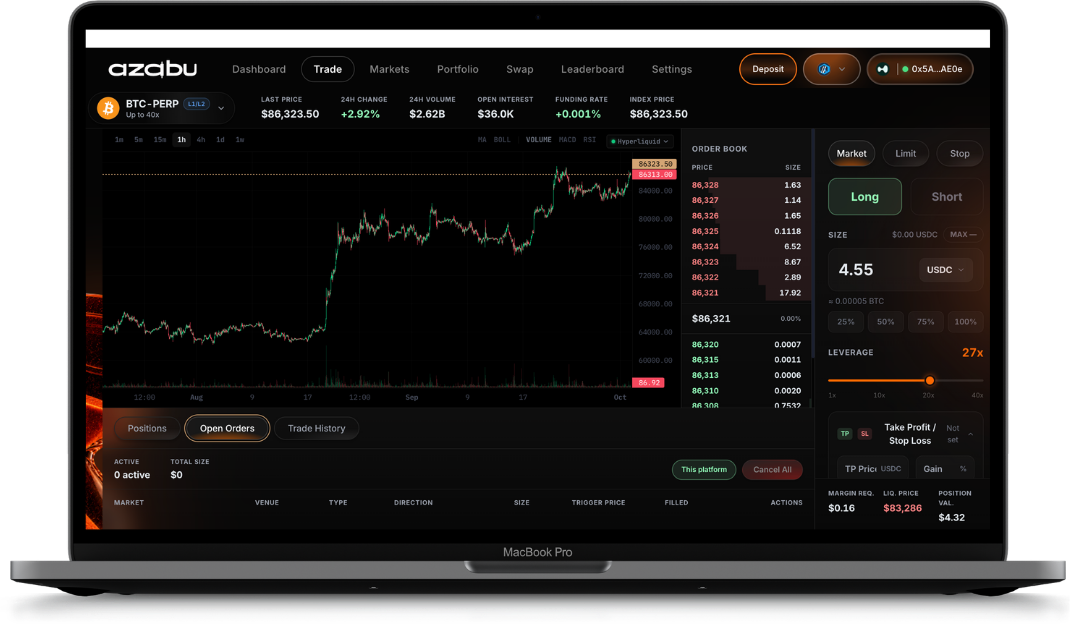
The trade page carries the core of the platform’s functionality. The layout is three-column: order book on the left, TradingView Advanced Charts in the center, and the order panel on the right. The order panel supports market, limit, and stop order types, a leverage slider, and collapsible TP/SL configuration with a live fee breakdown calculated before the order is placed. Leverage ranges vary by instrument and are determined by what each venue offers for that specific market rather than a platform-wide ceiling.
A positions panel below the chart gives the trader tabbed access to open positions, pending orders, and trade history, with management actions available inline – editing TP/SL, closing partial or full positions, and cancelling pending orders without leaving the page.
swap
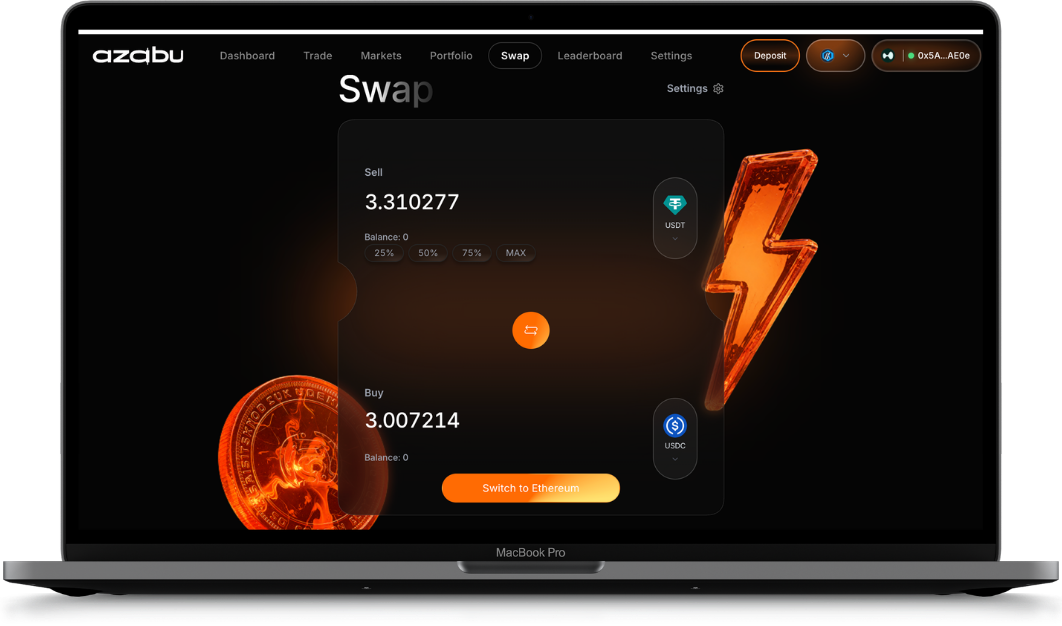
Token swaps route through 1inch, which handles liquidity aggregation across decentralised exchanges on Arbitrum. The swap interface keeps the interaction model familiar while following the same design system as the rest of the platform – input token, output token, slippage and speed controls, and an always-visible breakdown of price impact, minimum received, estimated gas, and routing path before the user confirms.
leaderboard and rewards
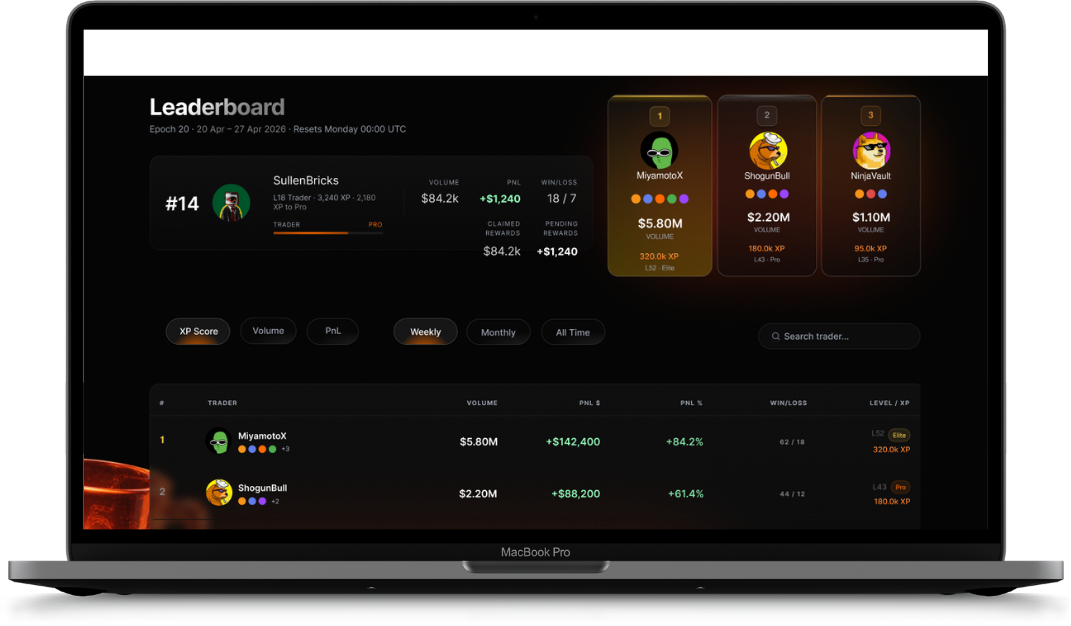
Trader activity drives rank. The more a user trades, the higher their position on the leaderboard, and rank determines reward allocation. Users accumulate XP through trading volume and advance through named tiers that are visible publicly on the leaderboard. A cashback mechanism rewards traders based on their tier, giving active participants a direct financial incentive to keep trading and climb the rankings. The system rewards sustained activity rather than one-off volume spikes.
admin dashboard
The operator dashboard handles user management and rewards administration. The client can review accounts, adjust reward distribution parameters, and oversee leaderboard and cashback configuration from one interface. This layer is kept separate from the user-facing platform and accessible only to the operator.
design and brand
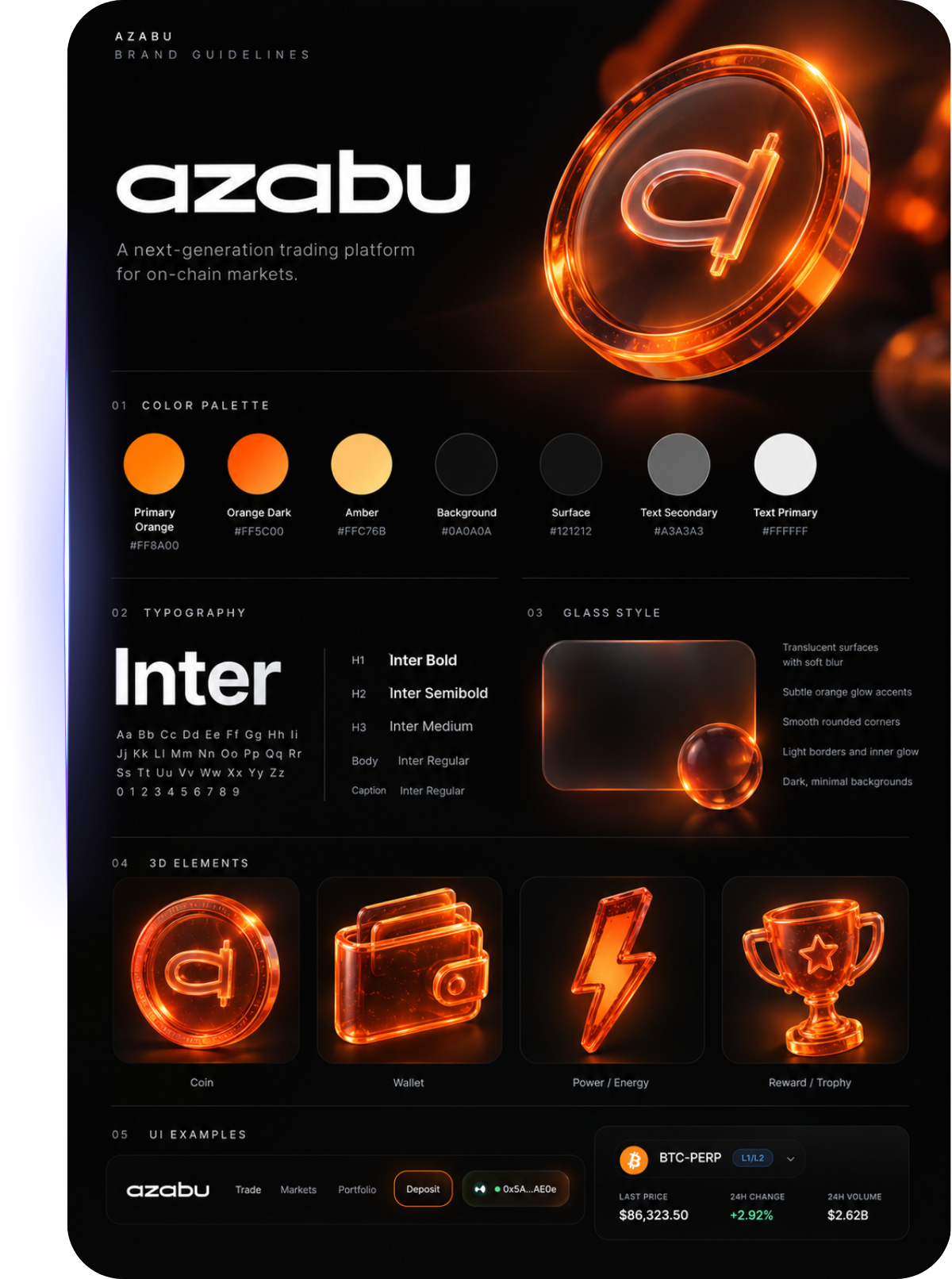
The visual language was developed entirely in-house, beginning with a theme proposal and reference direction agreed with the client.
The 3D glass artwork across the platform was created specifically for this project. Each page carries a different object, rendered in the platform’s orange against pure black so they composite cleanly using screen blend mode on dark backgrounds.
The trading interface prioritises data density without visual noise. Real candlestick charts with correct OHLC bodies and wicks replace placeholder visuals. Position rows carry green and red left-border accents that communicate PnL direction at a glance. Action modals for editing and closing positions carry full context – entry price, mark price, liquidation price, and estimated outcome – so the trader has everything they need to act without leaving the page.
Mobile was treated as a first-class surface throughout the design process. The mobile trade layout uses a sticky tab bar at the bottom of the screen that slides up position panels, order history, and pending orders as bottom sheets, keeping the chart and order panel always in reach.
what comes next
Four additions are planned for the platform following launch.
The aggregator’s venue count will grow. The current integrations cover Hyperliquid and Aster, both operating with EVM-compatible infrastructure. The roadmap includes Solana-based perpetual protocol providers, which will expand the instrument catalog. The platform architecture was built to support additional venue integrations, and adding Solana-based perpetual protocol providers is planned as the next expansion – an API integration the existing architecture is already designed to accommodate.
A native predictions market will be integrated into the existing platform, referred to within the product simply as Predictions. The architecture and interface conventions established in the trading and swap flows were built to accommodate additional modules, and the predictions product will extend both.
Azabu’s own token is planned for launch following the initial live period, integrating with the platform’s existing rewards and leaderboard infrastructure.
An AI trading agent will be built directly into the platform. The agent will give traders access to analytics and market insights on perpetuals without leaving the interface – surfacing information that currently requires switching between the platform and external tools.
the outcome
Azabu is live as a fully functional Perp DEX aggregator carrying a brand identity,
a complete design system, and a working rewards layer. Built from a concept across a three-month engagement.
Got a marketplace
that's outgrown its spreadsheets?
FAQs
How long does custom CRM development typically take from start to finish?
Algoryte scopes CRM builds in phases, so the team is usually working with a functional core system early rather than waiting on one large release at the end. Exact timelines depend on the number of integrations, user roles and workflows involved, which is why each build is scoped individually before a date is committed to.
What is the process for developing a proprietary customer relationship management tool?
Algoryte builds CRM systems around how the client's team actually works instead of a generic sales pipeline. The process starts with consolidating records from every source the client already uses into one interface, then layers in categorization, assignment and communication once that core is in place, so each stage is usable on its own rather than waiting on the full system.
What are the steps to launch an on-demand services platform?
Algoryte builds the coordination layer first: the CRM, admin dashboard and internal staff tools, so operations can run leads, vendors and job allocation through one system from day one. The customer and vendor-facing apps are built in parallel once that foundation is in place, with brand and UI/UX design applied across the platform rather than treated as a final step.
Can I hire a team to build a custom on-demand app for my business?
Yes. Algoryte builds CRMs, admin systems and mobile apps for marketplace and on-demand businesses as one connected system, covering the backend, staff tooling, and the customer and vendor-facing apps together rather than as separate projects.
What tech stack does Algoryte use for custom CRM development?
Algoryte chooses the stack based on what the data model and scale require rather than a fixed default. For CRM systems with a relational data model, where records like leads, users and transactions reference each other, that often means a Node.js and PostgreSQL backend with Next.js powering the staff-facing interface.
What are the essential features for a bespoke CRM system?
Algoryte builds CRM systems around three essentials: consolidating records from every source into one interface, categorization and assignment of that data, and communication built directly into the workflow instead of added on afterward. Beyond those three, what counts as essential depends on how the business already operates, which is why requirements are scoped from the client's workflow rather than a standard feature list.
Can a custom CRM be extended with AI features later?
Yes, when the system is architected for it from the start. Algoryte designs CRM systems so AI features, like automated support or workflow automation, can be added as an extension to the existing system rather than a rebuild.