




























































 Al Services
 Blockchain and Web3 Development
Data Science
 Game Development
 Game Art
 VR/XR Development
 Resource Augmentation
Al Services
Blockchain and Web3 Development
Data Science
Game Development
Game Art
VR/XR Development
Resource Augmentation
Full-stack AI engineered into your enterprise infrastructure, internal applications and SaaS workflows with Algoryte's enterprise AI services.
See what enterprise AI looks like on your systems.
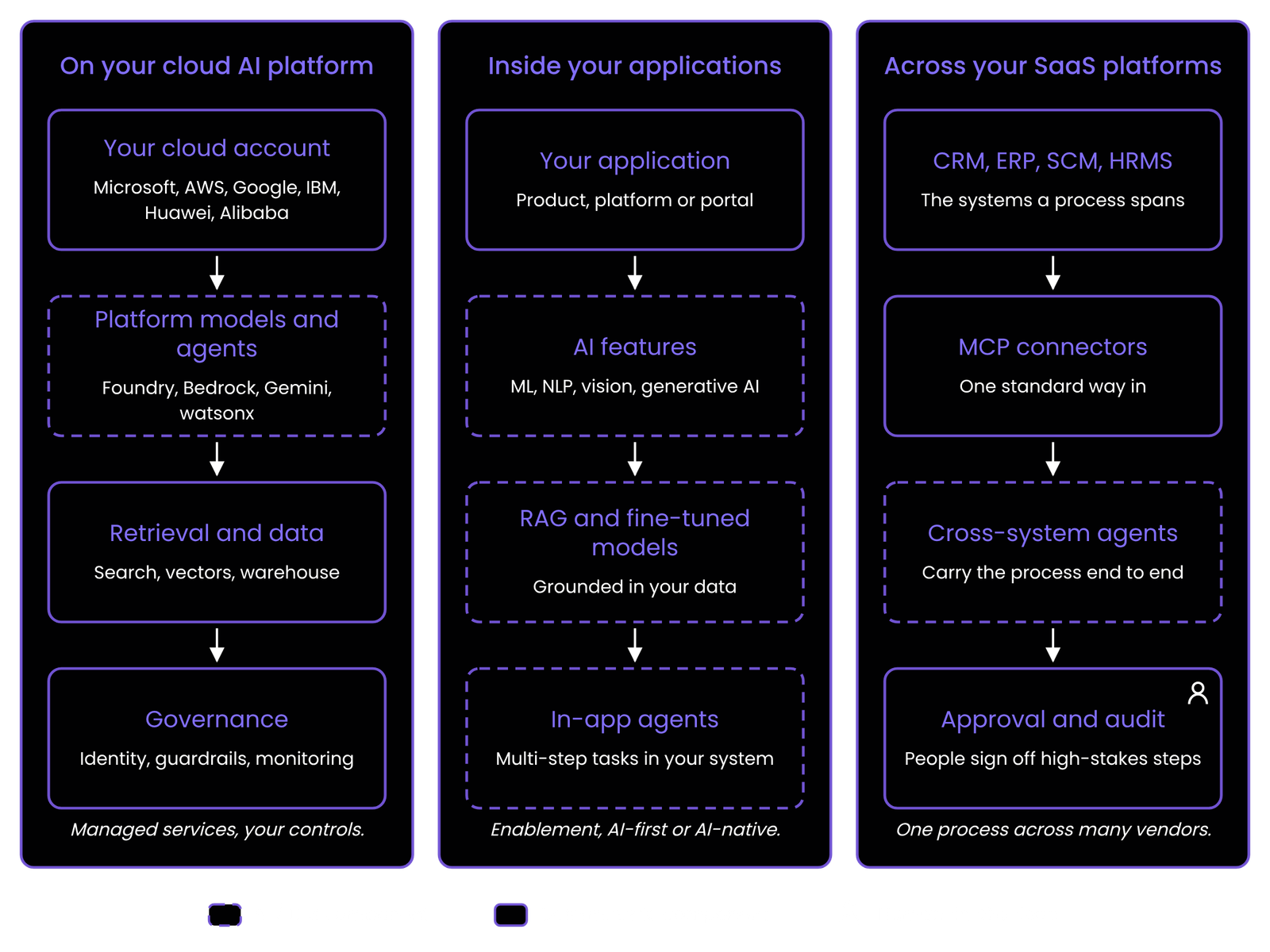
Algoryte's enterprise AI development services add AI to the systems your business already runs, in three places: on your cloud AI platform (Microsoft, AWS, Google, IBM, Huawei or Alibaba), inside the applications you own, and across the SaaS platforms your teams use, such as CRM, ERP and HRMS. Everything is deployed in your own cloud, under your identity and access controls, and measured against a baseline.
Enterprise AI is the use of machine learning, language models, computer vision and AI agents inside an organization's own systems and workflows, deployed under the security, governance and scale that a large business requires. It differs from consumer AI tools in where it runs (your cloud and applications), what it can see (your data, within each user's permissions) and how it is controlled (audit logs, approvals and monitoring).
Enterprise AI development services design, build, integrate and run AI inside a company's existing infrastructure, applications and SaaS platforms. Business software should learn from how people use it, remove manual effort and return a measurable result. Adding AI does not mean starting from scratch: we integrate it into your current stack, deploy it in your own cloud under your security and access controls, and surface it inside the software your teams already use.
Where you want a decision before a build, start with enterprise AI consulting.
what it is | AI built into your cloud platform, your own applications and your SaaS stack |
|---|---|
cloud AI platforms | Microsoft Foundry and Azure, AWS Bedrock and SageMaker, Google Gemini Enterprise Agent Platform, IBM watsonx, Huawei Cloud ModelArts, Alibaba Cloud Model Studio |
custom applications | AI-enablement of existing apps, AI-first workflow redesign, or AI-native builds |
capabilities | Machine learning, natural language processing, computer vision, AI automation, generative AI, RAG, fine-tuned models and in-app agents |
across SaaS | Cross-system agents, MCP connections, data reconciliation, decision models, governance and escalation |
where it runs | Your cloud account or project, under your identity provider, network boundaries and keys |
engagement models | Dedicated team, project-based delivery, fractional support or sprint-based work |
Most enterprise AI programs use more than one of these routes. Which one leads depends on where your data lives and where your people work.
| route | what we build | when it fits |
|---|---|---|
| On your cloud AI platform | Models, agents, retrieval and governance using the services your cloud provider already offers |
You have standardized on Microsoft, AWS, Google, IBM, Huawei or Alibaba Cloud |
| Inside your custom applications | AI features, AI-first workflows and AI-native products in the software you own |
The AI should be part of your product or internal platform |
| Across your SaaS platforms | Agents, MCP connectors and reconciliation that work across CRM, ERP, SCM and HRMS |
Your processes span several vendors' systems |
We build enterprise AI with the models, agents, retrieval and governance services each platform provides, deployed in your account and under your controls. This table compares the main building blocks; the sections below list what we build on each platform.
| platform | models | agents | retrieval and data | governance |
|---|---|---|---|---|
| Microsoft | Foundry Models |
Foundry Agent Service |
Azure AI Search, Fabric, Azure Databricks |
Foundry Control Plane, Entra ID |
| AWS | Amazon Bedrock |
Bedrock AgentCore |
Bedrock Knowledge Bases, S3 Vectors, OpenSearch |
Bedrock Guardrails, IAM, VPC |
| Google Cloud | Gemini Enterprise Agent Platform (Model Garden) |
Gemini Enterprise, ADK and Agent Engine |
BigQuery AI, AlloyDB and Spanner vector search |
IAM, VPC controls |
| IBM | watsonx.ai with Granite |
watsonx Orchestrate |
watsonx.data |
watsonx.governance |
| Huawei Cloud | Pangu models, MaaS |
ModelArts Studio |
OBS, ModelArts data services |
Huawei Cloud IAM |
| Alibaba Cloud | Model Studio (Qwen) |
Wuying AgentBay |
DashVector, OpenSearch |
RAM access control |
Microsoft Foundry for models, agents, knowledge and governance; Azure Machine Learning for custom models; Fabric and Databricks for the data underneath; all under your Entra identity and access controls.
| service | what it is | what we build |
|---|---|---|
| Foundry Models | Models from OpenAI, Anthropic, Meta, Mistral, Cohere and Microsoft Phi on one platform |
Model selection per task, managed inside one security boundary |
| Foundry Agent Service | Managed infrastructure where AI agents run |
Agents designed, built and deployed on it, with the runtime set to your tenant, identity and network rules |
| Azure AI Search | Managed retrieval over enterprise content |
Grounding that gives employees cited answers from policies, contracts and manuals |
| Foundry Tools | Prebuilt APIs for document extraction, speech, image analysis and translation |
Integration into your workflows |
| Foundry Control Plane | Monitoring and governance for every AI system |
Agent health, cost, tracing, evaluations and audit logs in one place |
| Azure Machine Learning | Training and deployment of custom models |
Demand forecasting, risk scoring and defect detection on your data |
| Microsoft Fabric | Business data unified in OneLake |
Pipelines that connect current data to Foundry |
| Azure Databricks | Large-scale data processing |
Cleaning and modeling transaction histories, logs and sensor streams for AI |
Bedrock for models and agents, SageMaker for custom models and the data services underneath, all inside your AWS account under your IAM and VPC boundaries. We also use PyTorch, TensorFlow and Hugging Face on SageMaker, EC2 GPU instances and KMS where the work requires them.
| service | what it is | what we build |
|---|---|---|
| Amazon Bedrock | Models from Anthropic, Meta, Mistral, Amazon Nova and OpenAI through one API |
Model selection per task under your account's controls, with your data excluded from model training |
| Bedrock AgentCore | AWS's managed runtime for production agents |
Agents with policy controls, memory and VPC-only deployment where isolation is required |
| Bedrock Knowledge Bases | Managed retrieval over your documents |
Grounded answers from your files without custom RAG infrastructure |
| Bedrock Guardrails | Safety controls on model and agent outputs |
Content filters, topic limits and PII handling tuned to your policies |
| AWS AI services | Textract, Transcribe, Polly, Rekognition and Translate |
Document, speech, image and translation steps in your workflows |
| Amazon SageMaker | Training and deployment of custom models |
Forecasting, scoring and classification models, retrained as data changes |
| S3 Vectors and OpenSearch | Vector storage and search |
The embedding and search layer your AI systems query |
| AWS Glue and Redshift | Data preparation and warehousing |
Pipelines that feed clean, current data to the systems above |
The Gemini Enterprise Agent Platform (formerly Vertex AI) for models and agents, BigQuery for AI on your data, and prebuilt APIs for applied tasks, all in your Google Cloud project under your IAM. We serve on GKE and Cloud Run and train on GPU and TPU compute where needed.
| service | what it is | what we build |
|---|---|---|
| Gemini Enterprise Agent Platform | Google's AI platform, with Gemini, Claude, Gemma and open models in Model Garden |
Model selection per task, plus custom ML trained, tuned, deployed and monitored |
| Gemini Enterprise | Google's platform for running AI agents across an organization |
Agents grounded in your data through its connectors, with security and access set up |
| Agent Development Kit and Agent Engine | Google's agent framework and managed runtime |
Custom agents built in ADK and deployed to Agent Engine in your project |
| BigQuery AI | ML and generative AI in the data warehouse through SQL |
Analytics and AI workflows that keep data where it is |
| Vector search | Embeddings and search in BigQuery, AlloyDB and Spanner |
Retrieval that grounds AI in your operational data |
| Document AI | Extraction, classification and splitting of documents |
Intake and back-office document workflows |
| Speech, Vision and Natural Language APIs | Prebuilt APIs for speech, image, video, translation and text |
Applied AI steps in your workflows |
| CX Agent Studio | Google's platform for customer-facing voice, chat and messaging agents |
Conversation flows connected to your systems |
IBM's watsonx portfolio for models, agents, data and governance, deployed in your environment under your controls, with Granite models for open-weight deployment where they fit.
| service | what it is | what we build |
|---|---|---|
| watsonx.ai | IBM's AI studio, with Granite and hosted open-source models |
Agents, model customization and fine-tuning, RAG over your knowledge, and classic ML models |
| watsonx Orchestrate | IBM's platform for AI assistants and agents in business processes |
Agents connected to your systems and managed in production |
| watsonx.data | IBM's data foundation across hybrid environments |
The governed data layer that feeds current data to AI |
| watsonx.governance | Risk, compliance and explainability for AI |
Monitoring and audit for every model and agent from the start |
Huawei Cloud's AI stack for development, foundation models, model access and applied services, deployed in your Huawei Cloud environment on OBS storage and Ascend compute, under Huawei Cloud IAM.
| service | what it is | what we build |
|---|---|---|
| ModelArts | Huawei Cloud's AI development platform for the full ML lifecycle |
Custom models trained on your data |
| Pangu models | Huawei's foundation and industry models for language, vision, multimodal, prediction and scientific computing |
Model, application and agent development in ModelArts Studio |
| MaaS | Token-based API access to Pangu and open models such as DeepSeek, Qwen and GLM |
Applications on these models where they fit the task |
| AI services | Prebuilt OCR, image recognition, content moderation and video analysis |
Applied AI steps in your workflows |
Model Studio for generative AI, PAI for custom models, and the retrieval and applied services around them, deployed in your Alibaba Cloud environment on OSS storage, under RAM access control.
| service | what it is | what we build |
|---|---|---|
| Model Studio | Alibaba's generative AI platform built around the Qwen model family |
Applications on Model Studio, or Qwen deployed directly in your environment on any cloud |
| Platform for AI (PAI) | End-to-end ML platform for data, training, tuning and deployment |
Custom models trained on your data |
| Wuying AgentBay | Cloud execution environments for AI agents, with MCP-integrated tools |
Agents deployed and run within your permissions |
| DashVector | Managed vector retrieval |
The embedding and retrieval layer your applications and agents query |
| Prebuilt AI services | Chatbots, speech, machine translation, image search and visual intelligence |
Applied AI steps in your workflows |
| OpenSearch and AIRec | Managed intelligent search and recommendations |
Search and recommendations tuned to your catalog and users |
The applications you own, such as your product, internal platforms and customer portals, are where AI creates the most differentiated value, because what gets built is yours alone. We meet each system where it is:
| approach | what it means | when it fits |
|---|---|---|
| AI-enablement | Adding AI features to an existing application |
The workflow is sound and AI removes manual steps |
| AI-first | Redesigning a workflow around AI |
The process itself should change, not only speed up |
| AI-native | Building with AI at the core from day one |
The system is new |
We choose the intelligence for the problem, never the other way around.
| capability | features we build |
|---|---|
| Machine learning | Recommendations that surface the right product or content; predictive scores that rank leads, flag risk and surface churn; forecasts for demand, revenue and inventory; anomaly detection that catches fraud or errors early |
| Natural language processing | Chatbots that answer from your knowledge base; voice assistants; document understanding that pulls fields from contracts and forms; sentiment analysis of reviews and tickets; FAQ automation |
| Computer vision | OCR that turns receipts, IDs and forms into records; image recognition that catches defects, verifies uploads and flags anomalies; visual search from a photo |
| AI automation | Tickets, requests and documents sorted and routed; approvals and validations without a queue; reports generated and delivered on schedule |
| Generative AI and LLMs | Product descriptions, emails and reports drafted in your voice; conversational interfaces; summaries of long documents, threads and calls |
| Full-stack additions | RAG that grounds answers in your data; fine-tuned models where off-the-shelf models fall short; in-app AI agents that run multi-step tasks in your system |
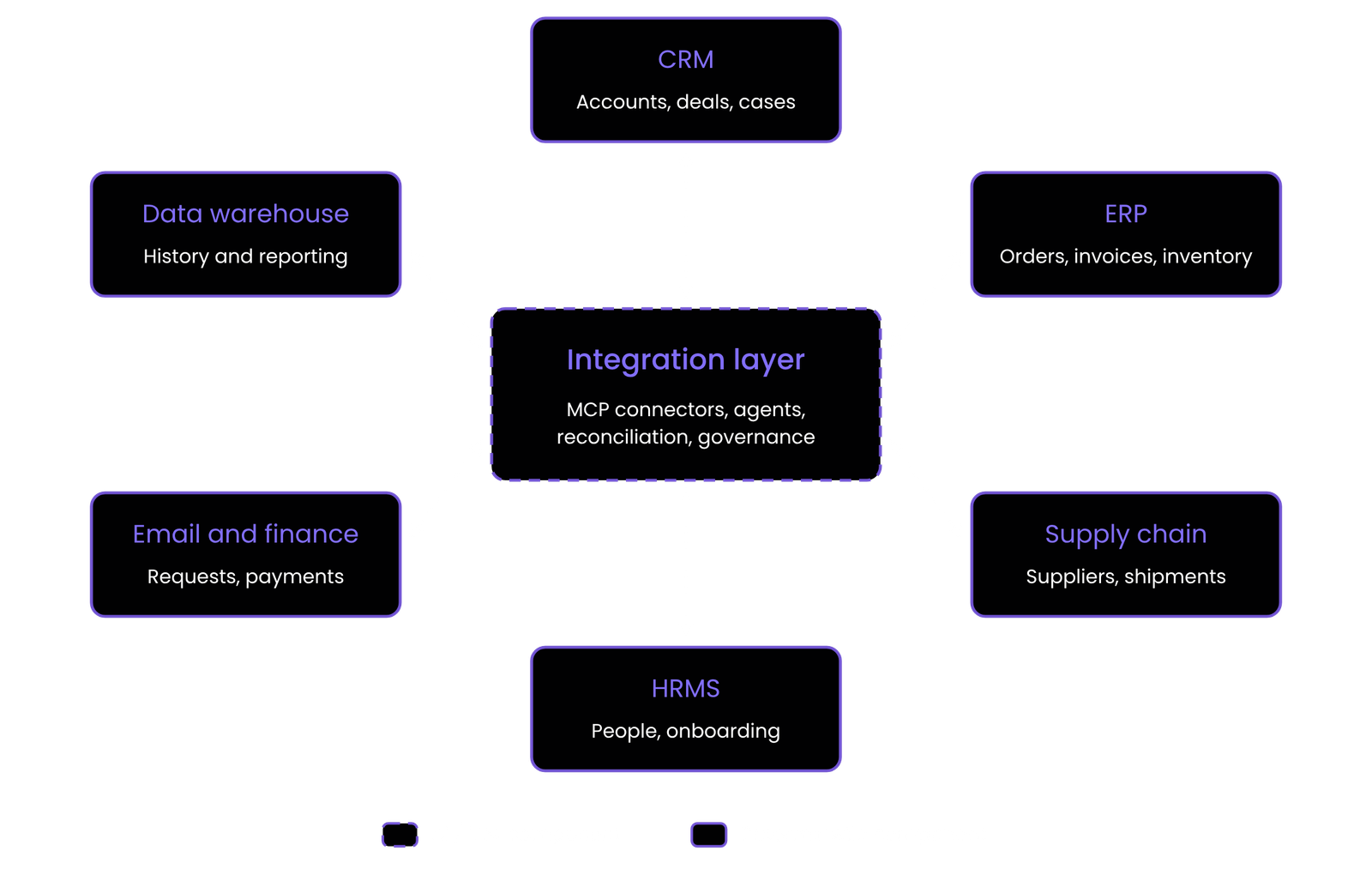
CRMs, ERPs, SCM and HRMS platforms include built-in AI, but it only works inside each vendor's boundaries. Processing an order, managing a claim or onboarding an employee spans several systems. We build the integration layer that connects them:
Agents that carry a process across your stack, from CRM to ERP, email and finance, completing multi-step tasks and updating records without manual data transfer. See agentic AI.
Connectors built on the Model Context Protocol that let any LLM or internal tool read from and write to your systems securely, without a custom integration for every pair of tools.
Agents that scan, match and resolve duplicate records and outdated fields across systems, so your core platforms share one source of truth.
Custom ML and fine-tuned models trained on your business rules, such as credit limits, compliance frameworks and pricing logic, to make context-aware decisions.
Role-based access, complete audit logs and human approval for high-stakes decisions before any system update is final.
Every enterprise AI build follows the same six steps, whichever route it takes.
We build on Microsoft, AWS, Google, IBM, Huawei and Alibaba Cloud, so the recommendation follows your stack and region, not our partnerships.
Everything runs in your account or project, under your identity provider, network rules and encryption keys. Your data stays inside your perimeter.
We use managed platform services where they do the job and write custom code only where your workflow needs it, which keeps cost and maintenance down.
Role-based access, audit logs, evaluations and human approval are part of the first release.
We record the baseline before the build and report results in the metrics your business already uses.
Systems it connects: Core banking, CRM, document stores
Systems it connects: Policy admin, claims, document systems
Systems it connects: EHR, payer portals, scheduling
Systems it connects: ERP, PIM, order management, helpdesk
Systems it connects: MES, ERP, maintenance systems
Systems it connects: TMS, WMS, carrier APIs
Systems it connects: PSA, CRM, document management
Systems it connects: Your product, CRM, billing, helpdesk
Systems it connects: Case management, LMS, records systems
Full-time engineers and specialists inside your team, from architecture through operations.
Best for: A program across several systems and business units
A defined scope, timeline and deliverables, from scoping to a system in production.
Best for: One use case on one route
Part-time specialists for monitoring, retraining and tuning live systems.
Best for: Systems already in production
Short cycles on one outcome: a proof of concept, an integration or a performance fix.
Best for: A bounded goal with a clear finish line
Enterprise AI is AI deployed across an organization's own software, data and workflows to automate processes and support decisions. It includes custom decision models, AI agents that work across systems, fine-tuned language models, retrieval over company knowledge, and the data pipelines, security and monitoring that keep these systems reliable inside core platforms such as CRMs and ERPs.
Connecting AI to internal records creates risks of unauthorized access, compliance breaches and data leaving your perimeter. These risks are managed by running AI inside your own cloud, enforcing role-based access at retrieval and at every tool call, keeping audit logs, excluding your data from model training, and making agents act only within your identity and network policies.
Adding AI to legacy systems does not require a rewrite. We connect to the system through its existing APIs, database or an MCP server, and add the AI as a service beside it: a model, an agent or a retrieval layer. The legacy system gains predictions, automation and natural-language access while its core logic and day-to-day operations stay as they are.
Data silos are overcome with a shared access layer, which avoids a large migration. We connect SaaS tools, databases and ERPs through MCP connectors and APIs, use reconciliation engines to keep records consistent across systems, and build retrieval over the combined data, so AI works from one current view while each system keeps its own data and permissions.
Enterprise AI success is measured on operational results against a baseline recorded before the build: cycle time per task, manual data entry error rate, cost per transaction, decision accuracy against your business rules, and the share of cases completed without manual intervention. Adoption by the people who use the system is tracked alongside, since unused AI returns nothing.
Choose an enterprise AI development company on checkable evidence: experience with your cloud platform, the ability to work inside your perimeter and identity controls, a clear view of which steps need AI and which do not, governance in the first release, and results measured against a baseline. Ask who owns the code and how the system is run after launch.
The best cloud AI platform is usually the one your data, identity and contracts already sit on: Microsoft Foundry for Microsoft 365 and Azure estates, Amazon Bedrock for AWS, the Gemini Enterprise Agent Platform for Google Cloud and BigQuery, IBM watsonx for regulated hybrid estates, and Huawei Cloud or Alibaba Cloud where regional presence matters. We compare the options on model choice, agent runtime, data location and cost before recommending one.
Enterprise AI cost depends on the route (platform services, custom application or cross-SaaS integration), the number of systems connected, data preparation needed, security requirements and usage volume. Running costs for models, compute and storage sit separately from engineering fees. We scope one use case first and price the build once the baseline and architecture are agreed.
A first enterprise AI use case typically reaches production in eight to sixteen weeks: two to three weeks for scoping and readiness, four to eight weeks to build and integrate, and two to four weeks of evaluation and rollout. Projects built mainly on managed platform services sit at the shorter end; those connecting several SaaS platforms sit at the longer end.