Algoryte's agentic AI solutions combine goal-oriented reasoning with autonomous execution to complete end-to-end, multi-step enterprise workflows across your systems.
Algoryte's agentic AI development services design, build and run AI systems that take a business goal, plan the steps, act in your CRMs, ERPs and databases, and finish the workflow. Your team keeps the approvals, exceptions and judgment calls, and every action the system takes is permission-scoped, rule-checked and logged.
what is agentic AI?
Agentic AI is an approach to building AI systems that pursue a goal on their own: given an objective, the system plans the steps, uses your tools and data, checks its own results and keeps working until the task is complete. A chatbot or copilot answers and waits for the next instruction. An agentic system carries the workflow.
what are agentic AI development services?
Agentic AI development services are the engineering work of taking a business workflow from idea to an autonomous system in production: choosing the right workflows, designing the reasoning and control logic, connecting the agent to your systems, setting permissions and approval gates, and running the system after launch.
Most enterprise AI applications help with single tasks. Agentic AI turns a high-level objective into completed work. As an agentic AI development company, Algoryte builds systems with strict guardrails so you keep full control of your operations: your team handles approvals, exceptions and strategic judgment calls, and the system manages the execution in between. Work finishes on its own, with oversight placed exactly where your business requires it.
Building a single agent for one role is covered on our AI agent development page, and coordinating several agents on one process is covered under multi-agent systems. This page covers the operating layer that lets either run real workflows on their own.
agentic AI development services at a glance
What it is
Automated workflows with AI inside them, plus agentic automation for the steps that need judgment
Two tiers
Tier 1: AI-powered workflows on a fixed path. Tier 2: agentic automation where an agent plans the path
Platforms
n8n, Make, Zapier and Apache Airflow for workflows; LangGraph, CrewAI and similar frameworks for agents
AI capabilities
Natural language processing, computer vision and document extraction, generative AI and machine learning scoring
Integration
Your existing CRM, helpdesk, email, finance and ERP systems through APIs, webhooks and MCP
Where to start
The process with high volume, judgment in a few steps and a measurable cost in time or errors
Engagement models
Dedicated team, project-based delivery, fractional support or sprint-based work
how agentic AI helps enterprises and businesses
Agentic AI helps enterprises by finishing multi-step work that today waits on people moving between systems. The gains show up in five places:
work completes end to end
From intake to outcome, without hand-offs between tools and teams.
exceptions reach the right person
Cases that need judgment arrive with the evidence already gathered.
staff time moves to decisions
People stop collecting data and start approving, deciding and improving.
every action is on record
Each step is logged, so compliance reviews start from a complete trail.
capacity follows volume
Busy periods are absorbed without matching increases in headcount.
is your workflow ready for agentic AI?
A workflow is ready for agentic AI when it has repeatable decisions, reliable data and systems to work in, and a person who owns the outcome.
agentic AI readiness: fit and not a fit
A fit when
Not a fit if
The workflow has repeatable decisions and manual steps that consume your team's time
You need a chatbot or a one-off prototype
Source-of-truth data and systems exist for the agent to work with
There is no system access or reliable data for the agent to work from
A person can stay in the approval loop for decisions that need judgment
No one is available to own exceptions and escalations
Someone owns the workflow and the metric it is measured by
There is no baseline to measure impact against
The goal is a system running in production
The cost of a single wrong action is too high to accept any error rate
the bigger picture
how agentic AI works: LLM, RAG, MCP and the execution loop
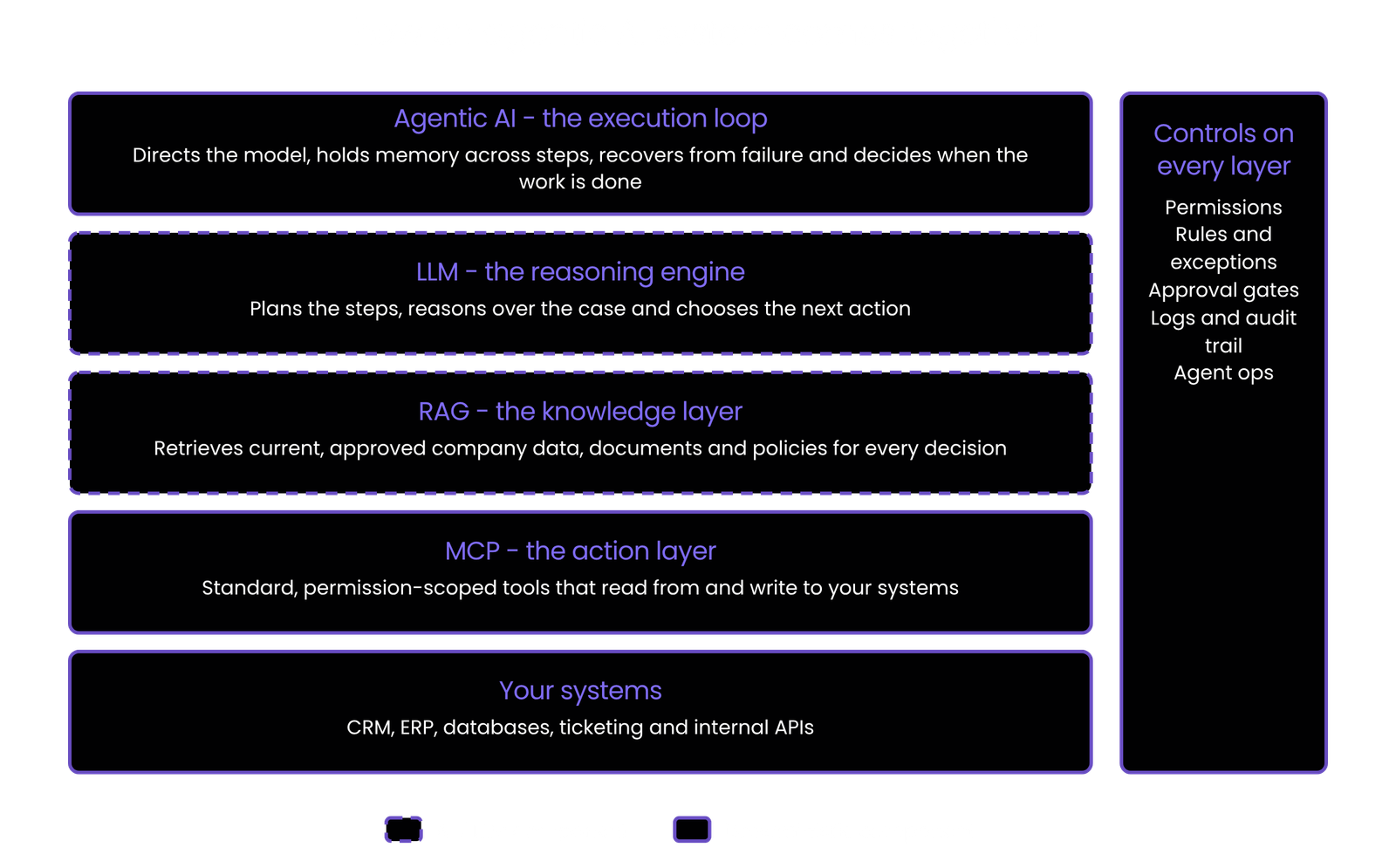
An agentic AI system works by stacking four layers: an LLM that reasons, a RAG layer that supplies company knowledge, an MCP layer that acts in your systems, and an execution loop that directs all three until the workflow is complete. Algoryte designs, implements and integrates each layer.
Figure 1: The four layers of an agentic AI system. The execution loop directs the LLM, pulls context through RAG and acts through MCP, with controls applied across every layer.
LLM - the reasoning engine
The language model is the central processor that plans, reasons and decides the next step. A base model only generates text from its training data. Algoryte selects and evaluates models per workflow, and fine-tunes them where needed, so they can work through complex enterprise cases and choose the best path forward.
RAG - the knowledge layer
Retrieval-augmented generation connects the reasoning engine to your company’s databases, documents and policies. We build secure RAG pipelines that supply current, context-specific business data at the moment of each decision, so every action is grounded in up-to-date company knowledge.
MCP - the action layer
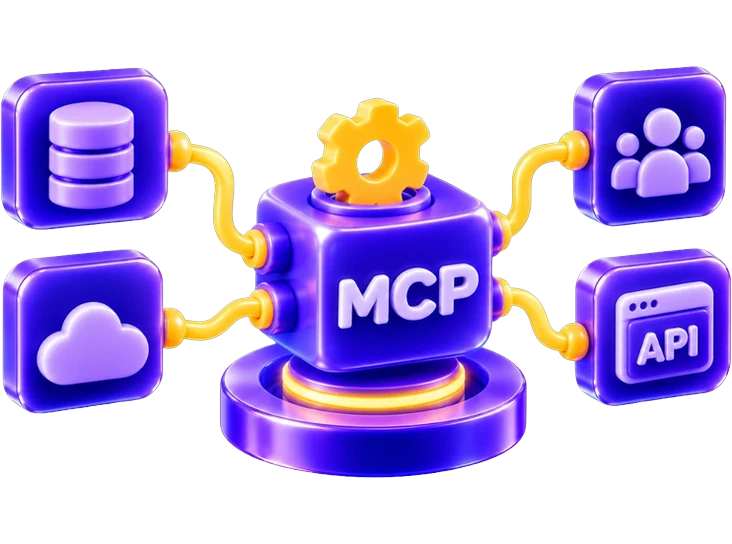
The Model Context Protocol gives the system a standard, secure way to use your existing software. Through MCP servers with scoped permissions, the agent can read from and write to your databases, CRMs, ticketing systems and proprietary APIs.
agentic AI - the execution loop
The outer layer runs the loop: it directs the LLM to plan, pulls context through RAG, holds memory across steps and executes actions through MCP, adjusting until the workflow is complete. Algoryte engineers this layer around your workflow: the planning, control and recovery logic that turns the other three layers into a system that finishes work.
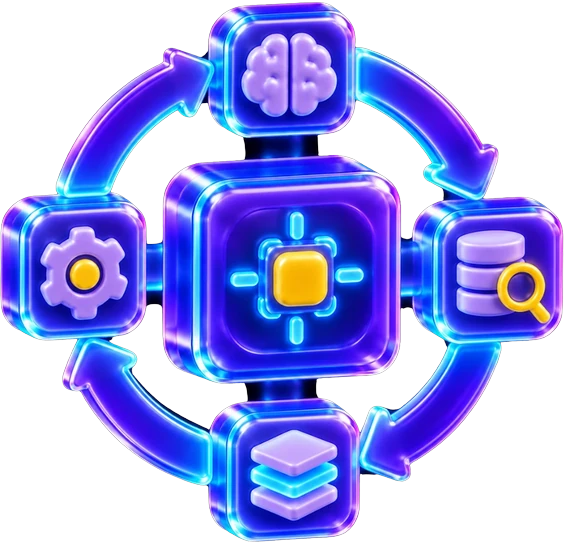
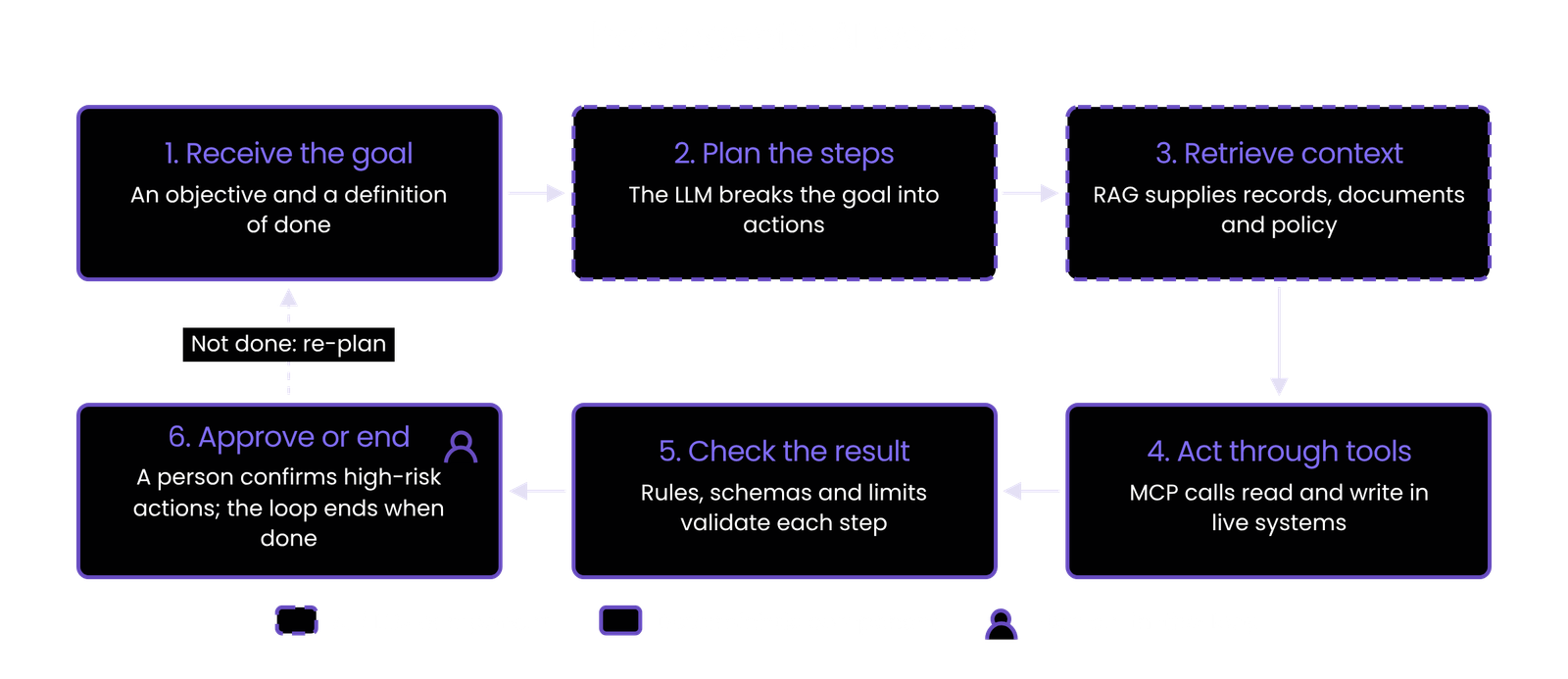
Figure 2: How an agentic system carries a goal to completion: it plans, retrieves context, acts, checks the result and re-plans, with a person approving decisions above a set risk line.
Figure 2 traces one pass through the loop. The system repeats it, re-planning after each check, until the definition of done is met or an approval gate hands the case to a person.
our agentic AI development services
agentic system architecture and design
Designing the reasoning and execution loop behind every autonomous system: how it breaks goals into steps, decides what to do next, recovers from failure and knows when the work is done.
custom AI agent development
Building AI agents that own workflows end to end, from the first trigger to the finished outcome. Each agent gets the reasoning, memory, tool access, permissions and RAG-grounded knowledge its role requires, and is tested against real cases before it touches production work.
multi-agent system development
Engineering coordinated agent teams for workflows too broad for a single agent. Covers orchestration, task handoffs, shared context and failure isolation, so specialized agents work on one process without conflicts or dropped steps.
tool and system integration
Connecting agentic systems to the platforms your teams already work in, such as CRMs, ERPs, databases, ticketing and internal APIs. Integrations built on MCP keep tool connections standardized, so any agent can reuse them.
human-in-the-loop, guardrails and safe deployment
Defining where autonomy ends and human judgment begins: approval gates, escalation rules, permission scoping and action limits. Every system is tested for behavior and edge cases before it gets access to live environments.
agent ops and optimization
Running agentic systems after launch: monitoring quality, cost and exception rates, growing the evaluation set from real cases, testing model and prompt updates before rollout, and reviewing what the agent is allowed to do as evidence builds.
our agentic AI development process
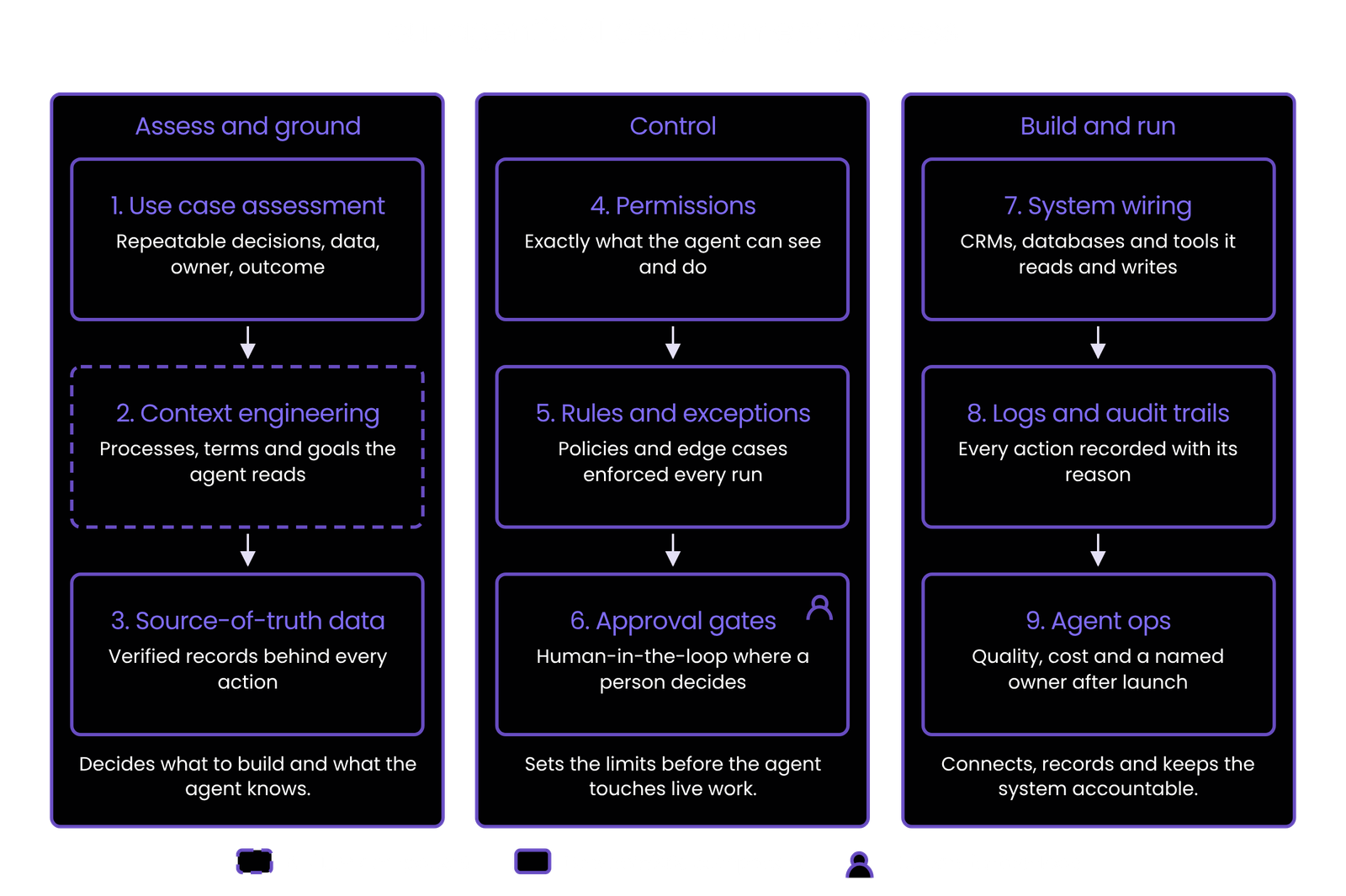
Every reliable agentic system rests on the operating layer around the agent: the context, controls, guardrails and monitoring it needs to work autonomously in production. We build that layer in nine steps.
Figure 3: Algoryte's nine-step agentic AI development process, grouped into three phases from use case assessment to agent ops.
how much autonomy should an agentic AI system have?
Autonomy in an agentic AI system means how many decisions it makes and carries out without a person approving them. We set it per decision type and widen it in four levels, each one earned with evidence from the logs of the level below.
the four levels of autonomy in an agentic AI system
Level
What the system does
What a person does
Moves up when
1. Suggest
Prepares the case and recommends an action
Decides and acts on every case
Recommendations match the team's decisions on real cases
2. Act with approval
Carries out the action after a person approves it
Approves or corrects each action
Approvals pass without changes for an agreed period
3. Act within limits
Acts on its own inside set limits and escalates the rest
Handles escalations and reviews a sample of completed work
Sampled work and exception rates stay within target
4. Act and report
Runs the decision type end to end and reports outcomes
Reviews dashboards, audits and the kill switch
Stays here only while monitoring confirms quality
Most systems run with different decision types at different levels: a refund under a set amount can sit at level 3 while a refund above it stays at level 2. Autonomy can also move back down when monitoring shows a drop in quality.
agentic AI vs generative AI, RPA and AI agents
Generative AI creates content, RPA repeats a script, an AI agent completes one task, and an agentic AI system carries a whole workflow to completion inside the rules you set.
agentic AI compared with generative AI, RPA and AI agents
Generative AI
RPA
AI agent
Agentic AI system
What it produces
Content such as text, code or images
A scripted task, repeated exactly
One bounded task completed with tools
A whole workflow finished across systems
Who decides the next step
The person writing the prompt
The script
The agent, within one task
The system, within set rules and approval gates
When inputs are messy
Answers but does not act
Stops or fails
Adapts within the task
Re-plans and escalates exceptions to a person
Controls needed
Content filters
Error handling and monitoring
Tool permissions and evaluation
Permissions, rules, approval gates, audit logs and agent ops
Best for
Drafting, summarizing and answering
Fixed paths with stable screens and rules
A task you can describe in one sentence
Multi-step work that needs judgment at several points
Many programs use all four: deterministic code or RPA for fixed rules, generative AI for content, single agents for bounded tasks, and an agentic system where the workflow itself needs judgment. The use case assessment sorts each workflow into the right column before anything is built.
why choose algoryte for agentic AI development
trust and data sovereignty
We design trust in from the start. Agentic systems can run in your own cloud environment, and where data must not leave it, we use open-weight models hosted inside it, so data, models and execution stay under your control. Every action an agent takes is logged as it happens, giving compliance teams a complete record of what was done, when and why.
balanced autonomy
We pair the model's reasoning with deterministic execution paths where consistency matters, so the system stays adaptive in its thinking and predictable in its actions. Where model output drives a decision, validation checkpoints catch errors and hallucinations before they reach live workflows.
engineered as distributed systems
Agentic systems are distributed systems: several components reasoning and acting across your infrastructure at once. We engineer state management, failure recovery and coordination in from the start, so the system stays reliable when parts of it slow down or fail.
technology-agnostic by design
We build on the architecture that fits your case, with no vendor commitment. Models, frameworks and tools stay swappable, so the system improves as the technology does, without a rebuild or lock-in.
deep environment integration
We integrate agents directly into your CRMs, databases and internal tools. Once a decision is made, the agent carries it out in the same systems without waiting on manual hand-offs, which shortens the time between a decision and its execution.
agentic AI workflows by business function
Agentic AI works best on workflows with a clear trigger, a clear finished outcome and several systems in between. These are the end-to-end workflows businesses hand to agentic systems most often, by team.
agentic AI for finance
Invoice received to invoice paid: matches invoices to purchase orders and receipts, resolves mismatches with suppliers, posts approved invoices and schedules payment
Period end to books closed: runs reconciliations, investigates breaks, prepares accruals and drafts the close checklist status
Human checkpoint: Payments above a set amount, unresolved mismatches, journal entries above materiality and final sign-off
agentic AI for sales
Inbound lead to booked meeting: qualifies the lead, enriches the record, drafts personalized outreach, follows up and books the meeting
Human checkpoint: Outreach to strategic accounts
agentic AI for customer support
Ticket opened to case resolved: reads the history, checks entitlement, takes the fixing action in your systems and closes the case with a summary
Human checkpoint: Credits and refunds above policy limits
agentic AI for HR
Offer accepted to employee productive: creates accounts, orders equipment, schedules training and chases paperwork across HR, IT and payroll
Human checkpoint: Exceptions to standard role access
agentic AI for IT operations
Alert fired to incident resolved: correlates alerts, checks recent changes, runs approved diagnostics and remediation steps, and writes the incident record
Human checkpoint: Any change to production
agentic AI for procurement
Purchase request to purchase order: checks budget and policy, collects and compares quotes, drafts the order and routes it for approval
Human checkpoint: Spend above the approval matrix
agentic AI for supply chain
Delay detected to customer informed: spots late shipments, finds alternatives, rebooks within agreed windows and updates the customer
Human checkpoint: Rebooking that breaks a customer commitment
agentic AI for compliance
Control due to evidence filed: collects evidence from source systems, tests it against the control and prepares the exception list
Human checkpoint: Control sign-off and exception handling
agentic AI for marketing
Campaign live to budget rebalanced: watches performance across channels, flags underperforming segments, drafts variants and proposes budget shifts
Human checkpoint: Budget changes and new copy before launch
agentic AI use cases by industry
Agentic AI fits any industry with multi-step work spread across several systems. These are the end-to-end workflows we see most often in each industry, each with a human checkpoint.
agentic AI for banking & financial services
Processing loan and credit applications from document intake to a decision-ready file
Monitoring transactions for anomalies and escalating suspected fraud with evidence attached
Running KYC refreshes and compliance checks and assembling audit-ready reports across accounts and jurisdictions
Human checkpoint: Credit decisions and fraud escalations stay with an analyst
agentic AI for insurance
Taking a claim from first notice of loss to an adjuster-ready file, with coverage checked and documents collected
Preparing underwriting submissions from broker emails and attachments
Running renewals from reminder to quote
Human checkpoint: Claim payouts and underwriting decisions are signed off by staff
agentic AI for healthcare
Handling patient intake, eligibility verification and prior authorization requests end to end
Coordinating scheduling, follow-ups and referrals across departments
Processing claims and flagging denials for review with the reason documented
Human checkpoint: Clinical and coverage decisions stay with staff
agentic AI for retail & e-commerce
Managing returns, refunds and order exceptions within policy limits
Monitoring inventory across channels and triggering reorders before stockouts
Resolving inquiries that need account lookups and order changes
Human checkpoint: Refunds and exceptions above policy limits need approval
agentic AI for logistics & supply chain
Detecting shipment delays, finding alternative carriers and rebooking within agreed windows
Checking freight and customs documents before cut-off
Chasing suppliers on late purchase orders
Human checkpoint: Rebooking that changes a customer commitment needs approval
agentic AI for manufacturing
Turning equipment alerts into scheduled maintenance with parts ordered
Following up supplier delays and adjusting production schedules
Compiling quality inspection reports and supplier corrective actions
Human checkpoint: Line stoppages and quality holds are decided by supervisors
agentic AI for real estate & property management
Taking tenant maintenance requests from intake to a completed, invoiced job
Running lease renewals from reminder to signed document
Qualifying leads and booking viewings across portals
Human checkpoint: Lease terms, pricing and contractor spend above limits
agentic AI for legal & professional services
Moving contracts from intake through playbook review to a redline-ready draft
Running client intake and conflict checks
Assembling matter research from approved sources
Human checkpoint: A lawyer approves every redline and piece of advice
agentic AI for cybersecurity
Triaging alerts, removing duplicates and escalating real incidents with context
Investigating suspicious activity across logs and systems and assembling the incident timeline
Executing containment steps when a threat is confirmed
Human checkpoint: Containment runs only after analyst approval
agentic AI for education & research
Processing admissions, enrollment and student service requests across systems
Compiling literature reviews and structured research summaries from defined sources
Managing grant compliance reporting and deadlines across active projects
Human checkpoint: Admissions decisions and grant submissions are signed off by staff
agentic AI for SaaS & software operations
Detecting incidents, running root-cause analysis and opening fixes for review
Managing ticket triage, routing and status updates across development tools
Monitoring deployments and rolling back or escalating when checks fail
Human checkpoint: Engineers review every fix before it merges
agentic AI for telecommunications
Resolving service faults from customer report to field visit or remote fix
Processing number ports and plan changes across billing and provisioning systems
Handling billing disputes within policy
Human checkpoint: Credits above policy limits and network changes
agentic AI for games & interactive entertainment
Resolving player account and purchase issues end to end
Watching live events and in-game economies and proposing fixes
Running QA test passes and filing reproducible bug reports
Human checkpoint: Bans, refunds and economy changes need a person
agentic AI for blockchain & Web3
Monitoring smart contracts and on-chain activity for exploit patterns and economic anomalies
Analyzing ledger transactions and token flows for audit-ready compliance reports
Assessing multi-chain liquidity, gas prices and congestion to schedule transaction routing
Human checkpoint: Transactions above a set value need sign-off
engagement models for agentic AI development
dedicated agentic AI team
Our engineers join your team full-time and carry long-running agentic work from the inside: system architecture, agent builds and the integrations that connect them to your environment.
Best for: Programs with several workflows planned
end-to-end project delivery
One scope, timeline and set of deliverables, from use case assessment through architecture and build to a system running in your environment.
Best for: Taking one workflow from idea to production
fractional agentic AI expertise
Part-time specialists for work that needs steady hands without full-time headcount: agent ops, guardrail tuning and keeping live systems monitored and improving.
Best for: Live systems that need ongoing care
sprint-based engagement
Short, focused cycles aimed at a single outcome: standing up a first agent, wiring in a new tool integration or fixing an underperforming workflow.
Best for: A defined change with a clear finish line
you know what agentic AI is. now see what it can do for you.
Agentic AI is an approach to building AI systems that work toward goals on their own: given an objective, the system plans the steps, acts across your tools and data, adapts when something unexpected comes up, and continues until the work is done. Assistive AI such as chatbots and copilots waits for an instruction at each step, while agentic AI carries the workflow. Agentic AI services cover building these systems for a business: choosing the right workflows, designing the architecture and controls, developing the agents and running them reliably in production.
2. What is the difference between agentic AI and generative AI?
Generative AI creates content such as text, code or images in response to a prompt, while agentic AI uses that capability to decide and act toward a goal across several steps and systems. A generative model stops when it returns its answer. An agentic system reads the situation, chooses a tool, acts, checks the result and continues until the goal is met or an approval gate stops it. Most agentic systems use a generative model as their reasoning engine.
3. What are examples of agentic AI?
Examples of agentic AI in business include a system that takes an invoice from receipt to payment, matching it to the purchase order and resolving mismatches with the supplier; a support system that takes a ticket from opening to resolution, including the refund or account change; and an IT system that takes an alert from detection to a resolved incident with the record written. In each, the system plans and acts across several tools, and a person approves the decisions above a set risk line.
4. What is the difference between agentic AI and AI agents?
The difference between agentic AI and AI agents is that an AI agent is the individual software unit that reasons, uses tools and acts toward a goal, whereas agentic AI is the system-level approach built around agents: the planning, execution, oversight and controls that let one or more agents carry a workflow autonomously. In short, agents are what we build; agentic AI is how they run reliably in production.
5. How does agentic AI relate to multi-agent systems?
Agentic AI describes how a system works toward a goal with autonomy, and a multi-agent system describes how it is built: several specialized agents coordinated by an orchestration layer. An agentic system can run on one agent or on a team of agents. A multi-agent design is used when the workflow is too broad for one agent, and either way the same operating layer of permissions, rules, approval gates, logs and agent ops keeps it safe.
6. How is agentic AI different from automation tools like RPA?
Agentic AI differs from RPA in how it handles change: RPA follows rigid, scripted steps and fails when reality deviates from the script, whereas agentic AI reasons about the goal, adapts to messy inputs, handles exceptions and re-plans when a step fails. The two also work well together: fixed rules stay in deterministic code or RPA, and the agent handles the judgment and language around them.
7. What does autonomy mean in an agentic AI system?
Autonomy in an agentic AI system means how many decisions the system makes and carries out without a person approving them. It is set per decision type, not for the system as a whole, and it is widened in levels: suggesting actions, acting with approval, acting within set limits, and acting and reporting. Each level is earned with evidence from the logs of the level below, and it can be pulled back when monitoring shows a drop in quality.
8. For which type of task is agentic AI most appropriate?
Agentic AI is most appropriate for multi-step tasks with a clear goal, repeatable decisions, reliable data and several systems involved, where the path changes from case to case: exception handling, case resolution, onboarding, reconciliations and incident response. It is less suited to fixed paths with simple rules, where deterministic automation is cheaper, and to rare, high-stakes judgments, where a person with good tools is the better choice.
9. How can I integrate agentic AI into my existing software systems?
You integrate agentic AI into existing software through APIs and the Model Context Protocol (MCP), so no replacement of your current stack is needed. We connect agents to your CRMs, ERPs, databases and internal tools with scoped permissions, and they read and write through the same systems your team already uses. Where a legacy system has no API, RPA or a database connector fills the gap.
10. How long does it take to build an agentic AI system?
A first agentic workflow typically takes three to five months from use case assessment to a system running in production, with the supervised pilot taking the largest share. Assessment takes two to three weeks; control design, integration and build take six to ten weeks depending on how many systems are involved; and the pilot runs until real cases justify each decision the agent is allowed to make. A second workflow on the same foundation is faster.
11. How much does agentic AI development cost?
Agentic AI development cost depends on the number of systems the agent acts in, how strict the controls need to be, case volume and how much of the ongoing operation your team takes over. A workflow in one system with an API sits at the low end; one spanning ERP, CRM and email with approval gates and custom rules sits at the high end. Running costs come from model usage per case, hosting and agent ops. We quote the use case assessment at a fixed price and give a scoped estimate for the build after it.
12. Can we pilot agentic AI before a full rollout?
Yes. Every engagement starts with a use case assessment and a first build scoped to one tightly bounded workflow, so you see the system working on real cases, with a person approving its actions, before committing to a wider rollout. The pilot is measured against the baseline set during the assessment.
13. What are the ethical considerations when implementing autonomous AI?
The main ethical considerations for autonomous AI are accountability, transparency and control: knowing who is responsible for an agent's actions, being able to see why it did what it did, and keeping people in charge of decisions that need judgment. Our systems address these by design with scoped permissions, full action logs, approval gates and a named owner for every workflow.
14. How do you evaluate ROI from agentic AI?
To evaluate ROI from agentic AI, set the baseline before the build: what the workflow currently costs in hours, errors and delays. Then measure the live system against that baseline with metrics such as resolution time, cost per case and exception rate. We build this measurement into the process from the use case assessment onward.