





Overview
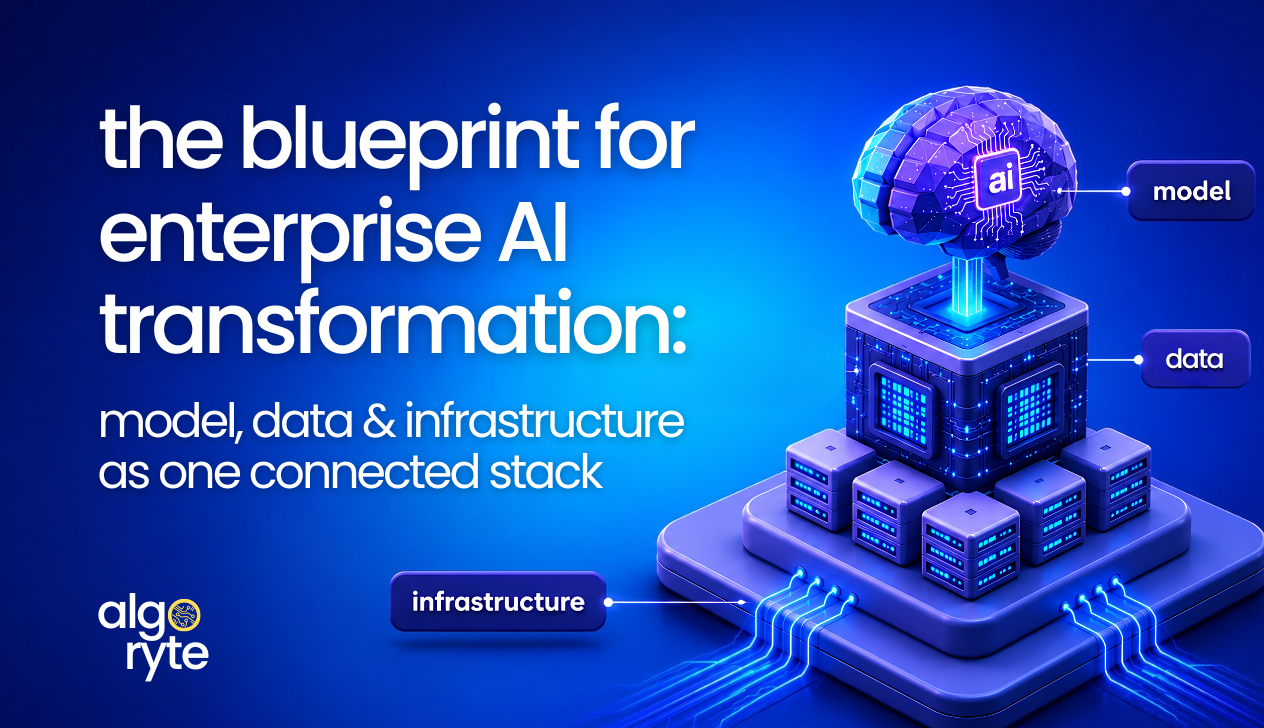
- True enterprise AI transformation is achieved when an organization looks beyond standalone model APIs and designs a cohesive, multi-layered architecture. For an AI system to scale and deliver sustainable business value, it must be engineered as a single, connected stack in which the model, data, and infrastructure layers operate in perfect harmony.
- Gartner projects that more than 80% of enterprise applications will have AI capabilities embedded in them by 2026. To capture this massive wave of innovation, organizations must shift from building localized demos to deploying production-grade AI architectures that can seamlessly handle live corporate traffic.
1. The Model Layer: Strategic Lifecycle Management
In a mature AI transformation, model selection is treated as a dynamic, continuous lifecycle rather than a static, one-time decision.
How It Works
The model layer governs how an AI system processes inputs and generates intelligent responses. Instead of relying on a single, massive general model forever, a sustainable architecture is built to orchestrate multiple AI models. It treats models as fluid assets, implementing automated pipelines to swap, cascade, or retrain them as business requirements evolve.
Why It Matters for Transformation
- Prevents Degradation: Models naturally drift as real-world inputs shift. Active governance ensures performance never decays after launch.
- Optimizes Costs with Specialization: A core part of AI readiness is transitioning from generic large language models to smaller, domain-specific models. A specialized model often outperforms a general one on narrow enterprise tasks at a fraction of the operating cost.
- Ensures Agility: Designing the architecture to make swapping models a routine operation protects the business from being locked into a single provider or technology stack.
2. The Data Layer: The Engine of Context & RAG
The data layer is the foundational bedrock of any AI system; it determines the ultimate quality and accuracy of the model’s outputs.
How It Works
Modern AI transformation relies heavily on Retrieval-Augmented Generation (RAG) to provide real-time enterprise context to the model. The data layer works by continuously transforming corporate data into mathematical vectors via embedding pipelines. These vectors are stored in dedicated Vector Databases (such as Pinecone, Milvus, or pgvector), which allow the AI system to instantly query and retrieve highly relevant, accurate context matching the user’s request.
Why It Matters for Transformation
- Eliminates Hallucinations: High-quality data pipelines provide the model with accurate context, ensuring reliable outputs regardless of complexity.
- Aligns with Business Velocity: An optimized data layer matches ingestion speeds to the specific use case, seamlessly handling real-time data streams or scheduled nightly batches based on business needs.
- Secures Enterprise Compliance: Integrating robust data governance, lineage tracking, and compliance checks directly into the data foundation ensures that the AI system can be safely deployed in highly regulated industries.
3. The Infrastructure Layer: Scalable, Workload-Aware Compute
An AI system requires a modern infrastructure layer optimized specifically for high-throughput, low-latency machine learning workloads.
How It Works
Standard cloud infrastructure is optimized for basic web traffic, whereas AI models require massive computational power to execute matrix multiplications. An AI-ready infrastructure layer dynamically provisions specialized hardware, such as Graphical Processing Units (GPUs) or dedicated chips, to run workloads efficiently and automatically scale according to real-time demand.
Why It Matters for Transformation
- Guarantees High Performance: Utilizing a deployment strategy tailored to the specific workload (whether containerized, serverless, or hybrid) ensures that the system remains fast and responsive under heavy user traffic.
- Controls Operational Costs: Proactive cost modeling allows businesses to accurately project token and compute expenses before launching, keeping the transformation strictly within budget.
- Provides Advanced Observability: Specialized infrastructure monitoring tracks compute performance, GPU utilization, and hardware-level anomalies – ensuring the physical layer running your AI workloads stays efficient and within cost parameters.
- Enables Agentic Expansion: An infrastructure layer built for scale is the foundation that agentic systems run on. As the architecture matures, autonomous agents can be deployed on top of it – operating across tools, triggering workflows, and executing multi-step tasks without human intervention at every step.
| Layer | Role | What It Delivers | Example Stack |
| Model layer | Strategic lifecycle management for the AI’s core reasoning | Stable performance over time, lower run-cost from specialized smaller models, and freedom to swap providers | Foundation LLMs paired with domain-tuned smaller models |
| Data layer | The engine of context, powered by RAG and vector retrieval | Accurate, hallucination-free outputs grounded in current enterprise data, at the velocity the business needs | Pinecone, Milvus, pgvector |
| Infrastructure layer | Scalable, workload-aware compute built for AI inference | Fast, cost-predictable performance under live traffic, with the headroom to add agentic systems on top | Containerized, serverless, or hybrid deployment on GPU compute |
The Integration Framework: MLOps, Orchestration, MCP & Observability
The true value of an AI transformation comes from how cleanly these three foundational layers connect into a singular, unified system. This is achieved through four core integration mechanisms:
MLOps
- How it works: MLOps brings traditional software engineering disciplines, such as version control, automated testing, and continuous deployment, directly into the AI lifecycle.
- Why it matters: It manages the fluid relationships between code, data vectors, and model parameters, creating automated feedback loops that catch system anomalies before users do.
Orchestration
- How it works: Software frameworks like LangChain or LlamaIndex automate the operational execution loops across the stack.
- Why it matters: It ensures that data pipeline completions automatically trigger model training jobs, updates are deployed without manual intervention, and compute resources scale dynamically based on workload volume.
Model Context Protocol (MCP)
- How it works: MCP serves as an open, universal standard protocol that enables LLMs to securely connect to data repositories and technical infrastructure tools.
- Why it matters: It replaces fragile, custom-built API wrappers with a secure, standardized connection point, radically simplifying how models safely read context and interact with enterprise environments.
Observability
- How it works: Dedicated monitoring tools, such as Arize AI, Langfuse, Weights & Biases, and Helicone, track model outputs, data quality, and system behavior continuously across all three layers.
- Why it matters: It catches model drift, data anomalies, and output degradation before users notice – giving teams the visibility to act on problems rather than react to them.
Designing Your AI Transformation Roadmap
Defining which business problems AI will solve, establishing governance policies around model usage and data access, and preparing teams for operational change are the decisions that determine whether a well-built system actually gets adopted and delivers value.
To evaluate whether your architecture is fully prepared for a production-grade AI transformation, use these four strategic questions as a design diagnostic:
Real-Time Data Velocity: Is your data pipeline built to feed a RAG architecture with real-time enterprise context, or is it restricted to batch processing
Architectural Flexibility: Can your current system seamlessly swap out or upgrade its underlying models without breaking the broader application architecture?
Deep Stack Observability: Do you possess comprehensive observability across your models, vector layers, and hardware compute, or are you limited to basic application uptime metrics?
Active Production Learning: Is your AI system built to dynamically learn and improve from live production data, or is it static and frozen at the point of initial deployment?
If you’d like help designing the model, data, and infrastructure layers as one connected stack, talk to Algoryte’s machine learning and AI team.
FAQs
1. What does it mean for an AI system to be “production-ready”?
A production-ready AI system is engineered to maintain high performance, accuracy, and cost-efficiency under real enterprise traffic. This requires a model layer with lifecycle management, a robust data layer governing quality, and an infrastructure layer optimized for specialized compute.
2. Why is the data layer prioritized over model selection during transformation?
Model selection is an exciting step, but even the most advanced model will fail if fed poor, stale, or context-starved data. Establishing a strong data foundation – complete with vectorization, real-time ingestion, and rigorous lineage tracking – is what guarantees long-term operational success.
3. What is the role of MCP in modern integration?
The Model Context Protocol (MCP) functions as an open standard that gives models a secure, uniform way to interact with data sources and infrastructure tools. It removes the need for custom, highly fragile glue code, accelerating development and enhancing system security.
4. What kind of business returns can an AI transformation deliver?
According to McKinsey, organizations deploying AI and agentic automation within a well-built architecture can realize a 20% to 40% run-rate cost reduction in initial deployments, with exponential returns scaling alongside broader adoption.
5. How does Algoryte accelerate this AI transformation?
Algoryte’s comprehensive data science, machine learning, and data engineering teams map out your models, RAG pipelines, and cloud infrastructure as a singular system. We build the secure MLOps framework and orchestration connective tissue required to launch a reliable, high-performance architecture from day one.