experience virtual
reality without
real-world risks,
costs, or limits

Get fully immersive VR experiences with 90+ FPS, comfortable locomotion, and production-ready spatial computing – optimized for Meta Quest, PlayStation VR, PC VR headsets, SteamVR, and Apple Vision Pro.

create, innovate,
immerse - build
your VR world now!

virtual reality services

Algoryte develops end-to-end virtual reality experiences that prioritize user comfort, frictionless interaction, and technical performance. We create immersive VR applications that power innovation across industries – from gaming, healthcare, and education to retail, architecture, real estate, product showcase and enterprise collaboration – handling everything from concept to building 3D environments, interaction mechanics using controllers or hand gestures, optimization, and deployment.

Our VR development balances high-quality visuals with essential performance, ensuring smooth frame rates, minimal motion sickness, and comfortable interactions. Whether you need a fully custom VR experience or want to adapt existing content for virtual reality, our team brings the technical expertise and design sensibility that separates comfortable, engaging VR from experiences users abandon after five minutes.

our VR services

Virtual reality headsets with development tools and cloud integration

custom VR
development

End-to-end VR experience creation from concept through deployment. We design concepts, craft 3D worlds, engineer interactions, integrate storytelling elements, and optimize performance for your target headset – enabling you to launch high-quality VR products.

Virtual reality hand interaction design with 3D cube element

interaction design
& engineering

User-centric interaction paradigms optimized for comfort and natural use. We design and implement hand tracking systems, controller input schemes, physics-based object manipulation, spatial UI layouts, locomotion methods (teleport, smooth, room-scale), and haptic feedback – creating interaction patterns that feel instinctive and minimize learning curves.

Virtual reality 3D environment production on monitor with checkmark

3D production
for VR

Performance-optimized 3D content specifically engineered for VR constraints. We create high-fidelity environments, characters, and interactive objects with appropriate polygon budgets, VR-friendly LOD systems, spatial audio integration, accurate scale and lighting, and rendering techniques – maintaining 60+ FPS across target hardware while supporting both realistic and stylized design goals.

Virtual reality performance optimization with speedometer and gear icon

performance
optimization

Technical optimization ensures consistent frame rates and comfortable experiences. We profile and optimize rendering pipelines, implement dynamic quality scaling, reduce draw calls and GPU load, manage thermal constraints on standalone headsets, and eliminate performance bottlenecks – targeting 90-120 FPS across Meta Quest, Pico, and PCVR platforms.

Virtual reality headset with global deployment and location icons

multi-platform
deployment

Cross-platform development spanning hardware ecosystems with seamless third-party integrations. We build for Meta Quest, PSVR, PC VR, SteamVR, etc. – handling platform-specific requirements, input differences, performance scaling, store submission processes, and integrating productivity tools, analytics systems, cloud backends, and APIs as your project requires.

Three users enjoying virtual reality multiplayer experience

multiplayer &
social VR

Multiuser VR experiences supporting collaborative or competitive interactions. We implement real-time multiplayer with voice chat, spatial audio, avatar synchronization, shared workspaces, persistent virtual hubs, and optimized network performance – enabling training sessions, meetings, social spaces, or multiplayer gaming experiences.

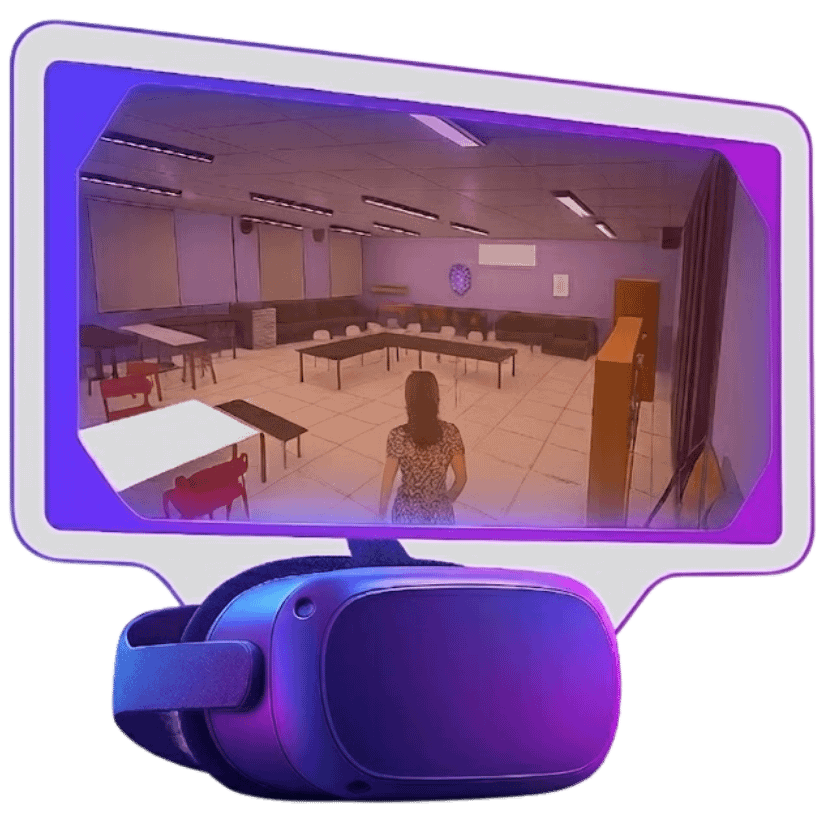
Virtual reality classroom simulation environment

simulation &
digital twins

Interactive VR simulations replicating real-world equipment, workflows, and environments. We build digital twins helping teams test scenarios, train staff, visualize operational data, and explore facility layouts before making real-world decisions – reducing risk and improving planning through virtual representation.

Virtual reality headset with desktop content integration

VR porting &
adaptation

Converting existing applications or games for virtual reality platforms. We redesign UI for spatial contexts, implement VR control schemes, optimize rendering for dual-eye requirements, address comfort concerns, restructure gameplay for VR paradigms, and ensure stable performance – transforming flat-screen content into proper VR experiences rather than uncomfortable direct conversions.

Virtual reality prototyping design tools and ruler

rapid prototyping
& R&D

Rapid prototyping and validating concepts before full-scale development. We create quick prototypes, testing mechanics, workflows, spatial layouts, and user interactions – helping you refine ideas, validate feasibility, and make informed decisions about VR suitability before committing significant development resources.

Virtual reality analytics dashboard with growth metrics

analytics &
user testing

Data-driven optimization through user behavior analysis and comfort testing. We implement analytics tracking interactions and drop-off points, conduct comfort testing with diverse user groups, measure performance metrics, and provide actionable insights guiding iterative improvements – ensuring experiences work for real users in real conditions, not just controlled developer environments.

Virtual reality headset with maintenance tools and gear icon

maintenance
& support

Ongoing technical support, keeping your VR application current and functional. We provide performance updates, feature expansions, device compatibility upgrades as new headsets release, content refreshes, bug fixes, and security patches – ensuring your VR investment

remains stable, relevant, and compatible with the evolving XR ecosystem.

why choose algoryte for
VR development?

performance-first
development

We build VR experiences maintaining 90+ FPS on target hardware through aggressive optimization, efficient rendering techniques, and smart LOD systems. We understand that smooth performance isn’t optional in VR; it’s the difference between comfortable experiences and instant nausea.

comfort &
accessibility
expertise

We understand VR comfort principles – designing locomotion systems that minimize motion sickness, creating UI that doesn’t strain eyes or necks, implementing adjustable comfort settings, and testing across diverse users to ensure experiences work for broad audiences.

cross-platform
VR deployment

We develop across Meta Quest (standalone and PC-linked), PSVR, PC VR (SteamVR, Oculus PC), and other enterprise headsets – understanding each platform’s technical constraints, input paradigms, and user expectations while maintaining consistent core experiences across different hardware capabilities and price points.

VR-native
interaction
design

We design interactions specifically for VR’s strengths rather than translating flat-screen patterns – leveraging hand presence, spatial audio, 360-degree environments, and physical gestures to create intuitive systems that feel natural in virtual space instead of awkward adaptations.

technical
optimization
mastery

We balance visual quality with VR’s demanding

performance requirements through draw call reduction, texture optimization, physics simplification, and shader efficiency – ensuring experiences look polished while meeting the frame rate and thermal budgets standalone headsets demand.

industry-specific
experience

Our portfolio spans VR gaming, enterprise training,

real estate visualization, social platforms, educational applications, and more – bringing proven expertise and

best practices from diverse use cases to inform solutions

for your specific industry and goals.

build VR that works - not
just look cool in demos

our VR development
process

discovery & feasibility analysis

We begin by understanding your goals, target audience,

content requirements, and platform preferences – assessing VR suitability for your use case, identifying technical challenges, and defining success metrics to ensure VR provides meaningful value over alternative mediums.

Lightbulb and clipboard with checklist representing augmented reality project discovery and feasibility analysis phase
Virtual reality development planning with warning and maintenance tools

concept development

We create design documentation defining VR experience flow, interaction paradigms, locomotion systems, and UI approaches – prototyping key interactions in VR to validate comfort and usability before committing to full development, ensuring mechanics feel natural in the virtual space.

3D environment & asset creation

We build optimized 3D environments, characters, and interactive objects specifically for VR performance requirements – creating spatial audio environments, implementing realistic lighting while respecting performance budgets, and designing assets that read clearly at VR viewing distances.

Virtual reality headset displaying immersive 3D environment
Virtual reality headset with hand controller and touch interactions

interaction system implementation

We develop VR input handling, hand tracking integration, physics-based interactions, spatial UI systems, and comfort features – implementing locomotion options (teleport, smooth movement, room-scale), grab mechanics, and feedback systems that make virtual objects feel responsive and tangible.

audio & immersion layer

We implement spatial audio with distance attenuation and occlusion, create ambient soundscapes reinforcing presence, add haptic feedback for touch interactions, and design audio cues guiding attention – building the sensory layer that completes immersion beyond visual fidelity alone.

Virtual reality headset with spatial audio and headphones
Quality assurance checklist with magnifying glass and security shield for augmented reality testing and refinement

performance optimization & comfort testing

We profile frame rates across target hardware, optimize rendering and physics calculations, implement dynamic quality scaling, and conduct comfort testing with diverse users – identifying and eliminating motion sickness triggers, visual artifacts, and interaction frustrations before wider deployment.

platform deployment & quality assurance

We build for all major VR platforms (Meta Quest, PlayStation VR, SteamVR-compatible headsets), handle store submission requirements, test across different headset models and configurations, and verify controller compatibility – ensuring consistent experiences across hardware variations and resolving platform-specific issues.

Purple gear icon with orange checkmark representing augmented reality deployment and technical support services
Virtual reality headset with strategy planning and iteration workflow

launch support & iteration

We provide post-launch monitoring, gather user feedback on comfort and usability, release updates addressing issues, and implement feature enhancements – supporting your VR application as the platform ecosystem evolves and new headsets enter the market.

industries we have
worked with

Gaming industry icon with game controller

gaming & entertainment

Immersive VR games, escape rooms, virtual arcades, narrative experiences, rhythm games, puzzle adventures, and multiplayer social gaming – leveraging VR’s presence and interaction for entertainment that flat screens can’t replicate.

Education industry icon with stacked books

training & education

Medical procedure training, equipment operation simulations, soft skills practice, hazardous environment training, historical recreations, science visualization, language immersion, and corporate onboarding, as well as VR classrooms and teacher dashboards – enabling safe, repeatable practice at scale.

Real estate and architecture industry icon with buildings

real estate & architecture

Property tours, pre-construction walkthroughs, interior design visualization, urban planning presentations, construction progress documentation, and remote client reviews – helping stakeholders understand spaces before they’re built.

Enterprise and collaboration industry icon with handshake and circular arrows

enterprise & collaboration

Virtual meetings and conferences, remote collaboration spaces, product demos, product design reviews, data visualization environments, virtual showrooms, customer experience centers, and brand activations – bringing distributed teams together in shared virtual spaces.

Healthcare industry icon with medical cross symbol

healthcare & therapy

Exposure therapy for phobias, pain management distraction, physical rehabilitation exercises, surgical planning, anatomy education, meditation environments, and PTSD treatment – applying VR’s immersive qualities to therapeutic and medical applications (non-regulated).

Manufacturing and industrial industry icon with factory and conveyor belt

industrial & manufacturing

Equipment maintenance training, assembly procedure practice, safety protocol education, factory layout planning, remote expert assistance, quality inspection simulations, logistics optimization, and digital twin support – improving industrial processes through virtual representation.

Military and defence industry icon with tank and security shield

military & defense

Mission rehearsal simulations, vehicle and aircraft operation training, battlefield awareness scenarios, tactical decision-making exercises, and command-and

-control visualizations – using VR to improve readiness, coordination, and situational judgment in safe, controlled environments.

our VR tech stack

VR platforms

Meta infinity logo for immersive technology platform
PlayStation VR headset platform logo
HTC Vive headset platform logo

meta quest 2/3/pro

playstation VR2

HTC vive

Valve Index headset platform logo
Pico headset platform logo
Apple Vision Pro spatial computing platform logo

valve index

pico

apple vision pro

game engines

Unreal engine
Unreal engine

unreal engine 5
(VR template, openXR)

unity (XR interaction toolkit,
XR plugin management)

SDKs & frameworks

OpenXR open standard platform logo
Oculus platform logo with oval icon
SteamVR gaming platform logo

open XR

oculus SDK

steamVR SDK

PlayStation VR2 headset platform logo
XR Interaction Toolkit development tool logo

PS VR2 SDK

XR interaction toolkit

interaction systems

Meta Quest hand tracking feature logo
Ultra Leap hand tracking technology logo
Eye tracking technology for VR and AR applications logo

quest hand tracking

ultraleap

eye tracking

PhysicsVR virtual reality physics simulation logo
Spatial UI logo for virtual reality user interface design

physics-based interactions

spatial UI

networking

Photon Unity Networking multiplayer solution logo
WebRTC real-time communication protocol logo
Mirror networking solution for Unity logo

photon

WebRTC for multiplayer/
collaborative VR

mirror

Unity Netcode for GameObjects networking solution logo
Normcore real-time multiplayer networking solution logo

netcode

normcore

audio

Steam Audio spatial sound solution logo
Google Resonance Audio spatial sound platform logo
Oculus Audio spatial audio SDK logo

steam audio

resonance audio

oculus audio SDK

performance tools

Unity Profiler performance optimization tool logo
Oculus heads-up display developer tool logo

unity profiler

oculus performance HUD

Qualcomm Snapdragon Profiler performance analysis tool logo
RenderDoc graphics debugging and profiling tool logo

snapdragon profiler

render doc

FAQs

VR development demands up to 90 FPS (45 per eye) versus typical 30-60 FPS, requires dual-eye rendering doubling GPU load, must minimize latency below 20ms to prevent motion sickness, needs spatial UI design instead of flat screens, and demands constant comfort testing. Input paradigms completely differ – using hand tracking, room-scale movement, and physical gestures rather than controllers or mouse/keyboard. Performance optimization is critical because frame drops cause nausea, making VR far less forgiving than traditional development.

We implement multiple comfort strategies, such as maintaining consistent 90+ FPS, offering locomotion options (teleport, smooth with vignetting, room-scale only), keeping the horizon stable during movement, avoiding camera acceleration, providing fixed reference points, designing predictable interactions matching user expectations, and including comfort settings users can adjust. We test with VR-sensitive users, identifying triggers early and iterating based on comfort feedback, not just visual impressions.

Standalone VR (Quest) runs on mobile processors requiring aggressive optimization – lower polygon counts, simpler shaders, fewer simultaneous elements, and careful thermal management to prevent throttling. PC VR leverages desktop GPU power, enabling higher visual fidelity, complex physics, larger environments, and more simultaneous objects. Standalone prioritizes accessibility and wireless freedom; PC VR prioritizes visual quality and complexity. We often develop for both, creating scalable experiences that run on Quest while offering enhanced visuals when connected to a PC.

Yes, but effective VR conversion requires more than camera adjustments – we redesign UI for spatial contexts, implement VR-appropriate controls replacing keyboard/mouse or gamepad inputs, optimize rendering for VR’s performance demands, redesign gameplay mechanics that don’t translate well to VR, address comfort concerns traditional games ignore, and often restructure level design for VR sightlines and movement. Simple conversions cause discomfort; proper adaptations respect VR’s unique requirements and opportunities.

Simple VR experiences (training scenarios, architectural walkthroughs) take 2-4 months. Medium-complexity VR games or applications require 4-8 months. Complex multiplayer or enterprise VR platforms need 8-12+ months. Timeline factors include: content scope (number of environments, interactions), target platform count (Quest-only vs. multi-platform), custom interaction system complexity, multiplayer/networking requirements, asset creation volume, optimization demands for standalone headsets, and comfort testing iterations. We provide detailed estimates after understanding your specific requirements and quality expectations.

let's get working
on your new
project!