mixed reality
that understands
physical space - not
just overlays on it
Deploy MR experiences using spatial computing to enable real-time environment understanding, surface detection, and persistent anchoring – developed for Microsoft HoloLens, Magic Leap, Apple Vision Pro, Meta Quest, and HTC Vive platforms.
your real room + our
holographic overlays =
mixed reality done right
mixed reality solutions
Our MR solutions let holograms coexist with physical environments – recognizing real surfaces, adjusting to room lighting, and staying anchored even after you remove the mixed reality headset. We develop MR applications for Microsoft HoloLens, Magic Leap, Apple Vision Pro, Meta Quest, and HTC Vive that enable natural hand gestures and eye-tracking interactions.
Whether overlaying schematics onto machinery, placing 3D models in conference rooms, or building collaborative workspaces, our applications persist content across sessions. Multiple users can see and interact with the same holograms anchored to shared locations – enabling teams to manipulate virtual objects together in person or remotely.

our mixed
reality services

spatial mapping &
environment understanding
Enable MR applications that comprehend physical spaces and adapt digital content accordingly. Our team implements real-time spatial mapping using depth sensors and computer vision – creating mesh representations that allow virtual content to hide behind real objects, sit on actual surfaces, and respect physical boundaries.

holographic content
development
Create 3D holograms that users can view from any angle and interact with naturally. We design and optimize holographic assets with proper transparency, lighting responses, and visual clarity – ensuring virtual objects remain believable when placed alongside physical objects.
hand tracking &
gesture interaction
Enable intuitive control through natural hand movements without controllers. We build gesture recognition systems responding to pointing, grabbing, pinching, and custom poses – with comfortable interaction distances, visual feedback, and fallback options for low-confidence tracking.

spatial anchors
& persistence
Keep digital content anchored to specific physical locations across sessions and devices. We implement cloud-based spatial anchors that remember where holograms were placed – enabling users to return days later and find virtual objects exactly where they left them, or allowing multiple users in the same physical space to see synchronized content at shared locations.

voice commands
& gaze interaction
Provide hands-free control through voice recognition and eye-tracking for efficient MR navigation. Our team integrates natural language processing for contextual voice commands, implements gaze-based cursor systems for targeting and selection, and combines these input methods for accessible interfaces that work when hands are occupied or unavailable.

multi-user spatial
collaboration
Enable teams to work together in shared physical spaces with synchronized holographic content. We develop co-location experiences where multiple headset users see the same virtual objects anchored to the same physical locations, implement real-time synchronization of object manipulation, and build systems for remote participants to join spatial sessions and view accurate representations of physical environments.

physical-digital
object interaction
Create experiences where virtual content responds realistically to physical objects and surfaces. Our
team implements physics simulations that respect real-world constraints, builds systems where holograms detect and react to physical touch points, and develops interactions where digital tools manipulate virtual representations of scanned physical items.

spatial audio
& sound design
Enhance immersion through 3D
audio that responds to physical
space geometry and user position. We implement spatial sound systems where audio sources emanate from specific hologram locations, reflect off real walls detected through spatial mapping, and adjust volume and directionality as users move through physical environments.

platform-specific MR
application development
Build production-ready mixed reality applications for leading spatial computing platforms. Our team tailors each application to the interaction model, performance limits, and store or enterprise deployment requirements of your target hardware so solutions are reliable, maintainable, and ready for real-world use.

spatial UI/UX design
for mixed reality
Design intuitive spatial interfaces that make complex 3D workflows feel natural and approachable. Our team creates and tests MR-specific UI patterns – such as spatial menus, tool palettes, and anchored panels – while respecting depth, field of view, ergonomic reach, and comfort guidelines across headsets and spatial computing environments.

enterprise &
cloud integration
Connect mixed reality experiences
to the business systems and data sources you already rely on. Our team integrates MR applications with APIs, databases, IoT devices, and analytics platforms so holograms, dashboards, and workflows stay in sync with live operational data and can be monitored, updated, and
secured centrally.

digital twins & live
spatial visualization
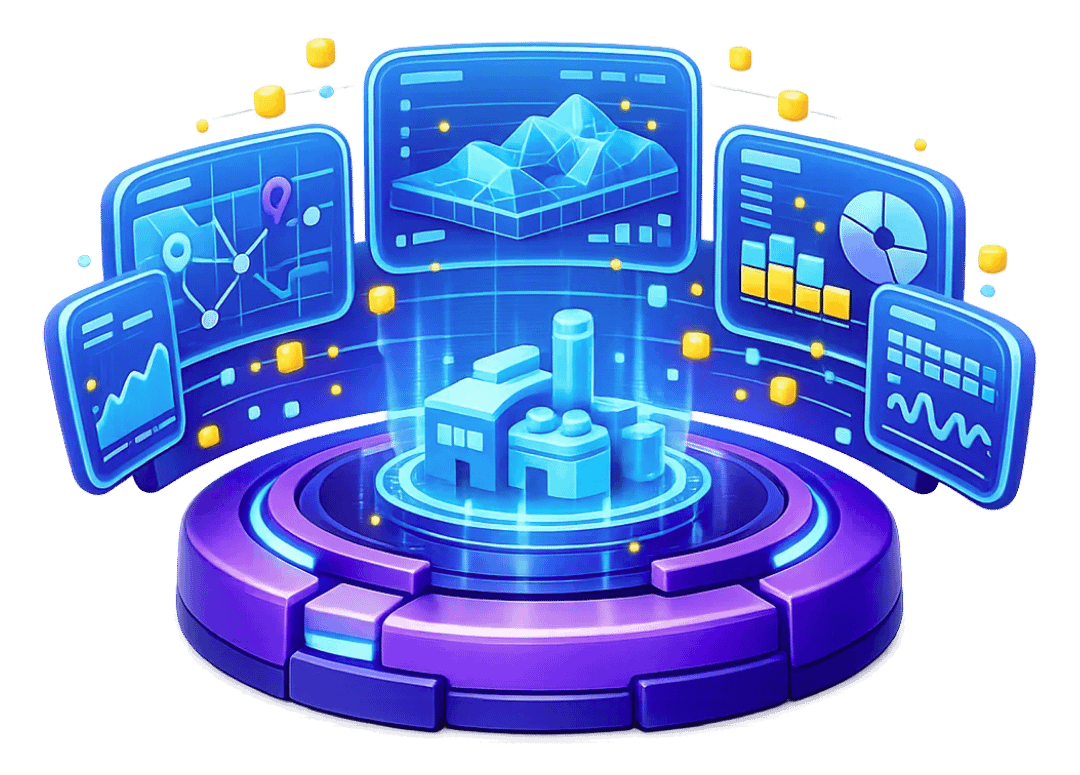
Create interactive digital twins that mirror real-world assets, spaces, and equipment in mixed reality. Our team builds pipelines that bring CAD/BIM models and sensor data into spatial computing environments – enabling inspection, simulation, and decision-making around factories, buildings, and field infrastructure in real time.

performance, safety &
deployment optimization
Ensure your mixed reality solutions run smoothly, comfortably, and safely in production environments. Our team profiles performance, tunes rendering and tracking, applies headset vendor safety and comfort guidelines, and prepares builds for pilot, staging, and full-scale deployment so MR experiences remain stable during extended use in the field.
why choose algoryte for
MR development?
spatial
computing
expertise
We understand how to leverage spatial mapping, environment reconstruction, and persistent anchoring to create MR experiences that genuinely understand and enhance physical spaces rather than simply overlaying graphics.
natural
interaction
design
Our MR interfaces prioritize intuitive hand gestures, voice commands, and gaze interactions that feel natural and comfortable during extended use – minimizing user fatigue and cognitive load inherent to headset-based computing.
cross-device
MR development
We build for Microsoft HoloLens, Magic Leap, Apple Vision Pro, Meta Quest, and HTC Vive platforms – implementing device-specific capabilities while maintaining consistent user experiences where possible.
performance
in complex
environments
We optimize MR applications to maintain frame rates and tracking stability even in challenging conditions – large spaces, dynamic lighting, reflective surfaces, and environments with multiple moving objects or people.
enterprise-ready
solutions
Our MR development process accounts for real-world deployment constraints, including device management, network requirements, multi-user scalability, content updates, and integration with existing enterprise systems and workflows.
curious how holograms
could work in your space?
our MR development
process
spatial requirements analysis
We evaluate your physical environment constraints, user mobility patterns, interaction requirements, and technical limitations – defining how MR experiences will function in actual deployment spaces with real lighting, surfaces, and spatial configurations.


interaction prototype development
Our team builds functional prototypes focused on core spatial interactions, testing hand tracking accuracy, gesture recognition, hologram placement, and environmental understanding before committing to full production – validating feasibility in target physical spaces.
3D holographic asset creation
We model, texture, and optimize all digital content for MR deployment – ensuring holograms render clearly at appropriate distances, respond correctly to environmental lighting detected by devices, and maintain visual quality while respecting performance constraints.


spatial computing implementation
We develop complete MR applications with environment scanning, spatial anchor persistence, multi-user synchronization, and interaction systems – building experiences that understand physical spaces and enable natural engagement with holographic content.
real-world testing & calibration
Our team conducts extensive testing in target deployment environments, evaluating spatial tracking accuracy across different room configurations, lighting conditions, and surface types – refining interactions and optimizing performance based on real-world usage patterns.


deployment & user training
We provide deployment documentation, device configuration guidance, spatial anchor setup for specific locations, and user training materials that prepare teams to use MR applications in their actual work environments effectively.
industries we have
worked with
manufacturing & industrial
Assembly guidance with holographic instructions on actual equipment, maintenance procedures with 3D exploded views, quality inspection with measurement overlays, and remote expert assistance with shared spatial context
architecture & construction
Life-size building visualization in actual sites, design review with stakeholders in physical spaces, construction progress tracking with digital twin overlays, spatial planning with scale models in real rooms
healthcare & medical
As mixed reality service providers specializing in healthcare applications, we deliver surgical planning with 3D anatomy overlaid on patients, medical education with interactive holographic models, rehabilitation exercises with virtual guidance in physical therapy spaces, and telemedicine with spatial context sharing
education & training
Hands-on learning with holographic demonstrations in classrooms, laboratory simulations with virtual equipment in real spaces, anatomical education with life-size models, and historical reconstructions anchored to physical locations
retail & real estate
Our mixed reality services for retail and customer experience enhancement include product visualization at actual scale in customer spaces, virtual showrooms with physical context, property staging with holographic furniture, spatial design consultation with clients in real environments
defense & aerospace
Mission planning with holographic terrain maps, maintenance training with equipment overlays, tactical coordination with shared spatial awareness, and simulation training in physical operational spaces
our MR tech stack
MR platforms


microsoft hololens 2
magicleap 2
HTC vive XR elite


meta quest 3
apple vision pro
development engines


unity
unreal engine
spatial computing


open XR
mixed reality toolkit (MRTK)


ARkit
ARcore
hand tracking

ultraleap
meta hand tracking SDK
holoLens hand tracking API
spatial anchors


azure spatial anchors
magic leap spatial anchors

meta spatial anchors
voice integration


azure cognitive services
unity voice commands
networking


photon
custom webRTC solutions
mirror
3D modeling


blender
maya


substance painter
3ds max
FAQs
Virtual reality immerses you in completely digital environments, blocking out the physical world entirely. Augmented reality overlays digital content on phone or tablet screens, but often lacks deep spatial understanding. Mixed reality (MR) combines both – using advanced headsets with depth sensors and high-resolution passthrough cameras to map your actual environment. This allows digital objects (holograms) to interact with real surfaces, hide behind furniture, and remain anchored in specific locations. MR devices understand room geometry and enable natural, hands-free interaction, making digital content feel like it genuinely coexists with your physical space.
We connect MR applications to your current systems through APIs, databases, and enterprise platforms. Holograms can pull live data from ERPs, CRMs, IoT sensors, and analytics dashboards – displaying real-time information spatially. We integrate with tools like Microsoft Dynamics, SAP, Salesforce, and custom internal systems so your MR experiences reflect current operational data. Authentication, user permissions, and data security adhere to your existing protocols, and changes made in MR can be written back to source systems for seamless, bidirectional workflows.
Apple Vision Pro uses visionOS with the RealityKit and ARKit frameworks for high-fidelity spatial computing. Meta Quest – powered by Meta Horizon OS and the Presence Platform SDK, which handles passthrough and spatial anchors. Samsung and Google Devices utilize the Android XR platform and the Jetpack XR SDK, allowing for seamless integration with existing Android ecosystems. Microsoft HoloLens – supported via the MRTK3 (Mixed Reality Toolkit), which is now an industry-standard, cross-platform framework. Magic Leap offers the Magic Leap SDK specifically for its optical see-through enterprise hardware. We primarily use Unity or Unreal Engine with OpenXR to build standardized applications that can run across multiple different headsets without rebuilding the core logic.

Modern MR devices achieve centimeter-level spatial accuracy and high stability through AI-driven scene understanding. Holograms remain locked to physical objects even as users move. We implement Persistent Spatial Anchors and Cloud Anchors, which allow digital content to remain in the same spot across different sessions and multiple users. While accuracy can be affected by low lighting or reflective surfaces, 2026 hardware utilizes advanced IR sensors and machine learning to maintain alignment in most professional and industrial environments.
Simple single-user experiences with basic interactions take 2-3 months, while complex multi-user applications with extensive spatial mapping and custom interactions typically require 4-8 months. The timeline depends on the complexity of holographic content, the sophistication of interactions, multi-user requirements, target device platforms, and enterprise system integrations. We’ll provide detailed estimates after understanding your specific requirements and deployment environments.
We differentiate through our spatial computing expertise and cross-platform development capabilities. Unlike firms focused on single platforms, we build for HoloLens, Magic Leap, Vision Pro, Quest, and Vive – while maintaining consistent experiences. Our enterprise-ready approach emphasizes production deployment, not just demos, with performance optimization for real-world environments and integration with existing business systems.
Absolutely. Algoryte develops games and provides comprehensive MR services across industries. We can help you compare how different MR headsets perform for gaming versus our enterprise solutions (training simulations, industrial visualization, healthcare applications). The core spatial computing technologies – real-time 3D rendering, spatial tracking, and hand/controller input – work similarly across use cases, but gaming demands higher performance thresholds. We evaluate headsets based on gaming-specific requirements like low-latency tracking (sub-20ms), immersive spatial audio, multiplayer synchronization, and sustained frame rates, then help you determine whether MR gaming aligns with your goals compared to traditional VR or other gaming platforms we develop for.