






One System for Different Leaderboards in Our Game
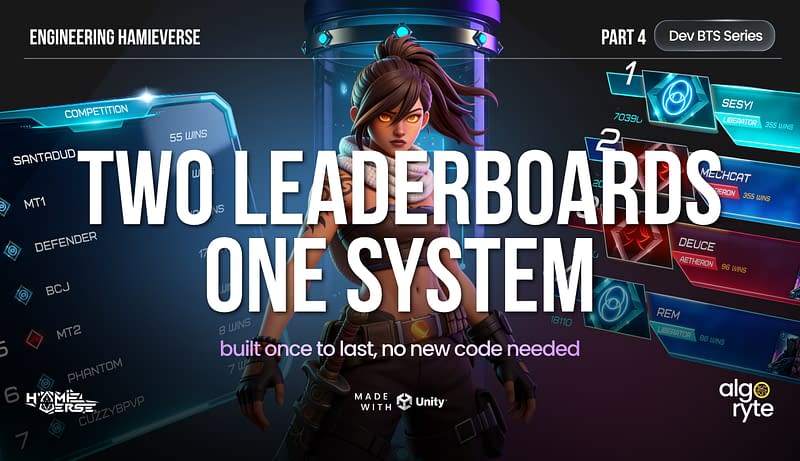
This blog covers how we built two leaderboards with one system in Hamieverse. In Pre-Alpha, Hamieverse’s leaderboard read directly from a single, all-time table — simple, but loading every player’s history at once isn’t convenient. Bounding the Cost As the player base grew, Alpha capped the display to the top 100, which bounded query costs […]
The Database Optimization Strategy Behind Our Game’s Scalability

Databases don’t usually get to change shape mid-flight. Hamieverse’s did — twice — without a single player noticing. Starting Simple, On Purpose Pre-Alpha read straight from the database with no caching. It was the right tradeoff for a handful of testers, and it bought us speed when speed was the only thing that mattered. A […]
How We Applied Clean Architecture in This Game
Every team building fast makes a decision they know isn’t permanent. Ours was linking Hamieverse’s UI directly to its game logic. A Calculated Shortcut In Pre-Alpha and Alpha, the priority was proving the concept fast. Linking the UI straight to gameplay logic meant no abstraction layer slowing us down, just quick builds and quick player […]
Fast Prototyping Without Sacrificing a Game’s Foundation: Our Approach to Building Hamieverse

When the Hamieverse team came to us, they needed one thing fast: a playable prototype. Wallet sign-in, a card collection, a store, and a leaderboard — enough for players to touch the game and validate the idea. Fast prototyping was the brief. What we built underneath it went further than that. Two Priorities, Running At […]
Meta Just Slashed More Than 1,000 Jobs & 3 VR Studios – Is This the End of VR-First Game Development?
Overview Meta’s VR Retreat Four years ago, Mark Zuckerberg changed Facebook’s name to Meta and declared the metaverse would be the next frontier of human interaction. He promised a billion users within a decade, hundreds of billions in digital commerce, and a VR-first future. On January 13, 2026, that vision took its most decisive blow […]
Gaming Industry Trends 2025: Nintendo Switch 2 Success, Indie Dominance & the AI Reckoning
Overview The $197 Billion Global Game Market The year 2025 saw the global games market reach a record-breaking revenue of nearly $197 billion, a healthy 7.5% increase over the previous year. This growth, however, signals less of an expansion and more of a crucial phase of market maturation – the industry is no longer just […]
Challenges We Overcame While Migrating From Unreal Engine 5.3 to 5.6
Overview What They Don’t Tell You About Unreal Engine Mobile Development Developing mobile games on Unreal Engine presents significant technical challenges that we encountered firsthand while developing a mobile game powered by Unreal Engine 5. Mobile game development on Unreal Engine is notoriously complex, demanding specialized knowledge of platform-specific requirements, rendering optimizations, and toolchain intricacies […]
GTA VI, Marvel 1943 & More – Why 2025 Became Gaming’s Year of Delays
Overview The Games That Defined 2025’s Delay Crisis GTA VI It suffered the most dramatic delay saga of the year, slipping twice from its original fall 2025 target. Rockstar first pushed the game to May 26, 2026, citing quality concerns and the need for additional polish. Then, in November, the studio delayed again to November […]
How to Teach Game Mechanics Without Breaking Immersion?
Overview Modern game design increasingly prioritizes teaching game mechanics through environmental cues, contextual prompts, and diegetic interfaces that maintain immersion rather than explicit tutorials that break player engagement, with subtle onboarding techniques particularly crucial in horror games where maintaining tension and atmosphere directly impacts the experience’s effectiveness. Excellent video games across all […]
Why Are Social-First Game Mechanics Becoming Fundamental to Modern Game Design?
Overview The Evolution From Single-Player to Social-First Gaming’s transformation from solitary entertainment to social platform happened gradually, then suddenly. Early multiplayer games treated social interaction as a bonus feature – useful for competition but not central to the experience. You played Doom or Quake with friends when convenient, but the core game existed independent of […]