





Overview
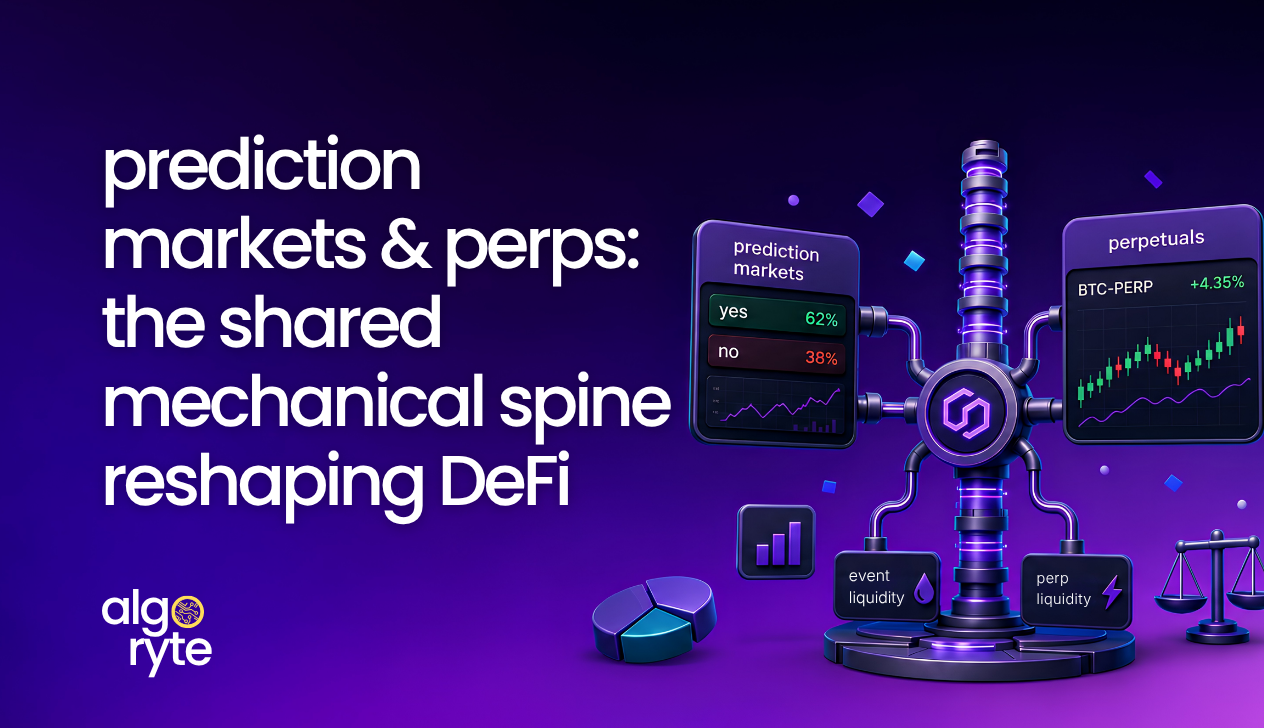
- Prediction markets and perpetual futures look like different products on the surface. Still, they share a common mechanical spine – a continuous price that updates with new information. While traditionally kept on track through either periodic funding payments (for perps) or final binary resolution (for prediction markets), these two settlement mechanisms are now actively merging.
- CFTC Chair Michael Selig’s January 29, 2026, statement on a forthcoming prediction markets rulemaking is pulling perps onshore, while prediction market venues are launching perpetual products, and perp venues are launching outcome markets. The result is one product category with two routes in.
The Core Logic Connecting Prediction Markets to Perps
If you have spent time on Polymarket, watching the implied probability of a political race tick up and down, you are already familiar with how a perp trader watches funding rates. Both interfaces show the same thing – a real-time estimate of an outcome, priced by people putting money on it. The wrappers differ (a yes/no resolution on one side, a continuous running price on the other), but the engine underneath is the same.
That is why the two categories are merging. The question for builders has shifted from which product to ship to whether the venue can host both, because resolution, oracle, funding, and liquidation engineering get harder when one matching engine has to serve both. Algoryte’s blockchain development team is building platforms that need to do exactly that.
What Are Prediction Markets & How Do They Work?
A prediction market is a venue where you buy and sell contracts that pay out based on whether a specific event happens. Each contract pays $1 if the event resolves ‘yes’ and $0 if it resolves ‘no’. The price of the contract between now and resolution is the market’s implied probability that the event will happen. A contract trading at $0.62 means the market is collectively assigning a 62% chance that the outcome resolves yes.
That is what separates prediction markets from polls or expert forecasts. A poll asks people what they think. A prediction market asks people to put money behind what they think, and being wrong gets expensive quickly. The financial discipline is what turns the price into a calibrated probability rather than a vibe check. Kalshi and Polymarket are the two venues that dominate the category today.
What Are Perps & How Are They Different from Dated Futures?
A perp, or perpetual future, is a derivative contract that lets a trader take amplified exposure to an asset’s price without an expiry. Traditional dated futures expire on a specific date and have to be rolled over. Perps solve this with a mechanism called the funding rate, a periodic payment between long and short holders that keeps the perpetual contract’s price tethered to the underlying spot price. If the perp trades above spot, longs pay shorts. If it trades below, shorts pay longs.
Perps were invented by BitMEX in 2016. By 2026, they dominate crypto derivatives. Hyperliquid is the largest on-chain perp venue today, and the funding-rate model that started on offshore venues is now the template for how onshore exchanges are bringing perps into regulated markets.
Why Are Prediction Markets & Perps Mechanically Cousins?
Once you strip the surface differences away, prediction markets and perps share a common spine:
- Continuous Pricing Engines: Both update second by second based on incoming information and the current order book.
- Settlement Mechanisms: Both end somewhere. A prediction market settles to $0 or $1 at resolution. A perp does not settle in the same way, yet the funding rate is essentially a continuous settlement, moving value between sides as the market evolves.
- Implied Expectations: A prediction market price is an explicit probability of a binary outcome. A perp’s price and its resulting funding rate carry an implicit expectation of market direction. A high positive funding rate means longs are paying a premium to maintain their positions, signaling aggressive collective demand for upside over downside.
- Unified Risk Engine: Both need a matching system, a margining model for leveraged participants, and an oracle or settlement source to anchor truth.
- Cross-Margining & Capital Efficiency: Both architectures increasingly rely on shared ledger states. Instead of forcing a trader to split capital across isolated venues, a unified architecture allows a user’s open, leveraged perp position to dynamically serve as the margin collateral backing an outcome market bet without friction or settlement delays.
This shared structural spine is exactly why the convergence is happening at the protocol layer – teams building these venues are running into the same infrastructure problems and reaching for the same answers.
| Structural Feature | Prediction Market Contract | Perpetual Futures Contract (Perp) |
| What You Are Trading | Real-world event outcomes (Yes/No) | Continuous underlying asset price exposure |
| Payout Target | Fixed binary outcome ($1.00 or $0.00) | Capped only by asset price movement |
| Price Tether Model | Final resolution date / Settlement | Funding rates (Periodic value swaps between traders) |
| Leverage Mechanics | None (Usually 1:1, capped risk at purchase price) | High leverage supported (Requires liquidation engines) |
| Primary Data Needed | Oracle resolution feeds (e.g., UMA, Validator sets) | Continuous spot price feeds (Mark prices) |
Why Now: The Legal Shift Forcing Prediction Markets & Perps Onshore
For most of the perps’ history, they lived offshore. BitMEX, Binance, OKX, Bybit, and others ran the format from non-US jurisdictions, and serious US-based exposure to crypto perps was practically impossible through regulated venues. That changed in 2025-2026.
On January 29, 2026, CFTC Chair Michael Selig gave his first public statement as Chair, directing staff to withdraw a 2024 proposed rule that would have restricted certain event contracts and to start work on a new event-contracts rulemaking, per the CFTC’s own press page.
- Kalshi already runs a CFTC-regulated event exchange.
- Polymarket acquired a smaller CFTC-approved exchange for a regulated US-facing arm alongside its offshore book.
The regulatory door cracking open is what is enabling the convergence to happen onshore.
The Convergence Is Happening in Two Directions
The shift is moving on two tracks at once:
Direction One: Product Expansion
Prediction market venues are launching perp products, and perp venues are launching prediction markets.
- Polymarket and Kalshi both announced perpetual futures products on the same day in April 2026, per CNBC, racing to bring high-margin derivatives into the US regulatory framework.
- Polymarket’s promotional rollout showed position multipliers from 7x to 10x on crypto, precious metals, and equities like Nvidia.
- Hyperliquid moved the other way, launching HIP-4 outcome markets on mainnet on May 2, 2026, per Bitcoin News, with zero fees on opening positions and binary contracts on US inflation data and Federal Reserve decisions.
Direction Two: Perpetual Prediction Markets
The deeper convergence is the perpetual prediction market itself – a contract whose price reflects the probability or state of an ongoing economic indicator with no fixed resolution date, settled via funding-rate-style payments rather than a single binary payoff at expiry.
For example, instead of betting on whether the Fed will raise rates this month (binary), traders buy or sell a perpetual contract tracking the long-term average inflation rate, where the funding rate continuously transfers value between longs and shorts based on how far the market price drifts from the actual monthly CPI oracle prints.
The engineering is within reach of teams that already run a perp DEX. Hyperliquid’s choice to embed outcome markets directly inside its existing perps and spot platform, with a single margin account and unified liquidity, is the architectural signal that this is where the category is heading.
The Major Players, Grouped by Where They Are Coming From
The teams coming from the prediction market side:
- Polymarket: Largest offshore prediction-market order book, with a CFTC-approved US arm acquired in 2025, launched perps in April 2026.
- Kalshi: CFTC-regulated event exchange, sports-heavy product mix, launched perps in April 2026.
The teams coming from the perp side:
- Hyperliquid: Largest on-chain perp venue, launched HIP-4 outcome markets in May 2026 using its own validator-based resolution rather than UMA.
- dYdX, BitMEX & Offshore Perp Venues: Still doing most of the global derivatives volume, watching the onshore shift closely.
The same names showing up in coverage of both categories is the clearest signal that the products are converging at the institutional level.
The Technical Architecture: Where the Platform is Built
For teams building or evaluating either product, the same five engineering problems dominate the build:
- Resolution Frameworks: Who decides if an event happened, and when? Polymarket leans on UMA’s optimistic oracle. Hyperliquid’s HIP-4 uses its own validator set, ingesting news and voting on settlement, per CoinDesk. The choice has compliance and liability consequences now being tested in regulated US markets.
- Oracles Architecture: Mark prices, funding inputs, and resolution sources depend on tamper-resistant data feeds. A multi-feed design with deviation thresholds and circuit breakers is now standard for serious perp DEX engineering.
- Funding Rate Mechanics: Both directions of the convergence need a continuous payment system between counterparties, with parameters that prevent manipulation under thin liquidity.
- Liquidation Engines: Margined contracts need a liquidation engine that handles 20% moves in seconds without cascading. The October 2025 flash crash, when leveraged positions across multiple venues were force-closed during a sharp depeg event, showed what happens when liquidation logic prices collateral on internal order books instead of manipulation-resistant external oracles.
- Collateral & Stablecoin Architecture: Choosing the underlying asset for a hybrid venue’s pools introduces deep risk variables. Engineers must build robust accounting systems that can safely toggle between yield-bearing stablecoins or isolated protocol stables. The infrastructure must accurately distribute auto-yielding rewards to margin accounts without throwing off real-time funding rate calculations or asset maintenance thresholds.
These are the building blocks Algoryte’s DeFi development services and smart contract development teams scope on every perp or prediction market engagement, because retrofitting them after launch is what kills protocols.
What Are the Risks & Criticisms Worth Taking Seriously?
The convergence raises real concerns that go beyond the usual crypto critiques:
- Manipulated Resolution: Both products live or die on whether the source of truth at settlement is tamper-resistant. Single-oracle dependence is a known failure mode.
- Sports & Compliance Drift: Sports is the largest single category on Kalshi by a wide margin, and Democrats on the US House Agriculture Committee have urged the CFTC to rein in prediction-market sports betting and insider-trading concerns. The line between event derivative and unlicensed sportsbook is being tested in regulators’ offices in real time.
- Retail Risk: Polymarket’s 7x to 10x position multipliers on perps push the product closer to the high-risk profile that drove crypto derivatives losses on offshore venues.
- Cascade Risk: Multi-product venues with shared margin and liquidity reduce friction for users but concentrate failure modes. One stuck oracle or one manipulated resolution can ripple across perps, predictions, and spot at once.
What’s Next?
Three threads worth watching:
- The CFTC’s rulemaking under Chair Selig will define what products can be offered onshore through 2026-2027, and whether sports-heavy event contracts stay in scope.
- The perpetual prediction market category will solidify, with at least one venue running it as a primary product.
- The engineering bar will rise as regulators and institutional capital demand audit trails, multi-feed resolution, and tested liquidation logic before trusting serious flow on a venue.
- The shift toward permissionless market deployment. The industry is moving away from purely venue-curated contracts to user-defined markets. The software engineering hurdle here will shift toward writing programmatic anti-manipulation and slasher frameworks – forcing contract creators to lock up significant native tokens that are burned automatically if resolution tampering is detected.
Conclusion
The convergence between prediction markets and perps is happening at the protocol level. Once you see the shared mechanical spine (continuous pricing, specialized settlement mechanisms, market-driven implied expectations, and cross-margined risk architecture), the question for builders becomes how to scope a single venue that can host both.
If you are scoping a perp DEX, a prediction market, or the hybrid increasingly emerging as the right answer for both, talk to our blockchain development team about the resolution, oracle, funding, and liquidation engineering before any code ships.
FAQs
1. What is a prediction market?
A prediction market is a venue where you buy and sell contracts that pay out based on whether a specific event happens. Each contract pays $1 if the event resolves yes and $0 if it resolves no, so the price between now and resolution is the market’s implied probability of the outcome. The price moves as new information arrives, and the financial incentive to be right is what makes it more accurate than polls.
2. What is a perp & how is it different from a regular futures contract?
A perp, or perpetual futures contract, is a derivative that lets a trader take amplified exposure to an asset without an expiry date. Traditional dated futures expire on a specific day and have to be rolled. Perps use a funding rate mechanism, a periodic payment between longs and shorts, to keep the perpetual contract’s price tethered to spot indefinitely.
3. What are the main platforms offering prediction markets with perpetual contracts?
The primary platforms leading this convergence are Kalshi and Polymarket, which both aggressively expanded into perpetual futures contracts alongside their core event markets. Additionally, crypto-native perpetual platforms like Hyperliquid have crossed over from the other direction, launching their own native outcome markets.
4. What are the core differences between event-based forecasting platforms and continuous derivatives?
Traditional event-based forecasting relies on binary outcomes that settle completely to a fixed value (like $1.00 or $0.00) once a specific real-world event occurs. Continuous derivatives, like perps, track ongoing asset price fluctuations indefinitely without a final expiration date. The former measures static probabilities, while the latter tracks fluid, real-time market sentiment.
5. Explain the concept of funding rates in non-expiring futures contracts.
Because perpetual contracts never expire, they use a built-in balancing system called a funding rate to keep the contract price pegged to the actual spot price. Every few hours, value is automatically swapped directly between long and short traders based on market drift. If the perp price is higher than the spot price, longs pay shorts; if it is lower, shorts pay longs.
6. How does leverage affect trading on perpetual swap exchanges?
Leverage allows traders to open much larger positions than their actual account balance by borrowing capital directly from the exchange’s liquidity pools. While this amplifies potential profits from small price movements, it equally multiplies losses. High leverage heavily increases risk, requiring robust, real-time liquidation engines to close positions before a user’s collateral drops below safety thresholds.
7. Can I use stablecoins to trade perpetual contracts in prediction markets?
Yes, stablecoins like USDC are the primary collateral asset used to back and settle perpetual contract trades on decentralized and international hybrid platforms. However, regulated onshore US platforms typically launch initial phases using fiat US dollars to satisfy strict compliance frameworks. They roll out stablecoin margins later as regulatory approvals permit.
8. How do prediction market perps integrate with DeFi services?
Hybrid platforms plug directly into the DeFi ecosystem by leveraging decentralized smart contract vaults, automated liquidity pools, and optimistic oracles like UMA. This infrastructure allows for advanced cross-margining, where your open perpetual positions can instantly back binary event bets. It unlocks extreme capital efficiency across an entire trading portfolio without requiring central intermediaries.
9. Can Algoryte help build a prediction market or perp DEX?
Yes. Algoryte’s blockchain, smart contract, and DeFi teams scope the resolution model, oracle integration, funding mechanics, and liquidation engine that decide whether a venue holds up under load. The focus is on getting the architecture right before launch, since the same engineering decisions show up in both products, and retrofitting them under stress is much more expensive.