




Overview
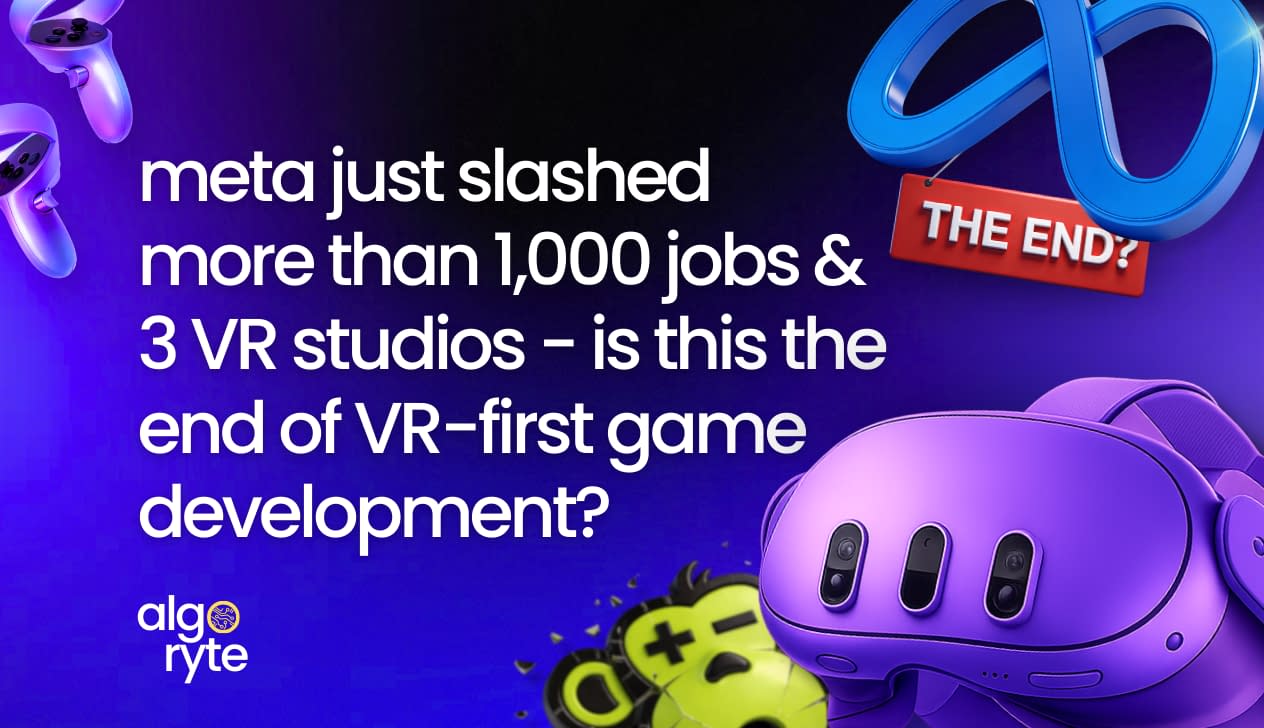
- In January 2026, Meta laid off approximately 1,000 employees and closed three internal VR game studios – Twisted Pixel, Sanzaru Games, and Armature Studio – marking a decisive retreat from first-party VR game development after experiencing significant losses.
- Meta is redirecting Reality Labs resources away from immersive VR headsets toward AI-powered wearables, specifically Ray-Ban Meta smart glasses, with production capacity targeting 20-30 million units by year-end – a clear signal that lightweight, socially acceptable AR has won over bulky VR hardware.
Meta’s VR Retreat
Four years ago, Mark Zuckerberg changed Facebook’s name to Meta and declared the metaverse would be the next frontier of human interaction. He promised a billion users within a decade, hundreds of billions in digital commerce, and a VR-first future.
On January 13, 2026, that vision took its most decisive blow yet. Meta laid off approximately 1,000 employees (10% of its Reality Labs division) and shuttered three internal VR game studios in a single day. What remains are just four active internal game studios – Beat Games, BigBox VR, Camouflaj, and Ouro Interactive.
After Reality Labs burned through $70 billion since 2020 and Quest sales declined for consecutive quarters, Meta has made its choice – VR-first content is out. The company is pivoting hard toward AI-powered wearables and Ray-Ban smart glasses, where production capacity is being scaled to 20-30 million units by year-end – a stark contrast to the 1.7 million Quest headsets shipped in the first three quarters of 2025.
What Got Axed
Meta’s announcement was swift and brutal. In a single wave, the company shuttered three studios that had delivered some of the Quest platform’s best-reviewed titles:
- Twisted Pixel: Released Deadpool VR just two months before closure – their biggest project and latest Quest exclusive.
- Sanzaru Games: Makers of Asgard’s Wrath – known for high-quality VR ports and exclusive content development since Meta’s 2020 acquisition.
- Armature Studio: Creators of Resident Evil 4 VR, widely considered the best VR port ever made and proof that AAA experiences could work in VR.
The closures didn’t stop there. Meta also killed Horizon Workrooms – the corporate VR collaboration platform Zuckerberg personally championed in August 2021 – effective February 16, 2026. The company is ending sales of enterprise Quest headsets and managed services entirely, gutting any remaining commitment to “VR for work.”
The Numbers Don’t Lie
Reality Labs has been bleeding money for years, but the scale is staggering:
Financial losses:
- $73 billion in cumulative losses since 2021.
- $4.43 billion operating loss in Q3 2025 alone.
Market performance:
- Quest headset shipments down 17% year-over-year in Q3 2025.
- Only 1.7 million Quest units shipped in the first three quarters of 2025 (16% decline from 2024).
Mark Zuckerberg reportedly told executives to cut up to 30% of Reality Labs spending and halt several projects entirely. The message was clear:
VR isn’t paying off, and the company can’t justify these losses anymore.
Where the Money Is Going Instead
While VR crumbles, Meta’s Ray-Ban smart glasses are taking off. Meta and EssilorLuxottica are in talks to increase production capacity from 10 million units to potentially 30 million by the end of 2026 – a direct contrast to declining Quest sales.
Meta’s new priorities are:
- AI-powered wearables and smart glasses.
- Mobile-first versions of Horizon Worlds (targeting Roblox’s 150 million daily users).
- Courting Roblox developers to build experiences for Horizon’s mobile app.
In October 2025, Meta announced capital expenditures would reach $70-72 billion in 2025, with “notably larger” growth planned for 2026 – but that investment is going to AI infrastructure, not VR hardware.
CTO Andrew Bosworth confirmed Meta would continue developing the metaverse but focus more on bringing AI tools to mobile devices rather than intensely developing VR headsets.
The Ripple Effect Across VR Development
Meta’s pullback is hitting third-party developers hard. The Quest platform has been the dominant VR distribution channel, and its app store was the primary way independent studios reached audiences. With Meta cutting first-party content and reducing platform investment, smaller studios are struggling:
- Mighty Coconut (Walkabout Mini Golf) laid off 25% of staff and raised DLC prices.
- Cloudhead Games (Pistol Whip) cut 70% of its team.
The concern isn’t just about Meta – it’s about the entire VR ecosystem losing its biggest benefactor. Without Meta’s massive R&D spending, hardware innovation slows. Without exclusive content funding, high-quality VR games become harder to justify financially.
What This Means for Game Studios
The VR market isn’t disappearing – it’s maturing. And maturity means different economics, different expectations, and different partners.
If you’re building for VR, XR, or mixed reality experiences, the strategy has fundamentally shifted:
What worked in 2021-2024:
- Chasing Meta exclusives and platform funding.
- Betting on mass adoption and “the year VR breaks through”.
- Building games that required VR-first design.
What works now:
- Platform-agnostic development across VR, AR, and flat screens.
- Enterprise applications where ROI is measurable.
- Hybrid experiences that work in VR but don’t require it.
The studios that survive this transition will be the ones that can build high-quality immersive experiences without depending on a single platform or betting on overnight mainstream adoption.
Building for the Reality of Immersive Gaming
At Algoryte, we’ve been developing games and immersive experiences across VR, AR, and traditional platforms by treating platform choices as tactical decisions, not religious commitments – we help studios build what works for their audience and budget.
We specialize in:
- End-to-end game development across mobile, console, and immersive platforms.
- Unity and Unreal Engine development with teams experienced in both VR optimization and traditional game mechanics.
- 3D art and asset creation that works across multiple platforms and form factors.
- Resource augmentation when your internal team needs specialized XR, game art, or development expertise.
Whether you’re pivoting from VR-only to multiplatform, exploring AR/MR opportunities, or need a partner who understands the realities of immersive development in 2026, we’re here to help.
FAQs
1. What are the reasons behind Meta closing its VR studios?
Meta closed three VR game studios – Twisted Pixel, Sanzaru Games, and Armature Studio – due to Reality Labs’ cumulative losses exceeding $70 billion since 2020, declining Quest headset sales (down 16% in 2025), and a strategic pivot toward AI-powered wearables like Ray-Ban smart glasses. The closures are part of a broader 10% reduction in Reality Labs staff as Meta redirects investment from VR content creation to AI infrastructure and AR wearables with higher market adoption potential.
2. Will Meta Quest headsets stop working after the studio closures?
No. Meta Quest headsets (Quest 2, Quest 3, Quest 3S) will continue functioning normally. The Meta Quest Store remains open, third-party developers can still publish games, and existing titles remain playable. Meta shut down first-party game studios and Horizon Workrooms (enterprise VR), but the consumer Quest platform, store, and ecosystem are still operational. The four remaining active studios – Beat Games (Beat Saber), BigBox VR (Population: One), Camouflaj (Batman: Arkham Shadow), and Ouro Interactive (Super Rumble) – continue supporting their titles.
3. How will Meta’s strategic shift affect the overall virtual reality market?
Meta’s pullback creates a “VR winter” scenario where third-party developers face reduced platform investment, less first-party content competition, and uncertain market stability. Smaller studios like Mighty Coconut and Cloudhead Games have already cut staff (25-70%) due to Quest’s declining sales and reduced visibility. However, this could benefit the VR ecosystem long-term by forcing realistic market expectations (treating VR as a profitable niche rather than a mass-market platform) and encouraging multiplatform development strategies instead of Quest exclusivity.
4. What happens to existing VR games and apps on Meta Quest after the studio closures?
Existing games remain playable and purchasable on the Meta Quest Store. Titles from closed studios like Asgard’s Wrath 2 (Sanzaru), Deadpool VR (Twisted Pixel), and Resident Evil 4 VR (Armature) will continue working, though future content updates are unlikely. Supernatural, Meta’s VR fitness app, stopped receiving new content but remains functional for existing subscribers. Third-party developers can still release new Quest games – the platform infrastructure isn’t shutting down; only Meta’s internal game development capacity has been dramatically reduced.
5. What are the top-rated VR headsets not affiliated with Meta?
Leading non-Meta VR headsets in 2026 include:
- Apple Vision Pro: Premium spatial computing headset with industry-leading display technology.
- Valve Steam Frame (2026 launch): Wireless standalone VR headset with PC streaming capabilities.
- PlayStation VR2 (Sony): Console VR for PS5 with strong exclusive titles.
- HTC Vive XR Elite: Enterprise-focused mixed reality headset.
- Pico 4 (ByteDance): Popular in Asia and Europe, comparable to Quest performance.
These alternatives offer different ecosystems, pricing tiers, and content libraries independent of Meta’s platform decisions.
6. What is the long-term outlook for virtual reality adoption given Meta’s retreat?
VR is shifting from the “next big platform” to a sustainable niche market. Industry analysts confirm average consumers aren’t interested in wearing bulky headsets for extended periods. VR’s future likely resembles gaming consoles (a dedicated enthusiast audience) rather than smartphones (mass adoption). This means higher-priced games, smaller but passionate audiences, and a focus on specific use cases like enterprise training, simulation, and enthusiast gaming. Realistic projections suggest profitable stability rather than explosive growth, with AR wearables (smart glasses) capturing mainstream adoption instead.
7. How does Meta’s VR pivot affect the augmented reality market?
Meta’s shift accelerates AR adoption by redirecting $70+ billion in annual capital expenditure toward Ray-Ban smart glasses and AI-powered wearables. Production capacity for Ray-Ban Meta glasses is scaling to 20-30 million units by the end of 2026 – far exceeding Quest’s 1.7 million units shipped in three quarters of 2025. This validates the AR wearables market and pressures competitors (Snap, Samsung, Google, Apple) to accelerate their own AR glasses development. The message is clear: lightweight, socially acceptable AR has won consumer preference over immersive VR headsets for mainstream adoption.