

Overview
- A well-crafted game loop is essential for player engagement, providing a continuous cycle of action, feedback, reward, and motivation that keeps players invested over short and long periods.
- Successful game loops combine immediate satisfaction with meaningful progression, balanced challenge, and variety, creating addictive gameplay experiences across different game genres.
Introduction
Have you ever considered why you tell yourself “just one more turn” in Civilization, or why Diablo players spend hours grinding for better loot? The answer lies in one of game design’s most fundamental concepts, i.e., the game loop. This repeating cycle of actions is the invisible engine that powers player engagement, transforming simple game mechanics into compulsive, satisfying experiences.
A well-designed game loop is the difference between a game players abandon after ten minutes and one they can’t put down for hours. Whether you’re developing a mobile puzzle game, an expansive RPG, or a competitive multiplayer shooter, understanding how to craft and refine your game loops is essential to creating memorable, engaging experiences.
What is a Game Loop?
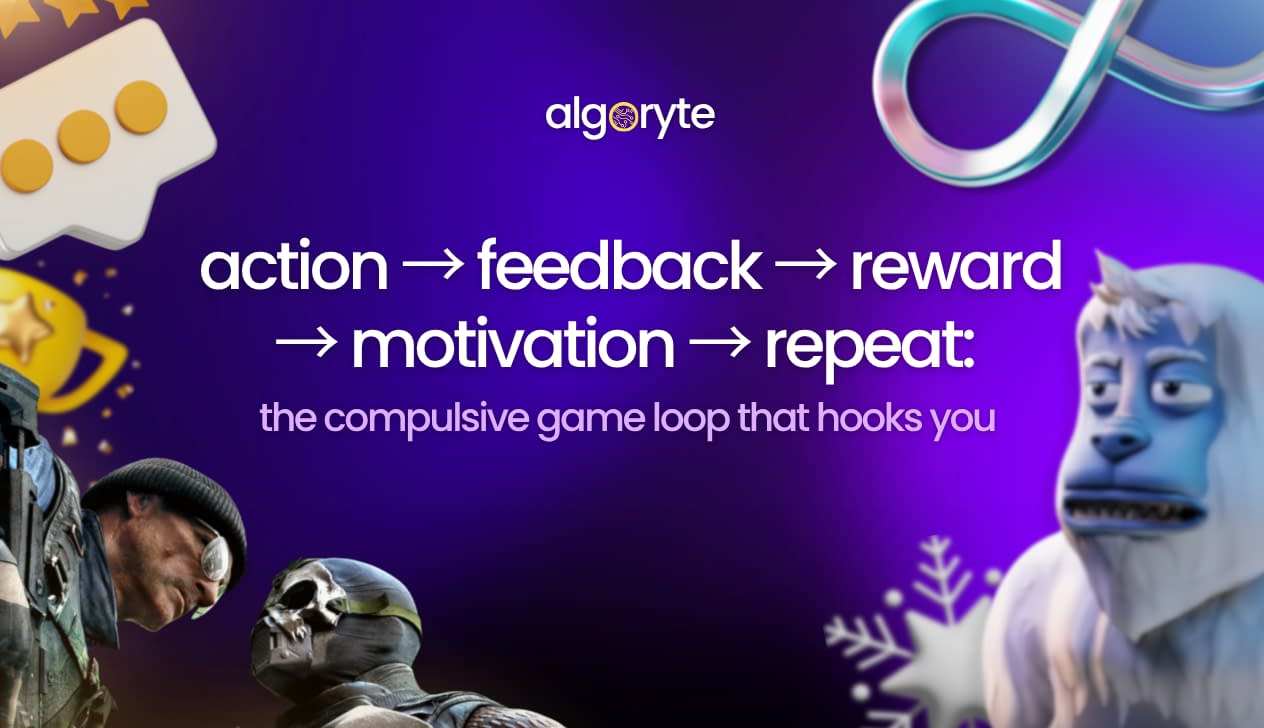
A game loop is the repeating cycle of actions that players perform throughout their gameplay experience. Think of it as the heartbeat of your game – the fundamental rhythm that players fall into as they play. At its core, a game loop follows a simple pattern:
Action → Feedback → Reward → Motivation → Repeat
For example, in a basic shooter game, you aim and shoot (action), see damage numbers and enemy reactions (feedback), collect ammunition or points (reward), spot the next enemy (motivation), and repeat the cycle. This loop might occur dozens of times per minute, creating a satisfying rhythm that keeps players engaged.
When players describe a game as “addictive” or having “great gameplay,” they’re often responding to a well-crafted loop that balances challenge, reward, and the compulsion to continue.
Types of Game Loops
Understanding the different scales of game loops helps developers create layered experiences that engage players on multiple levels simultaneously:
1. Core Loop (Primary Gameplay Cycle)
The core loop is the fundamental 30-second to 5-minute cycle that players repeat most frequently. This is what players spend the majority of their time doing. The core loop must be immediately satisfying because players will experience it hundreds or thousands of times.
In Call of Duty, the core loop is: spawn → navigate → engage enemies → eliminate/die → respawn.
In Stardew Valley, it’s: plant crops → water → harvest → sell → buy seeds.
2. Meta Loop (Long-term Progression)
The meta loop operates on a much larger scale, typically spanning hours or entire play sessions. It provides long-term motivation and a sense of progression beyond individual actions. Live service games often use seasonal meta loops where players work toward battle pass rewards or ranked progression over weeks or months.
In RPG making, this might be: complete quests → level up → unlock new abilities → access new areas → face tougher challenges.
3. Micro Loop (Moment-to-Moment Actions)
Micro loops are the smallest, most frequent interactions, often occurring multiple times per second. These loops contribute to the feel of your game and must be polished to perfection since they occur so frequently.
In a fighting game, each move, block, and counter forms a micro loop.
In a platformer, jumping and landing create a satisfying micro loop.
4. Nested Loops
The most engaging games stack these loops together strategically.
A roguelike like Hades demonstrates this beautifully, where micro loops of combat encounters nest within core loops of dungeon runs, which feed into meta loops of unlocking permanent upgrades and advancing the story. Each layer reinforces the others, creating a compelling experience that works on multiple timescales simultaneously.
Elements of a Successful Game Loop
Creating a game loop that players find irresistible requires careful attention to several key elements that work together to create engagement:
1. Immediate Feedback & Satisfaction
Every action in your loop should provide clear, immediate feedback. When players press a button, they need to see, hear, or feel the result instantly. Visual effects, sound design, screen shake, and haptic feedback all contribute to making actions feel impactful.
2. Clear Goals & Objectives
Players need to understand what they’re working toward at every moment. Ambiguity kills engagement. Whether it’s “defeat 10 enemies,” “reach the extraction point,” or “craft a diamond sword,” clear objectives guide players through the loop and provide direction.
3. Meaningful Progression
Rewards within the loop must feel valuable and impactful. Progression can be numerical (levels, stats, currency), mechanical (new abilities, items, tools), or narrative (story reveals, character development). The key is ensuring that completing the loop genuinely changes something about the player’s capabilities or understanding.
4. Balanced Challenge & Reward
The loop should exist in the flow state’s sweet spot – challenging enough to require attention and skill, but not so difficult that it becomes frustrating. As players improve, the loop should naturally scale in difficulty while also providing better rewards.
5. Variety Within Repetition
Even though players repeat the same basic actions, successful loops introduce variation to prevent monotony. This might come from randomized elements (different enemy types, procedurally generated levels), player choice (multiple strategies or loadouts), or gradual evolution (new mechanics introduced over time). The familiarity of the loop provides comfort, while variation maintains interest.
6. Compulsion to Continue
The best loops create a psychological pull to repeat “just one more time.” This comes from several factors, such as rewards that are almost within reach, curiosity about what comes next, the satisfaction of mastery, or the desire to improve performance.
Algoryte’s Expertise in Developing the Game Loops in RPG Making & the RTS/SLG Game Genre
Yetiverse
Yetiverse is an RPG play-to-earn Web3 game where the core game loop revolves around playing minigames and completing daily tasks to earn in-game currencies such as icicles and snowflakes. Players use these currencies to purchase loot boxes containing randomized clothing items, with the option to mint these items as NFTs.
The game also features an open-world metaverse lobby where players can socialize through chat, explore various locations, engage in minigames, complete daily challenges, and both earn and spend icicles, fostering a dynamic and immersive multiplayer experience centered around collecting and upgrading RPG weapons and gear.
Crown of Khosrow
Crown of Khosrow (available to play on Google Play & App Store) is an RTS/SLG title with an isometric game perspective, rooted in the historic 7th-century clash between Arabs and Persians. At its core, the game’s loop blends strategy and progression, where players complete daily objectives such as launching attacks on AI-controlled militant bases, defending their territories from enemy raids, upgrading buildings and heroes, and gathering essential resources within set limits. This continuous cycle of conquest, defense, and growth ensures players remain challenged while steadily advancing their empires, much like games like Clash of Clans.
Common Game Loop Mistakes
Even experienced developers can fall into traps that undermine their game loops. Here are the key pitfalls to avoid:
1. Too Much Friction Between Loop Iterations
Excessive loading screens, unskippable animations, convoluted menus, or unclear next steps kill momentum. Players should flow smoothly from one loop iteration to the next.
2. Unclear Feedback or Goals
If players don’t understand what they’re supposed to do or whether they’re succeeding, the loop breaks down. Every action needs a clear cause and effect, and every goal should be explicitly communicated or intuitively obvious.
3. Rewards That Don’t Feel Meaningful
Numbers going up isn’t inherently satisfying. A “+1% damage” upgrade feels meaningless compared to a new ability that changes strategy. Ensure progression is perceptible and impactful, not just theoretical.
4. Loop Becomes Too Repetitive Without Variation
Even satisfying actions become tedious with enough repetition. The loop needs to evolve through new elements, challenges, or player-driven experimentation to maintain interest.
5. Poor Pacing & Mastery Curves
Loops can be too fast (overwhelming) or too slow (boring). The rhythm should match your game’s intended experience and respect player time. Additionally, difficulty should scale with player skill to maintain the flow state – neither frustrating newcomers nor boring experienced players.
Practical Tips for Developers
Here are concrete, actionable recommendations for implementing these concepts in your own projects:
- Start with Your Core Loop Before Expanding: Polish the first 30 seconds of gameplay until they feel amazing before building progression systems, story content, or multiplayer features.
- Polish the Feel of Repeated Actions: Since players will perform core loop actions thousands of times, invest disproportionately in making them feel perfect through fine-tuned animation timing, audio feedback, visual effects, and responsiveness.
- Use Analytics to Track Loop Completion: Instrument your game to measure completion rates, stuck points, and phase timing to reveal problems that aren’t obvious during development and make informed design decisions rather than guessing.
- Don’t Add Complexity Before Mastering Simplicity: Master a simple, tight loop first and only add new mechanics when the existing loop feels completely polished.
- Study Games You Find Addictive: Whenever you catch yourself saying “just one more,” analyze what loop is driving that compulsion by breaking down the cycle of actions and understanding why you’re motivated to repeat it.
- Balance Instant and Delayed Gratification: Layer short-term rewards (responsive controls, clear feedback, quick rewards) with long-term goals (meaningful progression, unlockable content, narrative payoff) so there’s always something to work toward at multiple timescales.
- Respect Player Time & Attention: Cut unnecessary downtime and ensure every second in your loop feels valuable.
Conclusion
Mastering the art of game loops is crucial for any developer seeking to create captivating and enduring games. By carefully balancing instant feedback, clear goals, and meaningful rewards within an engaging and varied cycle, developers can create experiences that players return to repeatedly. From micro-interactions to long-term progression, the game loop is the heartbeat of gameplay, driving player motivation and satisfaction. Whether you’re working on an RPG, strategy game, or casual title, investing in solid game loop design will set your game apart and keep players coming back for more.
FAQs
1. What is the game loop of the most sold game ever?
The most sold game ever, Minecraft, features a core game loop of exploring, mining, and crafting. Players explore their environment, gather resources by mining, and then craft tools, structures, and items, which enables them to explore further and create more complex builds.
2. How does AI impact video game design?
AI in video games enhances player experience by controlling NPC behavior, adapting difficulty levels, creating dynamic content, and enabling smarter enemy tactics. It contributes to immersive, challenging, and personalized gameplay.
3. What are the main types of game loops?
Game loops are often categorized into micro loops (moment-to-moment actions), core loops (primary gameplay cycles), and meta loops (long-term progression and goals), each operating on different time scales to engage players.
4. Why is variation important in game loops?
Variation within repetition prevents gameplay from becoming monotonous. It keeps players interested by introducing new challenges, changing environments, or allowing multiple strategies, ensuring loops remain fresh and compelling.
5. What common mistakes should developers avoid when designing game loops?
Developers should avoid excessive friction between loop iterations, unclear goals, meaningless rewards, repetitive gameplay without variation, and poor pacing, as these factors can break player engagement and reduce retention.