Algoryte’s MCP development services design, build and run Model Context Protocol servers, gateways and clients that let LLMs and AI agents discover and use your enterprise systems through one standard. We build stateless servers to the current MCP specification, with OAuth 2.1 authorization, scoped permissions, approval for write actions and an audit log for every tool call.
what is Model Context Protocol (MCP)?
Model Context Protocol (MCP) is an open protocol that standardizes how applications provide tools and context to LLMs, without custom API code for each connection. An MCP server exposes a system once, and any MCP-compatible model or agent can discover what it offers and use it. Without a standard like this, LLMs stay disconnected from the systems your business runs on.
what are MCP development services?
MCP development services design, build, secure and host the MCP servers, gateways and clients that sit between your LLMs and your internal systems and data sources. They give models one pathway for every future integration and a stable foundation that scales as your AI capabilities grow.
Algoryte covers the full path: deciding which tools, resources and prompts to expose, building servers with the official SDKs, putting authorization and audit around them, migrating existing APIs, and connecting the result to Claude, ChatGPT, copilots and your own agents.
why do enterprises
need MCP?
Enterprises adopting LLMs need MCP (Model Context Protocol) because traditional software architectures create a massive bottleneck for AI. MCP serves as a secure, universal plug-and-play adapter that enables LLMs to safely discover, read, and act on enterprise data across fragmented systems.
comparison between API and MCP
Capability/
Dimension
Traditional Point-To-Point IntegrationsAPI
Enterprise MCP ArchitectureMCP
Primary Consumer
Deterministic Software Applications
Large Language Models (LLMs) and AI agents
Architectural Complexity
N Models x M System (Exponential upkeep)
N Models + M Systems (Linear, standardized)
Maintenance & Upkeep
Custom glue code for every new integration or API updates
Hard coded connections lock you into specific LLMs or platform
Decoupled layer allows seamless switching across LLMs (Claude, OpenAI, open-source)
our MCP development services
server engineering
and core protocol
MCP server design
Defining server capabilities, including executable tools, readable data resources, and standardized prompt templates, using structured schemas for reliable model interpretation.
custom MCP server development
Building secure backend connections that link databases, internal software, and enterprise applications to LLMs using the open MCP standard.
cloud deployment & scalable hosting
Deploying, hosting, and load-balancing your MCP servers on enterprise cloud platforms to ensure fast, reliable performance under heavy agent traffic.
stateless MCP server hosting
Building MCP servers where every call is a request carrying client info and protocol version parameters, allowing any server instance to handle requests across serverless compute platforms and load-balanced environments.
migration & modernization
Converting existing APIs, legacy webhooks, and custom middleware into standardized, reusable MCP infrastructure.
security, governance & observability
secure authentication & access control
Engineering secure credential management, user-level permissions, data masking, and runtime input validation to keep models within authorized operational limits.
audit logging
& observability
Setting up real-time tracking and logging so you can easily monitor every data request, executed action, and system event in full detail.
centralized MCP gateway & routing
Developing unified hubs to manage, monitor, and route traffic across multiple models and server networks, preventing infrastructure fragmentation as systems scale.
agent integration
& context layers
MCP model & interface integration
Connecting front-end applications, copilots, and user interfaces to connect seamlessly with custom MCP servers across platforms like Claude, ChatGPT, custom applications, or other open-weight, open-source, and frontier AI models.
custom MCP client development
Engineering existing tools through MCP configurations or building custom client agents to implement client-side features and real-time context updates for complete client-server feedback loops.
persistent memory & context layer integration
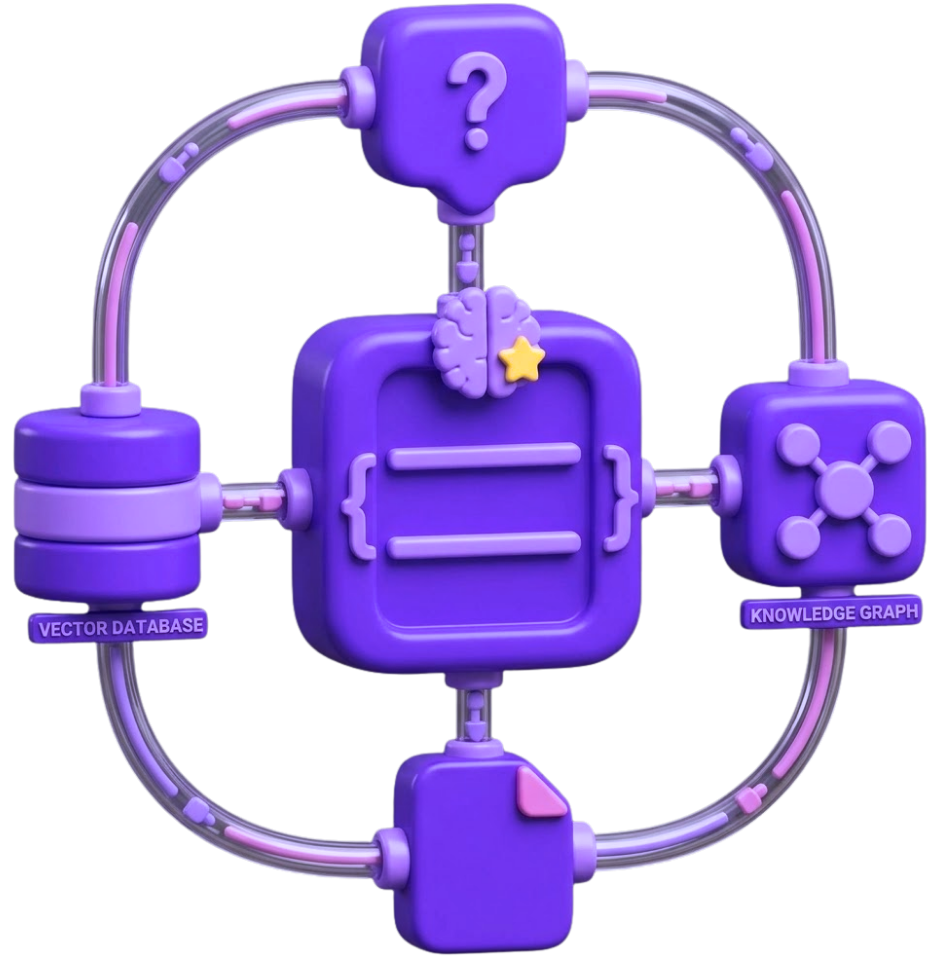
Connecting memory to vector databases and knowledge graphs so that our AI agents can use it appropriately for long-term context across user sessions.
how MCP works
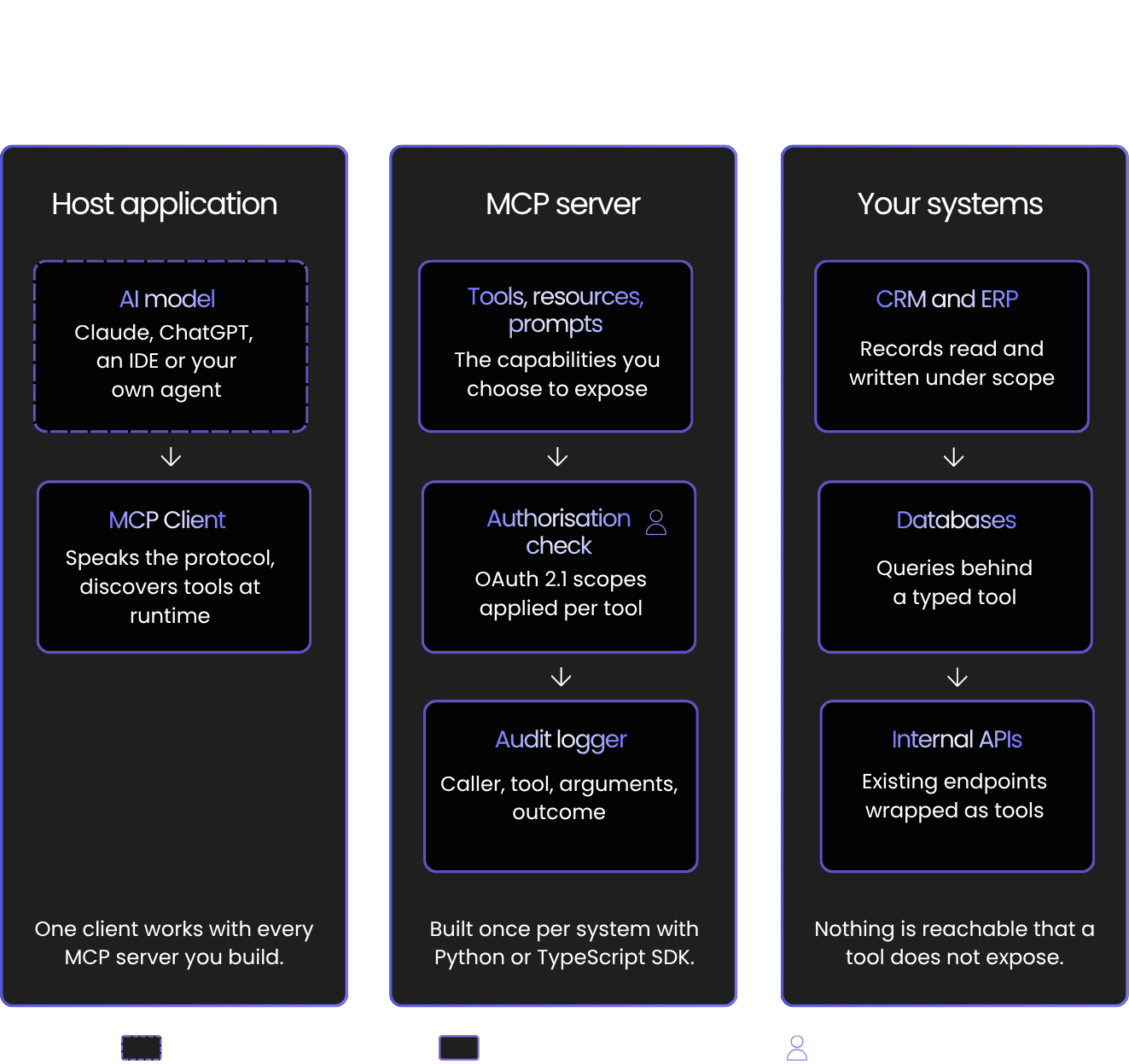
MCP works through three roles: a host application, an MCP client inside that host, and an MCP server that exposes a system. Every client speaks to every server the same way.
host
The host is the AI application: Claude, an IDE, a support console, or a custom agent. Inside it, an MCP client connects to one MCP server, and each request it sends stands on its own.
client
The client finds servers, asks the user to approve actions, and answers a server’s request for more input during a task through multi-round-trip requests, with new builds passing paths as tool parameters and calling models through the provider’s API.
server
MCP server wraps the target system and publishes tools (actions the model can invoke), resources (data the host can pull into context), and prompts (reusable task templates). It answers server/discover so clients can check what it supports.
capability discovery
Each request carries its own protocol version and client capabilities, and a client that needs to check a server’s features first calls server/discover. Requests travel over stdio for a local server or Streamable HTTP for a remote one, where Mcp-Method and Mcp-Name headers let gateways route and rate-limit them.
tool discovery
The client requests the tool list and receives a name, description, and JSON schema for each tool. The host passes that list to the model, which is how an agent learns what it can do without client-side code.
tool call with authorization
The model selects a tool and fills in the arguments. For write actions, the host shows the user an approval prompt, which is where human-in-the-loop control sits. The client sends the call with an OAuth 2.1 access token; the server validates it, checks that its scopes cover the tool, executes the call, and returns a structured result. If the server needs more input to finish, it returns a request for it, and the client sends the answer in a follow-up call.
logging
Every call is recorded with a request ID, caller identity, tool name, arguments, latency and outcome, then exported through OpenTelemetry to your observability stack, making an MCP deployment auditable.
Figure 1: How a host application, an MCP server and your business systems connect, with authorization and audit in between.
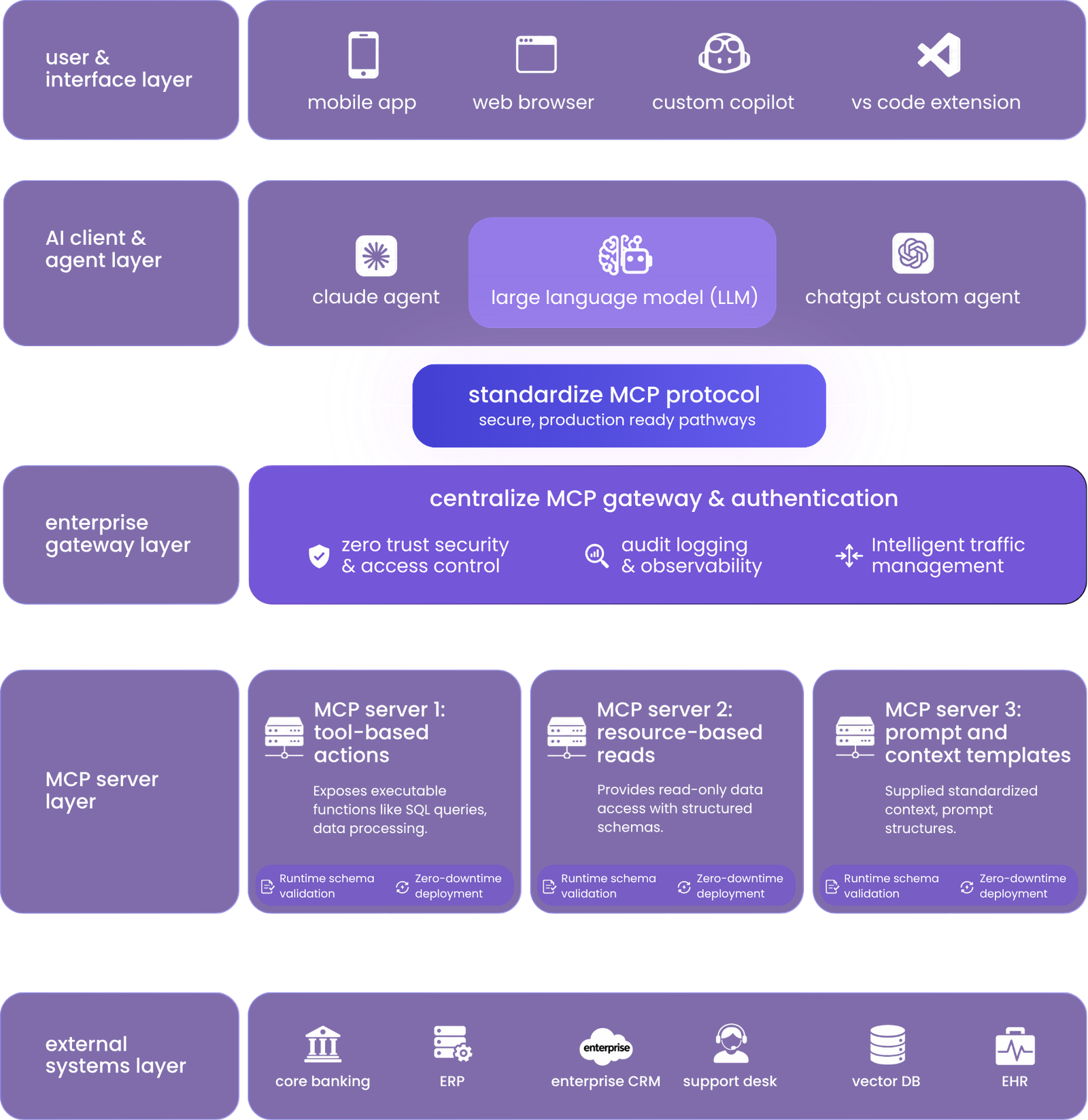
enterprise MCP architecture flowchart
Enterprise Model Context Protocol (MCP) Architecture Flowchart. This diagram illustrates the flow from end-user interfaces to secure backend enterprise systems, highlighting how a Centralized MCP Gateway standardizes and secures LLM connectivity while decoupling models from underlying data infrastructure.
our MCP development process
discovery & MCP architecture design
Auditing existing data stacks, mapping API dependencies, and defining strict operational boundaries to establish tool limits, schema designs, and human-in-the-loop escalation rules. We then decide what the server will expose as Tools (actions the model can take), Resources (data the host can pull into context), and Prompts (reusable task templates).
custom MCP server development
A lightweight microservice that sits directly in front of your applications and business tools, built with the official SDKs. We build to the 2026-07-28 specification: each request carries its own protocol version and client capabilities, and the server answers server/discover so clients can check what it supports.
transport mechanism
Choosing how clients reach the server: stdio for a local or desktop server, or Streamable HTTP for a remote server in the cloud or on-premises. Remote servers run stateless, with Mcp-Method and Mcp-Name headers on every request so gateways can route, rate-limit and log traffic. Servers still on the old HTTP+SSE transport are moved to Streamable HTTP.
agent & MCP client orchestration setup
The MCP client sits between the server and the model. It discovers the server’s tools, resources and prompts, and passes their names, descriptions and schemas to the model so the agent knows what it can do.
We build the client-side logic that connects custom agents and standard copilots to your servers. This covers approval prompts for write actions, multi-round-trip requests that let a server ask the user for more input during a task, paths passed as tool parameters, and model calls made through the provider’s API.
testing, debugging & security hardening
Testing tool permissions, data access limits, context accuracy, and system speed under heavy load, while running failure simulations, checking protocol compliance with MCP Inspector, and setting up audit logs to ensure compliance.
deployment & ongoing optimization
Deploying server infrastructure into enterprise environments, tracking runtime health through OpenTelemetry, and maintaining version control for evolving tool definitions. When the specification changes, we move servers off deprecated features within the deprecation window without accumulating technical debt.
why choose algoryte for MCP development
production-first security architecture
We build secure, production-ready MCP infrastructure with built-in protections such as zero-trust access, input validation, and real-time data masking to keep your company’s data safe.
modular & cross-model architecture
Our team separates internal data layers from the underlying LLMs. This decoupled framework allows your organization to switch, upgrade, or concurrently run multiple models (Claude, OpenAI, open-source LLMs) without refactoring any backend integration code.
multi-agent orchestration infrastructure
We establish unified MCP communication standards across multi-agent networks. By enabling specialized agents to securely query resources, share context, and execute cross-system tasks, our architectures prevent data leakage while eliminating custom point-to-point code.
precision schema & tool engineering
Hallucinations and failed tool calls usually stem
from vague prompts and schemas. We engineer high-precision JSON parameters and natural-language tool descriptions that translate complex business logic directly into model inputs.
zero-downtime system integration
Connecting custom MCP servers into active enterprise tech stacks (ERP, CRM, legacy databases) shouldn’t disrupt live operations. Our deployment framework leverages versioned APIs and blue-green strategies to guarantee continuous uptime throughout every rollout.
enterprise observability & management
We build full telemetry, centralized logging, and admin controls directly into your MCP network. By giving your team complete visibility into model activity, token usage, and server health, our architectures keep your AI operations transparent and easy to manage.
stateless, serverless-ready architectures
We engineer MCP servers using stateless connection protocols to eliminate session dependencies, making the protocol layer run on serverless cloud compute for instant auto-scaling and lower infrastructure costs while handling high volumes of simultaneous agent requests.
industries we serve
MCP development for healthcare
Connects LLMs directly to EHRs and clinical databases using standardized protocol contracts – replacing custom integration code to enable real-time patient record queries and safe administrative workflows.
MCP development for e-commerce & retail
Standardizes backend connections with reusable protocol endpoints that link AI models directly to inventory, ERP, and payment systems for real-time stock checks and automated order management.
MCP development for financial services & fintech
Unifies core banking platforms, risk feeds, and ledger databases under a single protocol layer for instant multi-system querying and automated transaction processing.
MCP development for education & edtech
Links learning platforms, gradebooks, and student databases to AI tutors through standardized protocol adapters – enabling live progress tracking and adaptive lesson adjustments.
MCP development for travel & hospitality
Unifies booking engines, live pricing feeds, and loyalty systems into a single tool, enabling AI assistants to query availability and execute itinerary updates in a single step.
MCP development for SaaS & software products
Converts platform APIs into reusable protocol endpoints – enabling embedded copilots to trigger multi-system, in-app workflows directly from simple user prompts.
MCP development for blockchain
Consolidates smart contracts, block explorers, governance forums, and decentralized indexers into standardized protocol endpoints – enabling AI agents to query on-chain data, analyze wallet activity, and execute secure transactions through unified protocol interfaces.
our engagement models for MCP development
dedicated talent for MCP engineering
Full-time technical experts integrated into your development cycles to build custom MCP servers, manage large-scale data routing pipelines, or architect complex application connections.
project- based MCP architecture
A ready-to-use, milestone-driven delivery covering everything from the initial data-source audit and schema design to a fully operational, context-aware communication bridge.
fractional MCP support
Time-bound, high-velocity engineering cycles used to solve specific performance bottlenecks, accelerate feature rollouts, or execute targeted technical upgrades.
sprint-
based MCP optimizations
Targeted, fast-tracked development cycles focused on accelerating response times, hardening data-permission boundaries, or quickly deploying new operational capabilities to your model.
MCP is the right choice when multiple AI clients need the same system, or when one AI client needs governed access to many systems. Signs that you are already there:
AI agents need to act in your systems to complete tasks.
Agents from different teams need the same system, each with its own results.
More than one AI tool needs the same data.
Integrations are being rebuilt for each vendor.
There is no audit trail of what AI tools access.
MCP is not the right answer for a single fixed integration with no agent in the loop. A regular sync between two systems is simpler and cheaper as a plain API call or integration platform job.
2. What is the difference between an MCP server and a standard API?
A standard API is designed for human developers who read documentation and write custom integration code for stateless endpoints. An MCP server acts as an AI-native translation layer that automatically exposes your systems as self-describing tools – allowing LLMs to discover capabilities and execute multi-step workflows dynamically.
3. What systems and software can be connected via MCP?
Almost any system with a readable or executable interface can be connected to an LLM via MCP. This includes SQL/NoSQL databases, internal software services, CRM platforms (such as Salesforce or HubSpot), enterprise software (such as ERPs or LMS), and third-party SaaS tools.
4. Do you need to know how to code to use an MCP server once it's built?
You do not need to know how to code to use an MCP server once it is built. Once an MCP server is deployed, end-users interact with it entirely in natural language through any MCP-compatible application (such as Claude Desktop, VS Code, or custom internal copilots). The AI automatically translates human prompts into the correct underlying technical operations.
5. How do MCP servers handle security and authentication like OAuth?
Remote MCP servers use OAuth 2.1. The client gets an access token for the signed-in user and sends it with each request, and the server checks that the token’s scopes cover the tool being called. Local servers that run over stdio use credentials from their environment. Write actions can also require user approval in the host, and every call is logged, so users and agents reach only the data they are authorized to see.
6. Can existing enterprise software be connected to MCP without rebuilding it?
Existing enterprise software can be connected to MCP without rebuilding it or changing your underlying software architecture. An MCP server acts as a lightweight wrapper that translates standardized protocol requests into calls to your existing backend endpoints, leaving your core business logic intact.
7. How does MCP differ from RAG and AI Agents?
MCP differs from RAG and AI Agents by serving as a completely distinct layer within the enterprise AI stack. RAG provides the unstructured knowledge memory, AI Agents handle reasoning and planning, and MCP provides the infrastructure that acts as the connection layer to safely execute actions across systems.
8. How do we ensure safe deployment of MCP servers for enterprise solutions?
For enterprise solutions, we ensure safe deployment of MCP servers by enforcing strict zero-trust access, runtime schema validation, and audit logging for every tool call. We provide consulting on MCP server development projects by designing these governance layers early in the architecture phase.
9. What options are available for organizations looking to outsource MCP development?
You can hire a specialist firm for the full build, add dedicated MCP engineers to your team, or bring in a partner for a fixed project or a short sprint. Algoryte offers four engagement models: dedicated talent, project-based delivery, fractional support and sprint-based optimization. Your internal team keeps ownership of the core product while we build and run the MCP layer.
10. How do you scale MCP infrastructure as usage grows across an organization?
MCP infrastructure scales horizontally because the protocol is stateless. Each request carries its own context, so any server instance can answer it, and containers or serverless functions scale behind a load balancer without sticky sessions. Remote servers use Streamable HTTP, the gateway routes and rate-limits by the Mcp-Method and Mcp-Name headers, and monitoring tracks latency and errors per tool.
11. Does Algoryte offer complete MCP development services?
Yes. Algoryte covers the full lifecycle: discovery and architecture design, server and client development, security and audit, cloud deployment, migration of existing APIs, and hosting and optimization after launch. You can engage us for a single server or for an enterprise rollout with a gateway and several servers.
12. What should we look for in an MCP development company?
Look for an MCP development company that builds to the current specification, designs tools and schemas around your business rules, puts security and audit in the first release, and can host and run servers after launch. Ask how they handle stateless hosting, permission scopes, versioning of tool definitions and migration of your existing APIs.
13. Can MCP servers be hosted on serverless infrastructure like AWS Lambda?
Yes. Since the 2026-07-28 specification, MCP is stateless: there is no session handshake, and each HTTP request carries its protocol version and client capabilities. Servers no longer need sticky sessions or a session database, so they run well on AWS Lambda, Azure Functions or Cloudflare Workers and scale with demand.
14. What is the difference between client-side and server-side MCP features?
Server-side features are what a server exposes: tools, resources and prompts. Client-side features are how the AI application uses them: discovering servers, asking the user to approve actions, and answering a server’s request for more input during a task. In the 2026-07-28 specification, the older client features for roots, sampling and logging are deprecated, so new builds pass paths as tool parameters, call models through the provider’s API and send logs to OpenTelemetry.
15. What changed in the MCP 2026-07-28 specification?
The 2026-07-28 specification made MCP stateless. It removed the initialize handshake and session IDs, added server/discover for capability checks, required Mcp-Method and Mcp-Name headers on HTTP requests, introduced multi round-trip requests for user input, and deprecated roots, sampling, logging and the old HTTP+SSE transport. Existing servers keep working during the deprecation window, and we upgrade them as part of migration work.
16. How long does it take to build an MCP server?
A focused MCP server for one system with a handful of tools typically takes two to four weeks, including schema design, security, testing and deployment. An enterprise rollout with a gateway, several servers and client integrations usually runs six to twelve weeks, depending on the number of systems and the approval rules involved.