





Overview
- While foundation models continuously evolve, production reliability depends on the surrounding architecture – spanning inference, runtime, observability, context assembly, and identity. It is called a harness.
- Securing enterprise AI relies on anchoring baseline security, governance, model hosting, and observability to Microsoft Foundry’s cloud platform, while building custom application code for the parts that decide how an agent behaves – orchestration and loop control, state and memory management, iterative context retrieval, and evaluation loops that validate each response and improve the agent over time.
Why Your AI Agents Need A Strong Harness
Building enterprise AI agents requires a clear boundary between raw model intelligence and operational architecture. As foundational LLMs rapidly evolve, production reliability ultimately depends on the surrounding harness – the inference, runtime, observability, identity, and context layers. While Microsoft Foundry provides a robust suite for core model management and platform controls, mission-critical applications require custom AI engineering, involving a precise balance between managed cloud services and custom application logic.
Algoryte bridges this gap with a hybrid engineering approach. We anchor our solutions to Microsoft Foundry’s infrastructure for enterprise security, tenant isolation, and OpenTelemetry observability, while engineering custom application controls where advanced orchestration demands precise execution. This gives enterprise clients the compliance backing of Microsoft Azure alongside the exact flexibility of custom software design.
The Enterprise Foundation Layer in Microsoft Foundry
Enterprise AI deployments require strict guarantees around security, auditability, data privacy, and model access. Microsoft Foundry satisfies these baseline requirements through its core platform layer. We rely on these stabilized components to manage the underlying compliance and operational controls:
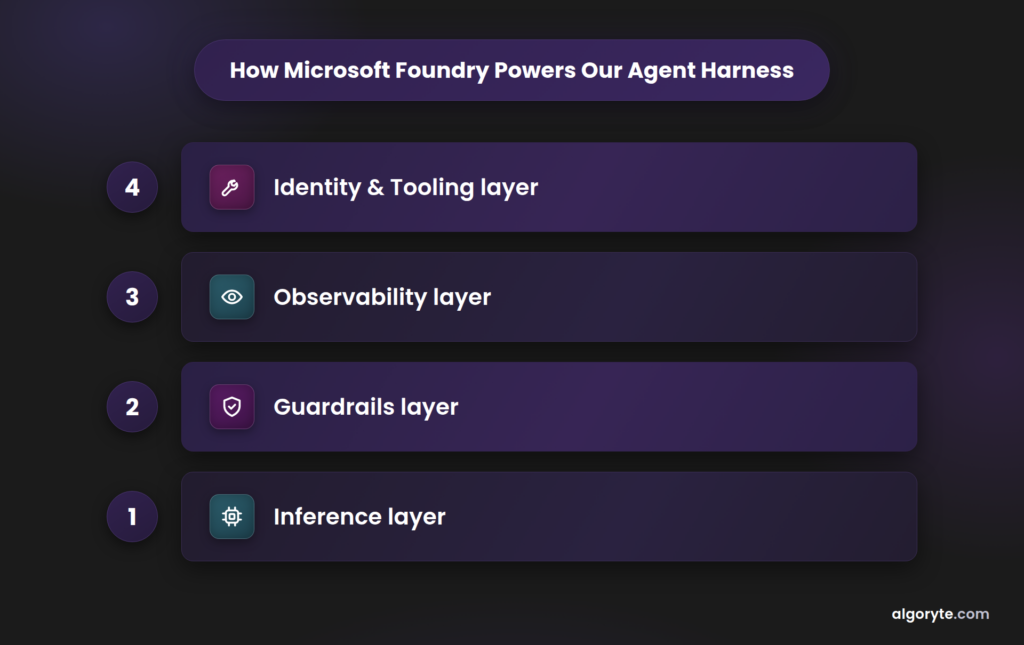
Inference Layer: Model Catalog & Direct Model Deployment
The core model hosting infrastructure within Microsoft Foundry is fully established. This layer allows developers to deploy direct-from-Azure foundation models, open-source models, and specialized industry variants with fixed runtime behavior.
We use Foundry’s core model endpoints to handle baseline inference tasks. As these endpoints offer stable API schemas and uptime guarantees, we route production traffic to them without risk of breaking output structures. We configure provisioned throughput and capacity options to match specific throughput and latency requirements – ensuring that model access remains deterministic across system components.
Guardrails Layer: Granular Security & Guardrails
Enterprise applications require safety controls that intercept unsafe prompts and malformed outputs before they reach critical systems. Microsoft Foundry centralizes security within a single Azure management scope.
This lets our team attach content filters, jailbreak defenses, and safety checks directly to the models an agent uses. Inbound prompts and model outputs are screened for unsafe or malformed content, thereby protecting proprietary data and supporting organizational compliance without custom middleware for basic safety validation.
Observability Layer: OpenTelemetry Observability
Monitoring distributed agent systems requires clear visibility into system bottlenecks, API latency, tool invocations, and token expenditure. Microsoft Foundry provides an open standard baseline using OpenTelemetry. We export these raw execution traces directly into Azure Monitor, giving infrastructure teams operational logging and cost-auditing visibility out of the box.
Identity & Tooling Layer: Tool Connections & Model Context Protocol Integration
Agents require external tools to interact with enterprise databases, line-of-business software, and third-party APIs. Foundry supports Model Context Protocol server connections and enterprise connectors within its standard tool integrations.
We leverage these tool connections to provide secure, schema-bound access to systems like Azure Logic Apps, databases, and custom REST APIs. As identity management and role-based access control are tied to Microsoft Entra ID at the subscription level, tool execution maintains tenant isolation and auditability.
Addressing System Complexity with Our Custom AI Engineering
Microsoft Foundry provides a comprehensive enterprise foundation – delivering secure model hosting, centralized safety guardrails, and production-ready operational management. To build deeply customized enterprise solutions on this foundation, complex workflows often benefit from custom application orchestration, specialized control logic, and state management that reflect an organization’s specific business logic.
To deliver resilient AI agents on top of this foundation, Algoryte pairs Foundry’s managed platform layer with custom application controls for orchestration and workflow execution:
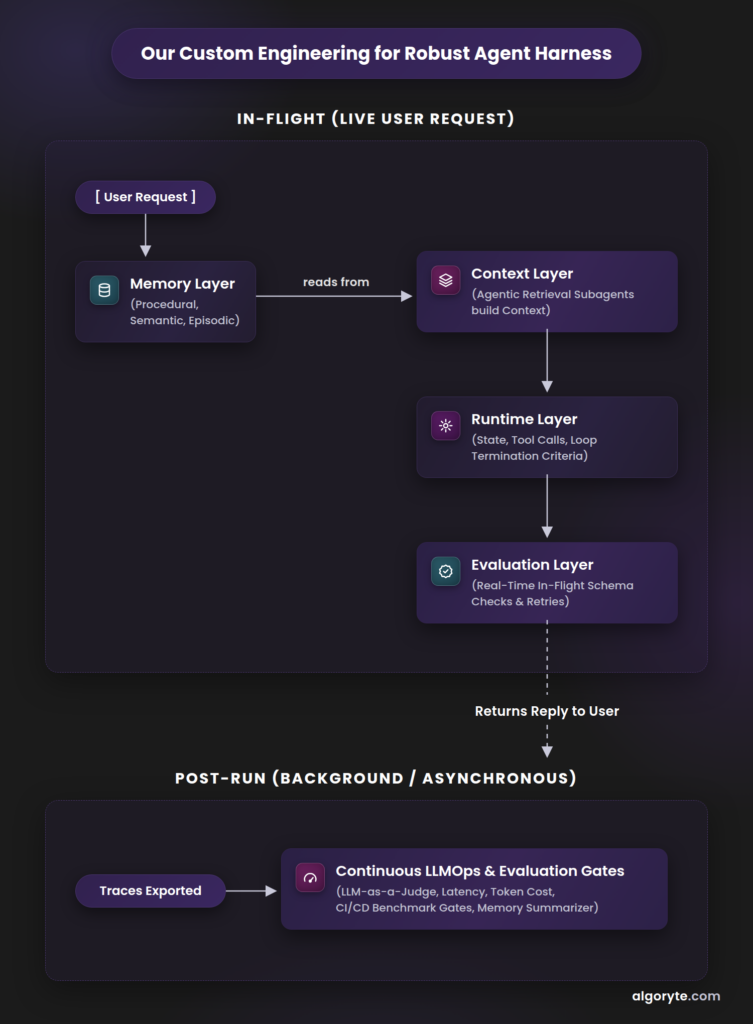
Runtime Layer: State Management & Loop Engineering
While Microsoft Foundry provides secure agent execution environments and model hosting, complex enterprise workflows require explicit code-level control. Algoryte writes custom code to maintain session state, manage database persistence, and execute isolated retry logic when tool calls fail. Keeping state management in standard application code ensures your orchestration logic remains easily testable, maintainable, and version-controlled alongside your existing microservices.
State is one half of runtime control, and knowing when to stop is the other. An agent works in a loop: reasoning, taking an action, reading the result, and deciding whether to go around again; without an explicit stopping condition, that loop can run longer than it should. Calling a tool it has already called, or continuing to search after it has enough to answer, are examples of the same failure – the agent looping on without a reason to.
We define the loop’s exit conditions in application code – a cap on how many times it may iterate, a check for whether what it has gathered is sufficient to respond, and a fallback that returns a clear answer when the agent cannot make further progress. Deciding when a result is good enough to hand back to the user is a judgment the surrounding code should own rather than something left to the model to settle on its own.
Context Layer: Agentic Retrieval Microservices
Simple vector searches often fail when answering complex enterprise queries. Rather than relying on single-pass lookups, we structure context gathering through dedicated retrieval subagents.
These subagents run multi-step search loops – evaluating initial search findings to refine follow-up queries until they compile a complete, verified data package. Offloading search logic to a separate retrieval service keeps raw, noisy database logs out of the main model’s context window – ensuring the primary LLM receives only clean, high-signal information.
Memory Layer: Procedural, Semantic & Episodic Stores
A retrieval subagent is only useful if there is something structured to retrieve from, and in practice, an agent’s memory is not a single store but several, each holding a different kind of information. What the model sees on any single turn is working memory: the assembled context of the system prompt, the current conversation, and whatever was retrieved for the request; that working set is temporary and rebuilt on every turn. Behind that working set sit the durable stores, each read in its own way:
- Procedural Memory: It holds the agent’s instructions and skills, the rules for how it should act.
- Semantic Memory: This holds durable facts and profile information in a vector store read through similarity search.
- Episodic Memory: This memory holds dated events and past conversations – kept in a mix of a vector store for relevance and a relational store for recency, so the agent can answer both what relates to a question and what happened most recently.
We write custom code to manage these stores, decide what is worth keeping, and keep them current, since a memory that is never updated slowly drifts out of step with reality. Left unmanaged, these stores also grow without bound and crowd the context window with noise, so a separate summarizer step running on a smaller and cheaper model periodically distills recent conversations into durable facts and folds them into long-term memory – running only after a set number of new exchanges rather than on every turn.
Evaluation & LLMOps Layer: Synchronous Control & Asynchronous Feedback Loops
When agents generate code, perform calculations, or extract structured data, accepting an unverified initial output risks downstream system errors. We implement deterministic feedback control loops directly within our application orchestration layer using explicit, rule-based evaluation rubrics:
Real-Time Output Validation (In-Flight)
When a Foundry model returns a response, application-side validation logic immediately executes JSON schema checks or unit tests against predefined compliance thresholds. If the output fails, the control loop programmatically constructs a revised context package, including precise error traces and failed parameters, and triggers a retry against the Foundry endpoint. Hardcoding strict retry limits at the application level prevents runaway recursive loops and keeps execution predictable and costs controlled.
Continuous LLMOps & Evaluation Gates (Post-Run)
The checks above validate a single response as it happens. Each agent run, from the user’s prompt through every tool call to the final response, produces one trace that records what was asked, what was retrieved, how many tool calls were made, how long each step took, and how many tokens each stage consumed. Those traces feed two separate questions:
- Continuous Evals: The first is whether the output was good – scored by a stronger model acting as a judge against the criteria we have defined.
- System Health Diagnostics: The second is whether the run was healthy – measured by latency, error rates, and token cost.
Read together, the two point to where and why a run went wrong.
When a fix is proposed – whether a revised system prompt, a different model configuration, a change to a tool, or an adjustment to how memory is retrieved – it passes through a gate rather than going live blindly.
The change is re-run against past cases and re-scored, and it is kept only if it improves those scores without regressing others; otherwise, it returns for another cycle of debugging, fixing, and testing.
Unifying Platform Infrastructure & Custom AI Engineering
Building production-ready AI agents centers on choosing the right boundary between managed cloud infrastructure and application code. Models will continuously be upgraded, but a resilient harness architecture remains constant. By grounding inference, identity, context protocols, and observability in Microsoft Foundry’s established cloud harness, Algoryte establishes a secure, enterprise-grade baseline. We complement this foundation with specialized software engineering – writing modular code to manage state and loop control, persistent memory, iterative context retrieval, and evaluation loops that both validate outputs and improve the agent over time.
This hybrid model reflects Algoryte’s core approach – giving enterprise clients the strict compliance, security, and infrastructure backing of Microsoft Azure, paired with the exact precision and control of custom software design. If you are looking to architect and deploy custom enterprise AI solutions, reach out to Algoryte to get started.
FAQs
1. What is Microsoft Foundry, and which parts are ready for production?
Microsoft Foundry is an enterprise AI platform in the Azure ecosystem for building, evaluating, deploying, and governing AI agents and applications – bringing model access, security guardrails, identity and access control, tool connectivity, and observability together within a single secure cloud boundary. Its core platform capabilities are generally available for production, including model hosting and deployment, Entra ID access control, model-level content safety, standard tool connections, and OpenTelemetry tracing into Azure Monitor. Some newer capabilities, such as multi-agent workflow orchestration, agent-level guardrails, persistent memory, and broader monitoring dashboards, remain in preview, where our custom engineering fills the gap.
2. Why does Algoryte build custom application code instead of relying on Microsoft Foundry alone?
Foundry gives a strong, secure foundation for model hosting, safety, identity, and tracing, and we anchor to it for exactly those guarantees. The parts that decide how an agent actually behaves, its orchestration, how it manages state, how it gathers context, and how its outputs are validated, benefit from explicit code-level control that reflects your specific business logic. Keeping that logic in standard application code also ensures it remains testable, maintainable, and version-controlled alongside your existing microservices, rather than relying on capabilities that are still maturing on the platform.
3. What is a retrieval subagent, and why not just use a single vector search?
A single-pass vector search often falls short on complex enterprise queries, where the answer has to be assembled from more than one place or the first search comes back thin. A retrieval subagent runs a multi-step search loop instead – evaluating what it finds, refining its follow-up queries, and continuing until it has compiled a complete, verified set of information. Running this as a separate service also keeps raw, noisy source data out of the main model’s context window, so the primary model receives only clean, high-signal input.
4. How does an AI agent’s memory work?
An agent’s memory is not a single store but several. Working memory is the temporary context the model sees on a given turn: the system prompt, the current conversation, and whatever was retrieved for the request. Behind it sit three durable stores: procedural memory for the agent’s instructions and skills, semantic memory for durable facts and profile information held in a vector store, and episodic memory for dated events and past conversations. We manage these stores in custom code and keep them current, and a periodic summarizer running on a smaller model distills recent conversations into durable facts, so the stores stay useful without crowding the context window.
5. How do you keep an agent from running too long or costing too much?
An agent works in a loop of reasoning and acting, and without a defined stopping condition, it can keep going past the point of usefulness, repeating work it has already done or continuing to search after it has enough to answer. We set the loop’s exit conditions in application code, including a cap on how many times it may iterate, a check to see whether it has gathered enough to respond, and a fallback when it cannot make further progress. This keeps execution predictable and costs under control, and it places the decision of when an answer is good enough in the surrounding code rather than leaving it to the model.
6. How do you know an agent’s output is correct, and how does it improve over time?
Two loops handle this. The first runs as each response is produced, where application-side validation checks the output against schema checks or unit tests, and, on failure, the system builds a corrected request and retries within a strict limit. The second runs at a slower cadence and improves the agent over time, drawing on the traces produced by every run. Each trace is scored two ways: whether the output was good, judged by a stronger model against defined criteria, and whether the run was healthy, measured by latency, errors, and token cost. When a fix is proposed, it passes through a gate, is rerun against past cases, and is kept only if it improves the scores, which lets the agent improve in a controlled and measurable way.