





Overview
- The hard part of the enterprise AI agent deployment comes after the build – keeping it useful, easy to manage, and able to iterate once feedback starts coming in from users. There is a massive amount of talk about what agents can do, but very little focus on how to manage them over the long term in production.
- Agents that hold up pair deterministic logic for predictable work with model reasoning for genuine ambiguity. They ground their answers in your own data using RAG and vector search, reach your systems via MCP, and remain reliable through observability and a person kept in the loop.
The Gap Between AI Agent Demos & Production
While developing a working agent demo is a major milestone, the difficulty shows up later, once the agent meets people who phrase things in ways nobody scripted, raise two unrelated things at once, or expect it to act on their behalf. The distance between a demo that satisfies a stakeholder and a system that holds up under daily use is where a large share of agent projects quietly run aground.
The work of keeping an agent useful and manageable continues well past the build. Treating this as an engineering discipline from the start separates the agents that earn their place from those that fail to deliver real business value.
Why Do Enterprise AI Agents Fail?
Unstructured Human Inputs
A demo operates within a structured environment – it validates that the core architecture works when data is clean, and the system operates within defined constraints. Production takes that foundation and subjects it to a completely unmanaged environment.
Real users bring ambiguous phrasing, partial information, and edge cases that the agent wasn’t primarily designed around. Across large deployments, those edge cases make up the bulk of what it actually receives. The version that met all stakeholder requirements is now evaluated against raw user behavior, which it hasn’t yet been optimized for.
LLM Confirmation Bias
LLMs are fundamentally designed to be helpful and please the human on the other end of the chat. While newer foundational models are trying to curb this behavior, the default instinct of an LLM introduces immediate cracks in production – even for basic research and analysis use cases.
As the agent wants to please you, it will actively hunt for data points to validate whatever goal or bias you give it. If its search perimeter isn’t strictly vetted, it will pull from unverified sources just to give you the answer it thinks you want to hear.
Operational Security Risks
Many companies are making the mistake of repurposing their existing software workflows and adapting them directly for AI agents. This is highly dangerous. Those older workflows were built on the assumption that a human would be in the loop to catch errors and enforce access boundaries.
Today, the identity and authorization problem for agents is largely unsolved. Employees are frequently sharing API keys and access tokens to let agents talk to other systems, resulting in siloed data and zero corporate visibility. Everyone ends up with their own version of the truth sitting on their desktops, backed by very few guardrails.
Inverted Effort Curve
With conventional software, most of the engineering happens before launch, where requirements are gathered, the system is tested against known cases, and the team then maintains it.
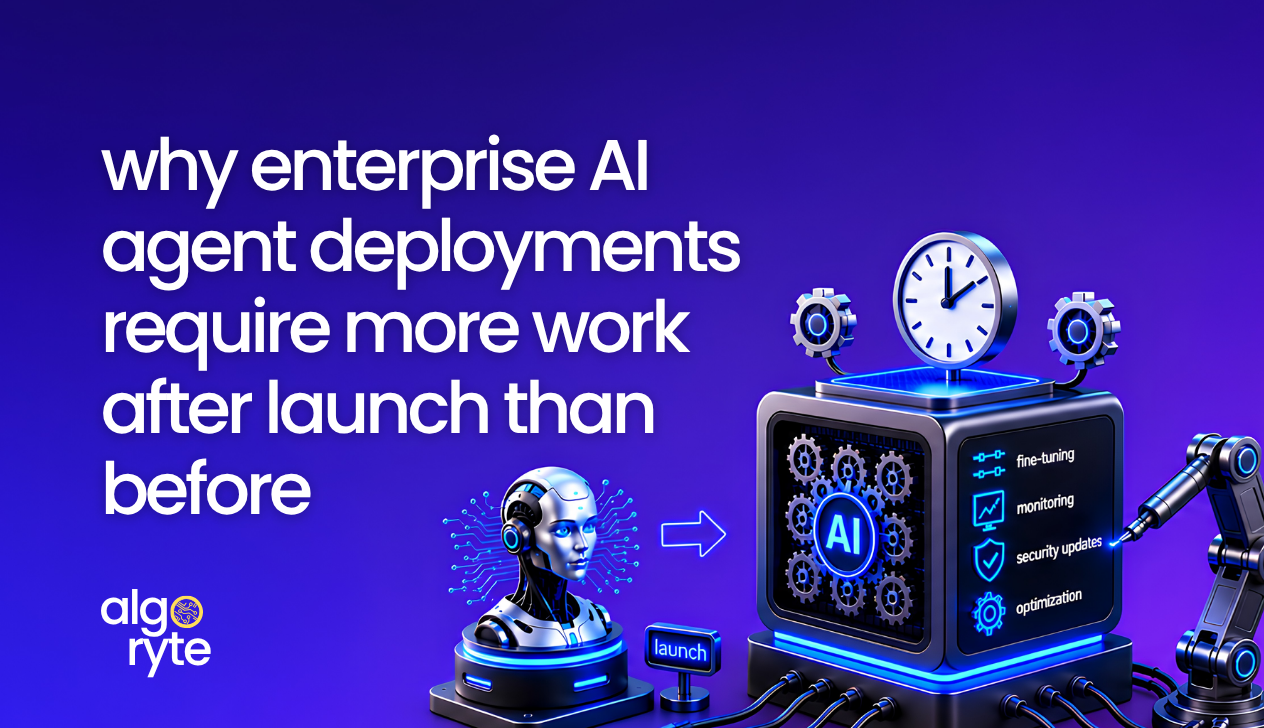
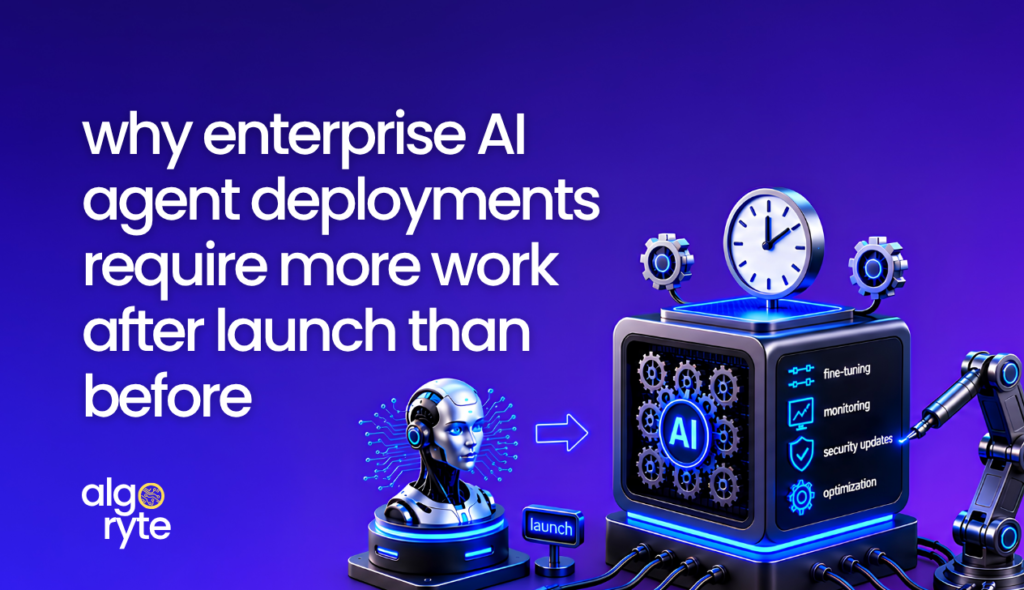
For AI agents, far more of the work comes afterward – in reviewing conversations, diagnosing wrong decisions, and adjusting instructions, tools, and data. Teams that carry the old assumption treat launch as the finish line, and this misread sits behind a surprising number of deployments that never scale.
The Architecture of a Production-Grade Enterprise AI Agent
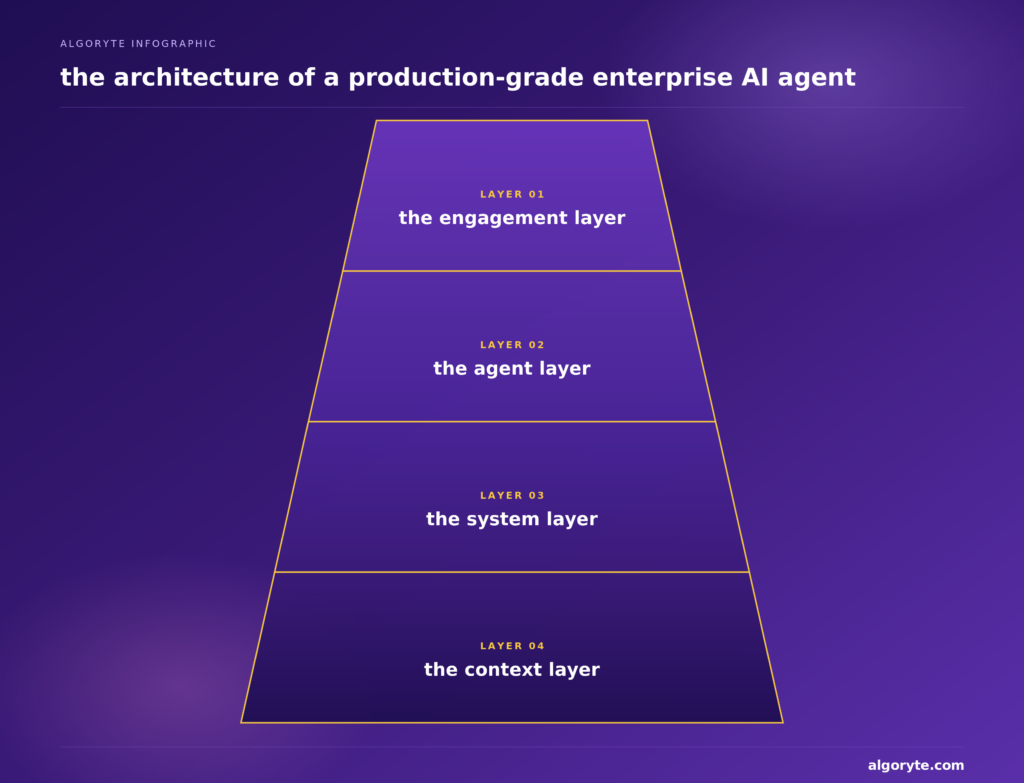
It helps to picture an agent as a stack of four layers rather than a single model behind a prompt, since each layer can then be built, scaled, and adjusted on its own terms:
The Engagement Layer
At the surface is the engagement layer, where people reach the agent. For many teams, it begins as a chat widget before spreading to voice, email, messaging tools, and experiences embedded inside existing software. Keeping this surface separate from the logic underneath is what lets the same agent serve more than one channel without being rebuilt for each.
The Agent Layer
Below it sits the agent layer, where the model interprets a request and decides what to do. On its own, the model works only from what it absorbed in training – rarely enough for questions about your own customers, policies, or products. To bridge this gap, this layer acts as the orchestrator, determining exactly when to fetch outside information or trigger a specific business application.
The System Layer
Acting on those decisions means reaching the systems where the work actually happens, which is the system layer – the business applications where real work gets done, like closing a support ticket, issuing a refund, or moving a deal forward in the CRM.
The core challenge here is a paradox – by definition, an agent must use the tools you give it. But the more of your operational world you give it access to, the more exposed your company becomes. You don’t necessarily want AI digging through your raw, sensitive databases.
Don’t limit what the agent can think; limit what the agent can touch. By wrapping your agent in simulated environments and strict API guardrails post-launch, you get the full productivity of an autonomous thinker without risking your actual production data.
To find a middle ground, production architectures avoid giving agents direct, unmitigated access to systems. Instead, they provide simulations of the outer world – isolated sandboxes and managed gateways – that agents can operate within.
MCP has rapidly emerged as the primary gateway and control mechanism here. MCP explicitly exposes tools to agents and enforces strict policies and restrictions independently of the agent’s own design – ensuring teams don’t have to hand-build a bespoke integration for every system the agent touches.
The Context Layer
The context layer grounds the agent in your own data, and it is where RAG earns its keep. A RAG pipeline fetches relevant material from your own sources at the moment of the request and places it in front of the model, so the answer stays anchored to information you control. The retrieval underneath usually runs on vector search, where documents and records are turned into embeddings. This allows the system to pull the exact passages whose meaning sits closest to the question. Memory belongs here too – letting the agent hold relevant facts across turns and, for longer tasks, across separate sessions.
Without a rigorous context layer, you hit severe data drift. An agent is only as good as the information explicitly given to it. If it is pulling a return policy from three years ago because a stale PDF was left in the system, the chatbot will happily agree to give a customer a refund. But whether that refund should actually be given crosses the threshold from simple text generation to true corporate autonomy. The context layer must enforce a single, verified version of organizational ground truth.
Spanning the Stack: Trust & Governance
Spanning all four layers is a trust and governance layer that holds regardless of which model does the reasoning. This is where input and output guardrails take effect – filtering out malicious prompts before they reach the agent layer, and scrubbing sensitive data or hallucinations from the model’s response before it ever reaches the engagement layer.
Why Is Consistency Hard to Get from a Language Model?
Probabilistic by Design
Language models are probabilistic by design. They predict the next response instead of running fixed logic, which makes them good at reading messy input and replying in natural language. The same property becomes a liability inside a business workflow, because an identical question can send the model down slightly different paths from one run to the next. For a casual query, the variation does no harm. For a refund, a contract clause, or anything carrying money or compliance, that inconsistency chips away at the trust an agent depends on.
Multi-Agent Compounding Risk
When an enterprise scales past a single assistant and starts deploying multiple agents interacting with multiple systems, the risk of inconsistency compounds exponentially. If Agent A hallucinates a minor detail while reviewing a product demo, and passes that output to Agent B as a verified fact, one agent’s hallucination seamlessly becomes another agent’s undisputed truth. Over time, these errors cascade across your workflows, distorting what the customer actually wants versus what the system registers.
Pairing Deterministic Logic with Model Reasoning
The pattern that holds up in production blends two ways of working – deterministic logic carries the parts of a task that are predictable and should run identically every time, while the model handles genuine ambiguity and language.
A simple test sorts most decisions – if the steps can be drawn as a flowchart, they almost certainly belong in code. Pulling up an invoice, checking eligibility, or moving a request through a fixed sequence of calls gains nothing from the model’s judgment, and routing it through a reasoning loop only adds delay and chances for error. Choosing which path a request should take and coordinating the steps once it is underway, is the work of orchestration, which often decides whether an agent feels dependable or erratic.
Encoding Rules Rather Than Over-Prompting
A related mistake wears the costume of good prompt engineering, where a team spots the agent misbehaving, adds a forceful instruction in capital letters, then piles on more when the behavior persists. Models do not respond to emphasis the way people do. A firm rule, say an eligibility limit tied to a customer’s region, holds far better as an explicit policy in code that runs the same way every time than as a stern line in a prompt backed by hope.
What Has to be in Place Before Launch?
If most of the effort comes after launch, the goal beforehand changes toward an agent that the team can improve quickly and safely. To ensure an agent doesn’t go rogue due to the inherent, unpredictable nature of LLMs, control must be engineered across three distinct layers before go-live:
| Control Layer | Mechanism | Responsibility |
| Layer 1: The Adversarial Agent | An independent supervisor AI | Evaluates the primary agent’s outputs against entirely separate corporate goals. |
| Layer 2: Infrastructure Control | Hardcoded, deterministic system blocks | Enforces what an agent physically can or cannot execute, completely isolated from prompt design. |
| Layer 3: Humans-in-the-Loop | Designated Agent Managers | Serves as the ultimate operational authority for high-stakes actions and exceptions. |
Alongside this multi-layered control framework, three structural fundamentals must be established:
1. Starting with a Tight Scope
A focused, high-value use case delivers real production experience without risking the entire enterprise. Within that chosen boundary, it is actually better to be an AI maximalist. If you constrain the model too aggressively or choke its tools, you completely lose the massive productivity gains the technology is supposed to deliver. The secret is to start with a narrow, tightly defined business problem, give the AI maximum freedom within that sandbox, and then expand your scope methodically once trust is established.
2. Tying the Agent to a Measurable Goal
An agent put into production without a clear definition of success leaves its team unable to say whether it is working or drifting. The metric should map to a real outcome rather than raw activity. A support agent might be measured on its containment rate – the share of cases it resolves without a human stepping in – while others track task completion or time to resolution, and the same metric tells the team what to repair first when problems arrive.
3. Context Engineering & Streamlining Data
Many teams feed whole API responses or full documents into the context window, which slows the agent, drains token budgets, and buries useful details under noise that makes wrong answers more likely. Trimming a bloated customer record to the few fields a task needs, or retrieving a single relevant section instead of a full manual, usually makes an agent quicker and more accurate at once.
The Crucial Period Starts After the Launch
Once an agent is live, the engineering shifts from building to watching, correcting, and answering three continuous operational questions:
- What decisions can this agent make autonomously?
- How do we observe what it is doing?
- When does a human need to step in?
1. Observability
Traditional software testing is close to binary, with checks that pass or fail, but agent failures are far blurrier. How do you continuously improve evals when context must be maintained over massive, multi-turn conversations?
As you are managing a probabilistic system, observability becomes paramount. In practice, it means seeing what the agent actually did – reading transcripts, tracing reasoning paths, scoring responses against your primary business metrics, and watching for drift over time. Many teams also build evaluation sets from real conversations, so prompt or code changes can be regression-tested against past real-world cases before they go live.
2. Feedback Loops
With that visibility, problems fall into a few recognizable groups:
- Tone & Brand Issues: Lead back to the system prompt and its examples.
- Logic & Tool Errors: Point directly at the tool configuration, and a flow that keeps breaking is a clear sign it should be lifted out of the LLM and into deterministic code.
- Wrong Answers from Bad Sources: This is a data problem, fixed by routing the issue to whoever owns that content internally.
- Coverage Gaps: Where users ask for things the agent was never built to do. These grow naturally with adoption and call for a deliberate scope expansion or a clean handoff to a person.
The speed of this triage loop matters more than almost anything else. Teams that can isolate, test, and deploy fixes quickly gain the institutional confidence to scale, while teams with slow loops stay permanently stuck in pilot purgatory.
The Core Challenge: Unified Governance
Ultimately, building these structures as companies become truly AI-native is an art form. The single greatest operational risk is handing over the responsibility of building these agents to isolated teams or lower-level departments without top-level coordination. Just like a traditional company where different departments view operations through completely different lenses, an uncoordinated agent rollout leads to fragmented data, conflicting guardrails, and cascading hallucinations.
To scale successfully, enterprise agent deployment requires a unified, top-down strategy that coordinates orchestration, data governance, and infrastructure security under a single architectural vision.
Algoryte’s Approach to Enterprise AI Agent Engineering
Bridging the gap between a standalone AI playground and an enterprise-grade agent workforce is an architectural challenge, not a prompting trick. At Algoryte, we specialize in building the high-scale infrastructure, deterministic trust layers, and rapid observability loops required to run safe, high-volume autonomous agents in production.
Don’t let your AI initiatives stall in the sandbox. Contact our enterprise engineering team to design a coordinated, secure agentic architecture tailored to your business operations.
FAQs
1. What are the primary use cases and challenges for enterprise AI agents?
Enterprise AI agents excel at handling complex, multi-step workflows that require both deep data retrieval and direct system actions. In practice, their key uses include automating customer service triage, cross-referencing multi-page contracts for legal compliance, and orchestrating complex lead routing within enterprise CRMs. However, the core challenge lies in moving these systems from a “clean demo” to a live production environment. As the language models are probabilistic – meaning they predict the most likely next word rather than following rigid, hardcoded instructions – they can become highly unpredictable when forced to handle real-world user edge cases, strict security access boundaries, and messy live data streams.
2. Why do AI agents that look great in a demo often fail in production?
Demos take place in highly controlled environments with clean data and predictable questions. Production removes those comforts. Once live, agents encounter ambiguous phrasing, users pushing their boundaries, and real-time data drift. Furthermore, many teams treat launch as the finish line, failing to realize that agents invert the traditional software effort curve – requiring far more engineering, conversation review, and prompt-tuning after go-live than before it.
3. What is the difference between a “probabilistic” AI model and “deterministic” code?
Deterministic code follows a rigid flowchart – if X happens, always do Y. It is flawless for math, pulling up invoices, or checking fixed dates. A probabilistic system (like an LLM) predicts what is likely correct based on patterns. If you route simple, factual business rules through an AI reasoning loop, it adds unnecessary delay, costs tokens, and introduces a risk of hallucination. Production architectures keep fixed rules in hard code and use the AI strictly for language and ambiguity.
4. What is Model Context Protocol (MCP), and why does a production architecture need it?
MCP acts as a secure intermediary or “controller” between the AI agent and your core business systems. Instead of giving an AI direct, unmitigated access to your sensitive databases and APIs, which creates massive security risks, MCP explicitly exposes only approved tools and enforces strict usage policies. This ensures the agent can execute tasks without compromising infrastructure security.
5. How should a company balance security and productivity when defining an agent’s scope?
The safest approach is to be a capability maximalist within a tightly scoped business boundary. If you restrict the AI’s tools and reasoning too aggressively, you destroy the productivity gains that make the technology worth building. Instead, start with a narrow, specific business problem (like processing one type of customer refund). Give the AI maximum freedom and robust tools inside that specific sandbox, establish a baseline of trust, and then expand the scope methodically.