





Overview
- Project Genie combines Google’s Genie 3 world model with Gemini to generate explorable 3D environments from text prompts or photographs, marking a significant leap toward AI-generated game worlds and virtual spaces.
- While the prototype shows revolutionary potential for 3D scanning, VR/AR gaming, and education, current limitations – 60-second sessions, 720p resolution, 24 FPS, and inability to implement game mechanics – reveal we’re still years away from AI replacing traditional game development.
What Is Project Genie?
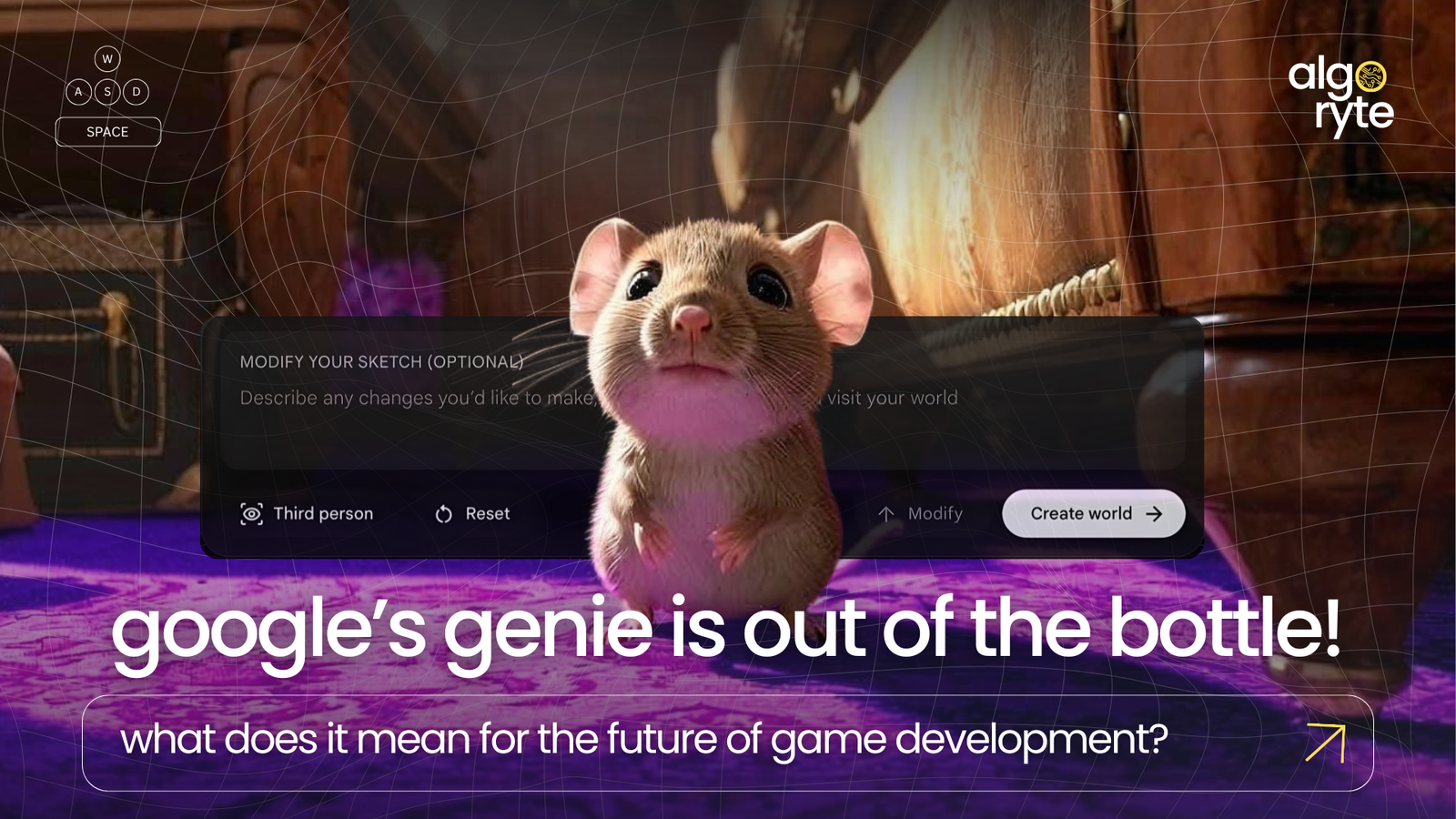
On January 29, 2026, Google unveiled Project Genie – an AI model that generates entire playable worlds from text prompts or photographs. Project Genie is Google’s experimental AI prototype designed to simulate environments by generating the path ahead in real-time as users move through virtual spaces.
In August 2025, Google DeepMind unveiled Genie 3 as the underlying world model behind Project Genie. Early access testers explored the system’s capabilities and discovered unexpected applications, creating diverse interactive environments that went beyond what the developers initially envisioned.
Here’s how it works from a user perspective:
- Start with a prompt – Type a description or upload an image of what you want to explore.
- Define your character – Choose your avatar or perspective.
- Choose your view – Explore from a first-person lens (through your character’s eyes) or a third-person lens (viewing your character from outside).
- Pick your navigation – Walk, fly, or move however you want.
- Explore in real-time – The AI generates the environment dynamically as you move.
Under the hood, Project Genie combines three powerful AI systems: Genie 3 (Google’s general-purpose world model), Nano Banana Pro, and Gemini. This combination allows users to sketch and shape worlds before jumping in to explore them, creating an interactive loop between imagination and experience.
What Early Users Are Creating
Early testers are discovering Project Genie’s ability to nail atmospheric effects that traditional 3D engines struggle with:
- Users are simulating animals like squirrels, cats, and mice in various environments with striking realism – capturing details from natural movement to fur texture and light passing through cartilage.
- The testers have successfully generated infinite backroom scenarios with dusty, liminal spaces lit by flashlight – capturing the eerie aesthetic that’s challenging to achieve in conventional game engines.
- Underwater sequences come complete with plankton, air bubbles, caustic lighting effects, and god rays filtering through the water.
- Users can explore cockpit perspectives – sitting in an F-35 chasing triangular craft through the sky.
In addition to that,
- You can step inside photographs, move around while exploring the surroundings, and zoom in and out to navigate through captured moments.
The system also allows users to re-roll and remix prompts, iterating on generated worlds until they match the creator’s vision. While frame rates can occasionally dip during complex scenarios, the trade-off delivers visual effects and environmental moods that would require extensive manual setup in traditional 3D pipelines.

Real-World Applications
The implications of Project Genie ripple across multiple industries:
- 3D Scanning & Digital Preservation: Architects, historians, and preservationists could potentially document spaces without expensive LiDAR equipment. Museums could offer virtual tours generated from photographic archives.
- VR/AR Gaming: Imagine playing a game set in your actual neighborhood, or exploring recreations of real locations without developers manually modeling every detail.
- Filmmaking & Pre-visualization: Directors and cinematographers could visualize scenes and camera angles in AI-generated environments before committing to expensive location shoots or set construction.
- Education: Students could walk through historical sites, scientific environments, or geographical locations generated from educational photographs and descriptions.
Google positions this capability as essential to their AGI research, arguing that truly intelligent systems must learn to navigate diverse environments – both real and imagined.
The Reality Check: Current Limitations
Before we declare the death of traditional game development, let’s talk about what Project Genie actually delivers in its current state.
It’s an early research prototype, and it shows.
Technical Constraints
- 60-second session limit – You get one minute per generated world before it resets.
- 720p resolution – In an era of 4K gaming, this feels like a step backward.
- 24 FPS – Not the smooth 60+ FPS modern gamers expect.
- High input latency – Characters can sometimes be less controllable or experience higher latency in control.
Quality Issues
- Prompt accuracy? Generated environments may not always closely match your text descriptions or uploaded images.
- Photorealism? Generated worlds often don’t look fully realistic.
- Real-world physics? Often out the window.
- Prompt drift? World generation gradually deviates from your original description the longer you explore.
- Interactive depth? You can walk through an AI-generated forest, but you can’t fight enemies, collect items, solve puzzles, or do any of the things that make games engaging beyond their first 60 seconds.
- Game mechanics? Can’t implement objectives, combat systems, inventory, or puzzles.
Real-World User Experiences Confirm the Limitations
One user who tested Project Genie reported disappointing results, saying that it was extremely easy to create worlds that were basically rip-offs of Nintendo games (Google says Genie was trained on publicly available data on the web), with interactions limited to basic movement and jumping and severe consistency issues where “the world forgets what you have already done or turns roads into grass.“
Another critic dismissed it as essentially “a pre-made walking and flying simulator with AI-generated character skins and environments swapped in.” Drawing from experience with both video game and tech presentations, they concluded this feels more like a gimmick than a genuine breakthrough poised to revolutionize gaming. The tester visibly struggled throughout their demo, and Project Genie consistently failed to render anything resembling licensed intellectual property.
Who Gets Access?
Google is rolling out Project Genie cautiously. Access is currently limited to:
- Subscribers to Google AI Ultra (Google’s top-tier AI service).
- Users aged 18 and older.
- United States residents only.
This restricted rollout makes sense given the prototype’s limitations. Google is testing, gathering feedback, and likely training the model on user-generated content before any broader release.

The Stock Market Reaction
Following Google’s January 29, 2026, announcement of Project Genie, ripples hit the gaming industry’s financial markets. Stocks for major game companies – particularly those specializing in game engines and hand-built open-world experiences – saw significant drops.
Companies affected included Take-Two Interactive, Roblox, CD Projekt Red, Nintendo, and Unity – with Unity taking the hardest hit at nearly 20% share price decline.
Project Genie generates playable worlds instantly (even crude ones) while AAA games demand years of development, massive teams, and inflating budgets. Investors saw AI potentially replacing human developers and panicked.
But the reaction reveals a misunderstanding of current capabilities. Genie can generate a forest environment, but it can’t create a compelling 100-hour RPG with branching narratives, memorable characters, and polished gameplay loops. Not even close.
How Does Project Genie Compare to Other AI Tools?
Project Genie isn’t the first AI tool aiming at game development, but it takes a fundamentally different approach.
Current AI tools operate on assembly:
- Sora generates videos.
- Scenario.ai creates game assets and sprites.
- Tripo 3D produces 3D models.
- Promethean AI assists with environment building.
- Layer AI creates concept art, game assets, and marketing materials.
- Tencent’s tools are capable of creating 360° pictures and 3D models.
All of these require developers to generate individual components – images, videos, models, and textures – and manually combine them into a cohesive game. It’s AI-assisted development, not AI-generated development.
Instead of generating pieces and assembling them, Genie attempts to generate the entire explorable world from a single prompt. You’re not building a game; you’re describing it and letting AI create it.
Genie’s Real Competition
Project Genie isn’t alone in the world model space:
LingBot-World (Open Source)
LingBot-World is the first open-source real-time interactive world model that rivals Google Genie 3 in quality, featuring 28 billion parameters and generating worlds at 16 FPS with sub-1-second latency.
What sets it apart:
- Stable generation for over 10 minutes without collapse, compared to Genie 3’s 1-minute full consistency.
- It’s also fully deployable under the Apache 2.0 License, while Genie 3 remains closed and research-only.
The trade-off? LingBot-World runs at 16 FPS compared to Genie 3’s 24 FPS, and requires enterprise-grade GPUs, making it inaccessible on consumer hardware.
The Bottom Line
The difference between traditional AI tools and world models is like comparing IKEA furniture (assembly required) to 3D-printed furniture (one button, complete product). Except Project Genie’s furniture currently collapses after 60 seconds and sometimes has legs where the arms should be, while LingBot-World’s lasts 10 minutes but requires a warehouse full of industrial equipment to produce.
The Future of Game Development with Genie
Project Genie is impressive as a research prototype and terrifying as a market disruptor, but it’s not ready to revolutionize game development tomorrow.
The 60-second limitation, visual inconsistencies, lack of game mechanics, and poor responsiveness all point to the same conclusion:
We’re witnessing the early stages of a technology that will eventually transform how we create virtual worlds, but that transformation is still years away.
For now, game developers can breathe easy. Project Genie can generate a forest, but it can’t create The Legend of Zelda. It can simulate a cityscape, but it can’t design Grand Theft Auto. And it certainly can’t capture the intentional design, emotional storytelling, and polished gameplay that make games memorable.
The revolution isn’t here yet. But Google just showed us what it might look like when it arrives.
Need a Game World That Actually Works?
As AI advances, one truth is clear: game development needs experienced artists and developers who understand both craft and technology.
Experienced artists and developers bring intentional design choices, emotional storytelling, and technical craftsmanship that automated systems can’t deliver.
Algoryte has delivered hand-crafted game environments for clients like Crown of Khosrow and Yetiverse – worlds with purposeful art direction, consistent visual polish, and gameplay-ready assets that players actually want to explore.
Check out our Game World Design, 2D Game Art, and 3D Game Art services, or get in touch to discuss your project.
FAQs
1. What is the core purpose of Project Genie?
Project Genie is designed to generate explorable 3D environments in real-time from text prompts or photographs, simulating interactive worlds as users navigate through them. Google positions it as essential research toward AGI, enabling AI agents to learn how to navigate diverse environments. Currently, it serves as an experimental prototype for testing how world models can create virtual spaces without traditional 3D modeling workflows.
2. How does Project Genie differ from current leading conversational AI tools?
Unlike conversational AI tools like ChatGPT or Claude that generate text responses, Project Genie generates interactive 3D environments you can explore in real-time. While conversational AI focuses on language understanding and text-based outputs, Project Genie creates visual, navigable worlds that respond dynamically to user movement and input. It’s a world model, not a language model – built for spatial simulation rather than conversation.
3. What are the potential applications of Project Genie in creative industries?
Project Genie could revolutionize pre-visualization in filmmaking, allowing directors to explore camera angles and scene layouts before expensive shoots. In game development, it offers rapid prototyping for environment concepts and level design iteration. For VR/AR, it enables the quick generation of immersive spaces from simple descriptions, while educators could create interactive historical or scientific environments for students to explore.
4. What are the best practices for integrating AI art into game development pipelines?
Use AI-generated assets for rapid prototyping and concept exploration during pre-production, but always have human artists refine and polish outputs for final production. Establish clear style guides and train custom AI models on your game’s specific art direction to maintain visual consistency. Treat AI tools as assistants that handle repetitive tasks – like generating asset variations or base textures – while artists focus on creative direction, emotional storytelling, and final quality control.
5. Differences between AI art generators tailored for 2D and 3D game art?
2D AI generators like Scenario.ai and Layer AI focus on creating sprites, concept art, UI elements, and textures with style consistency across flat assets. 3D AI tools like Meshy.ai and Tripo 3D generate volumetric models with geometry, textures, and sometimes rigging – producing assets ready for game engines like Unity or Unreal. While 2D tools excel at rapid iteration for visual styles and marketing materials, 3D generators handle mesh topology, UV mapping, and polygon optimization for real-time rendering.