





Overview
- Netflix Animation Studios has joined Blender’s Development Fund as a top-tier Corporate Patron with €240,000 annually. This move, likely influenced by the success of the Blender-built film Flow, positions Netflix to influence the development roadmap of the world’s leading open-source 3D software – raising questions about whether this benefits the entire community or prioritizes corporate needs.
- While Netflix’s funding could accelerate Blender’s capabilities with enterprise-grade features and optimizations, the creative community fears a shift in priorities away from indie developers and small studios. The concern isn’t about paywalls, but whether Blender’s development will pivot toward serving 500-person animation teams rather than solo creators who built the platform’s grassroots success.
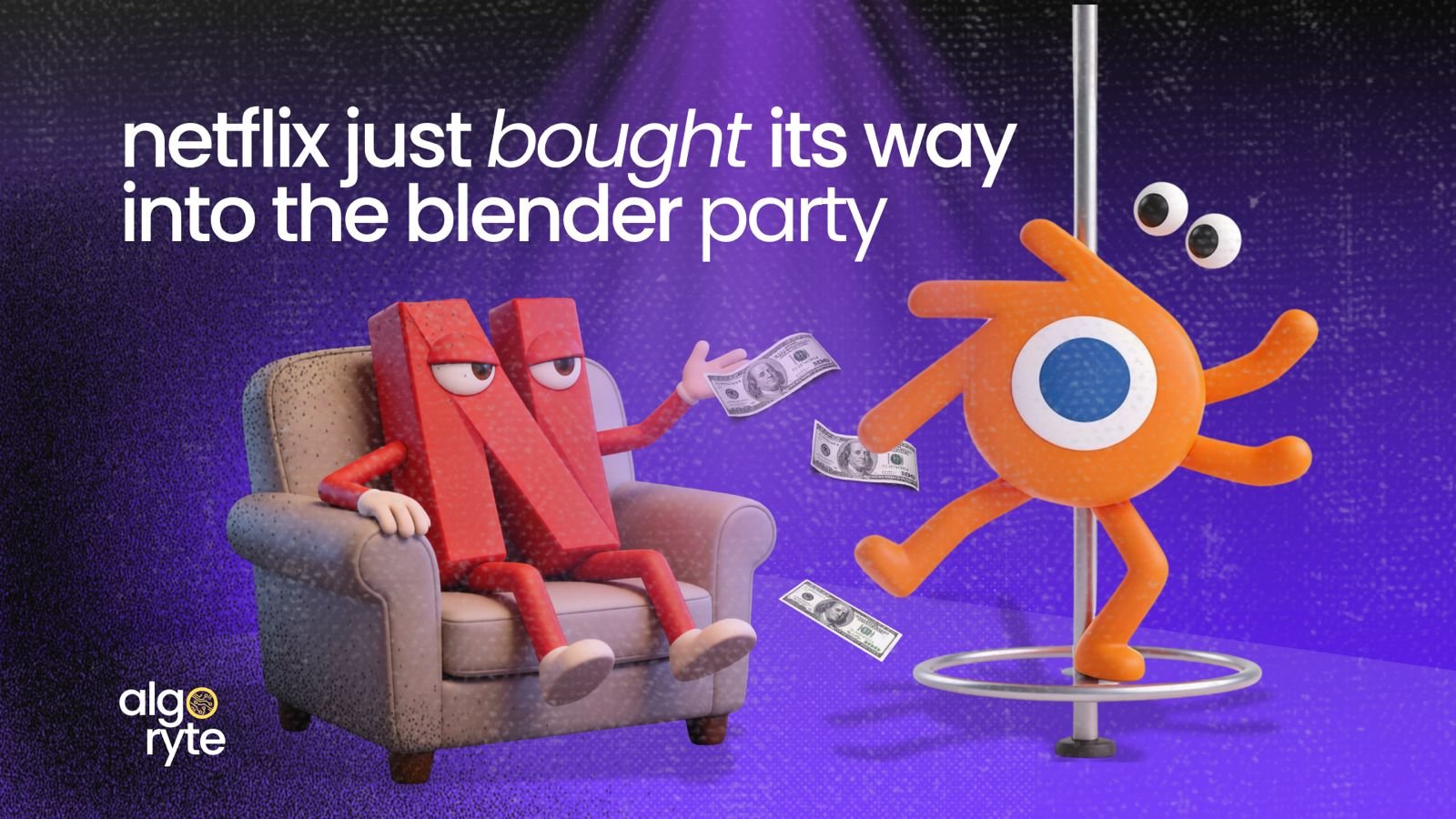
The industry just watched Netflix drop a €240,000 “tip” onto the Blender stage—but in the world of high-stakes tech, there’s no such thing as a free lunch. Especially when the diner is a streaming giant known for swallowing its competition whole.
The Power Move
As of January 2026, Netflix Animation has officially joined the Blender Development Fund as a Corporate Patron. They are now contributing the maximum tier of €240,000 per year. On paper, it looks like a win for open-source. In reality? It’s a calculated flex.
Netflix isn’t just “supporting” the community; they’re buying a seat at the head of the table. After their staggering $83 billion acquisition of Warner Bros. and HBO last year, Netflix has transitioned from a content distributor to an absolute apex predator. Now, they’re securing the “means of production.”
By funding Blender, they aren’t just helping a tool grow—they’re ensuring that the world’s most popular 3D engine evolves to serve their specific 2026 animation slate.
The “Flow” Effect
Why now? Because Blender just got its “I told you so” moment. The Oscar-winning success of the Blender-built film Flow proved to the suits in Los Gatos that they didn’t need to spend millions on proprietary software or overpriced licenses.
Netflix realised that if they can’t own the software, they can certainly rent the roadmap.
The Adobe/Figma Ghost
The creative community has PTSD, and for good reason. We’ve seen this movie before.
When corporate giants start “collaborating” with creative tools, the community starts smelling the ghost of Adobe’s attempted hijacking of Figma. There is a very real fear that financial dependence will lead to “feature capture.”
Sure, Blender is GPL-licensed and technically “free,” but the direction of development isn’t. Will the core developers spend 2026 fixing bugs for the solo indie dev, or will they be busy optimizing massive USD pipelines and high-end rendering clusters specifically requested by Netflix engineers?
The fear isn’t a paywall—it’s a priority wall. ### Indie Devs: Trickle-Down or Sidelined? For the indie game dev and the boutique animation studio, this is a double-edged sword:
- The Glow-Up: You might get “Netflix-grade” stability and performance patches for $0. If Netflix funds a faster Cycles render or a more robust animation toolkit, you reap the benefits.
- The Squeeze: If Blender’s roadmap pivots to serve the needs of 500-person blockbuster teams, the “one-stop-shop” simplicity that makes Blender the king of the indie scene could be sacrificed for “enterprise-grade” complexity.
The Verdict
Blender has always been the “people’s tool,” the zero-barrier-to-entry hero of the 3D world. But with a corporate giant now making it rain in the dev fund, the community is watching closely.
Is this a massive scale-up for open-source, or is it the beginning of the end for Blender’s individuality? 2026 will be the year we find out if you can take the corporate money without losing your soul.
Don’t wait for the giants to decide your future. While the titans battle for control over the tools, the real innovation is happening on the ground. Whether you’re an indie developer building the next viral hit or a studio looking to scale without the corporate baggage, you need a partner that understands the tech.
Build your legacy with Algoryte. From 3D art and game development to the bleeding edge of VR/XR, we help you master the tools of tomorrow.
👉 Explore the future at www.algoryte.com
FAQs
1. Can Netflix actually change Blender’s open-source license?
No. Blender is licensed under the GPL (General Public License), which legally guarantees it remains free and open-source forever. Netflix can’t make Blender subscription-based or proprietary. However, they can influence which features get prioritized, which bugs get fixed first, and where developer attention goes—essentially shaping the roadmap without touching the license. The software stays free; the direction might not stay democratic.
2. How does corporate funding compare to community donations for Blender?
Netflix’s €240,000 annual contribution is substantial, but Blender’s Development Fund relies on a mix of corporate patrons, small studios, and individual supporters contributing anywhere from €5 to €120,000+ per year. The Blender Foundation has historically maintained independence by diversifying funding sources. The risk isn’t Netflix’s money itself—it’s if corporate patrons collectively outweigh community voices, shifting the balance of influence away from grassroots users.
3. What precedent exists for corporate involvement in open-source projects?
The track record is mixed. Red Hat’s involvement with Linux helped scale enterprise adoption while keeping the kernel open. Google’s Chromium project powers multiple browsers but raised concerns about centralized control. Meta’s contributions to React and PyTorch have accelerated development, though critics argue they steer features toward Meta’s infrastructure needs. The key difference with Blender is its creative tool status—if development priorities shift toward Netflix-scale production pipelines, the simplicity and accessibility that made Blender revolutionary for solo creators could be compromised in favor of enterprise complexity.
4. What is Blender 3D used for?
Blender is a free, open-source 3D creation suite used for modeling, animation, rendering, video editing, VFX, game development, and motion graphics. It’s popular among indie developers, small studios, and increasingly, major productions—from animated films like Flow to AAA game assets and architectural visualization. Its zero-cost barrier and comprehensive toolset make it accessible to beginners while powerful enough for professional pipelines.
5. Explain the difference between Eevee and Cycles render engines.
Eevee is Blender’s real-time render engine that uses rasterization to produce fast, preview-quality renders—ideal for quick iterations, stylized work, and real-time applications like games. Cycles is a physically-based path-tracing engine that simulates light behavior for photorealistic results, though it requires significantly more rendering time. Think of Eevee as “instant feedback” and Cycles as “cinematic quality”—many artists use Eevee for workflow speed and Cycles for final output.