




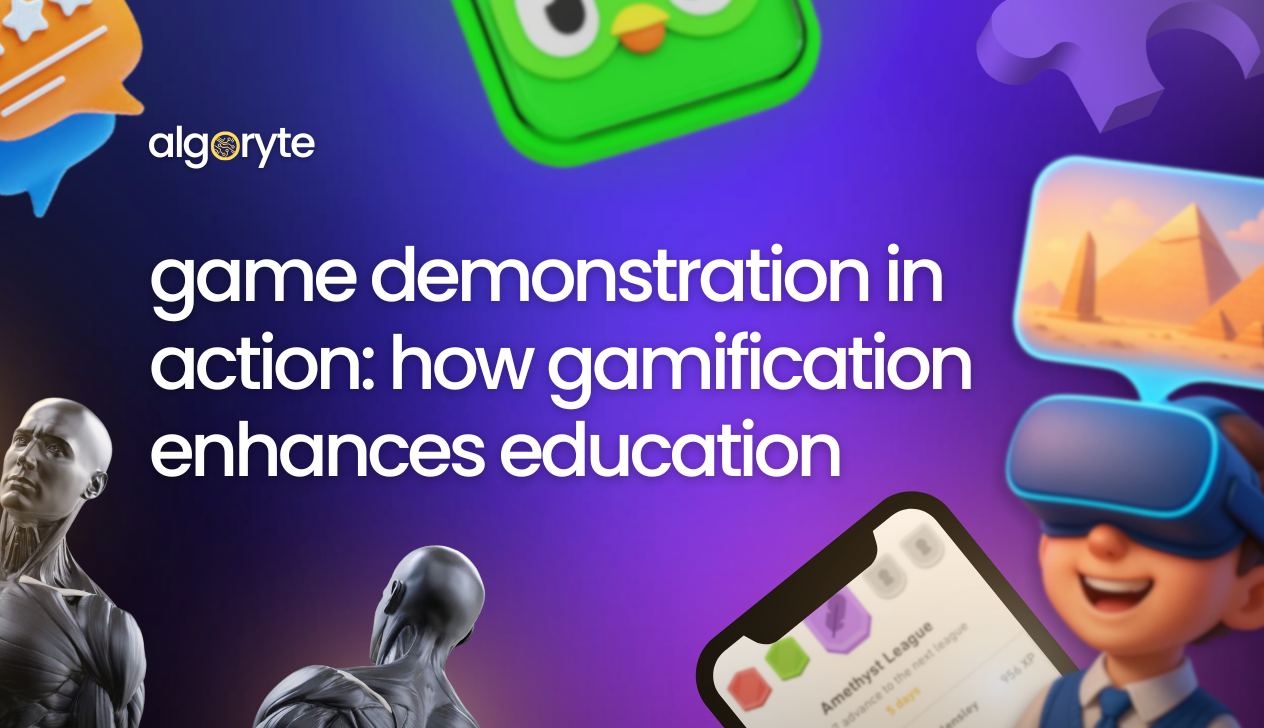
In today’s fast-paced digital era, education is no longer confined to chalkboards and textbooks. With the rise of interactive technology, educators and institutions are seeking new ways to keep students engaged and motivated. One of the most effective approaches is gamification in education—the integration of game mechanics and immersive storytelling into learning experiences. When done right, gamification transforms classrooms into vibrant environments where students are not just passive learners, but active participants.
At Algoryte, a leading Game Development company, we’ve seen firsthand how a simple game demonstration can revolutionize the way people perceive education. Through our Game Development services, we help schools, universities, and training institutions harness the potential of the game development industry to craft engaging, effective, and future-ready learning experiences.
What Is Gamification in Education?
Gamification in education involves applying elements typically found in games—such as points, levels, badges, challenges, and leaderboards—into non-game contexts like classrooms or training modules. Instead of merely listening to lectures or memorizing facts, students get to “play” their way to mastery.
For example, a game demonstration in a biology class might allow students to explore a 3D model of the human body, earning rewards for correctly identifying organs. Similarly, a history lesson could turn into an interactive strategy challenge where learners unlock stories from different eras by solving puzzles. These methods go beyond memorization—they ignite curiosity and sustain engagement.
Why Game Demonstrations Work So Well
Game demonstrations are powerful because they showcase concepts in action. Rather than reading abstract definitions, learners experience the subject matter dynamically. Here’s why they work:
- Active Participation – Students are no longer passive listeners. Instead, they actively make decisions, solve problems, and see results instantly.
- Instant Feedback – In games, feedback loops are immediate. Correct answers or smart strategies earn rewards, while mistakes encourage retry and reflection.
- Safe Learning Environment – Mistakes in a gamified system don’t carry the same risks as real life. This makes learners more willing to experiment and learn by doing.
- Motivation & Engagement – Points, achievements, and progress bars provide a sense of accomplishment, encouraging learners to keep going.
- Retention & Recall – Studies show that when learners interact with content, they retain knowledge more effectively than through passive consumption.
Examples of Gamification in Education
To understand the impact, let’s look at some practical applications of gamification:
- Language Learning Apps – Platforms like Duolingo use streaks, levels, and leaderboards to keep learners motivated. A simple game demonstration of vocabulary building turns language practice into a daily habit.
- STEM Education – Science and math concepts can be difficult to grasp. But when learners solve physics puzzles in a virtual environment, abstract formulas suddenly make sense.
- Corporate Training – Businesses are increasingly using gamified training modules to boost employee engagement. For example, sales staff might complete simulated “missions” where they practice negotiation skills.
- Virtual Classrooms – With the growth of remote learning, gamification ensures that online education remains interactive. Students collaborate in virtual worlds, earning rewards for teamwork and creativity.
At Algoryte, our Game Development services are designed to create such experiences—bridging the gap between education and entertainment.
How Gamification Enhances Learning Outcomes
The true power of gamification lies in measurable outcomes. When educators adopt gamified strategies, they often see:
- Increased Engagement: Students show higher attendance, participation, and enthusiasm.
- Improved Knowledge Retention: Interactive learning boosts long-term memory retention.
- Better Collaboration: Multiplayer and group challenges foster teamwork and communication skills.
- Critical Thinking Development: Gamified tasks encourage problem-solving, strategy, and creativity.
- Personalized Learning: Adaptive game systems allow students to learn at their own pace.
This aligns with modern educational psychology, which emphasizes active, student-centered learning over one-way instruction.
Role of the Game Development Industry
Behind every gamified education tool is the game development industry—a sector constantly pushing the boundaries of creativity and technology. Traditionally focused on entertainment, the industry is now expanding into areas like healthcare, business, and most importantly, education.
With rapid advances in AR, VR, and AI, game demonstrations are becoming more immersive. Imagine a medical student walking through a virtual hospital, practicing surgical procedures without risk. Or a history student stepping into a virtual battlefield to experience the strategies of past generals.
These experiences aren’t science fiction anymore. They’re happening today, and companies like Algoryte are at the forefront of designing and deploying them.
How Algoryte Brings Gamification to Life
As a trusted Game Development company, Algoryte specializes in building custom gamified solutions tailored to educational needs. Our approach includes:
- Understanding the Audience – Every age group learns differently. We design experiences that match learners’ abilities, attention spans, and interests.
- Blending Fun with Function – Our Game Development services ensure that entertainment never overshadows learning objectives. Every reward, level, or challenge is carefully aligned with curriculum goals.
- Cross-Platform Solutions – From mobile apps to VR simulations, we create experiences accessible across devices, ensuring inclusivity.
- Scalability & Customization – Whether for a single classroom or a nationwide curriculum, our gamified solutions scale seamlessly.
- Cutting-Edge Technology – Leveraging AI, VR, and cloud platforms, we craft experiences that feel futuristic yet practical.
By combining game mechanics with educational goals, Algoryte empowers institutions to rethink learning.
The Future of Gamification in Education
The future of gamification in education is limitless. As immersive technologies evolve, we’ll see classrooms where:
- Virtual reality allows students to “travel” to ancient civilizations.
- Artificial intelligence personalizes game levels based on individual progress.
- Cloud-based systems let learners across the world collaborate in real time.
- Gamified assessments replace traditional tests, making evaluation fun and less stressful.
In the coming years, the line between education and entertainment will blur even further. The game development industry will play a pivotal role in shaping this transformation, creating learning experiences that are not just informative but unforgettable.
Conclusion
Gamification is not just a passing trend—it’s a revolution in how we approach learning. By transforming traditional classrooms into interactive, engaging environments, game demonstrations bring education to life in ways textbooks never could.
At Algoryte, we believe in the power of games to change the world. As a leading Game Development company, our mission is to provide innovative Game Development services that empower educators, students, and organizations to embrace the future of learning.
In a world where attention spans are shrinking and competition for engagement is fierce, gamification offers a proven, powerful solution. And with the game development industry evolving at lightning speed, education is set to become more interactive, immersive, and inspiring than ever before.