





Overview
- Ghost of Yōtei is a visually striking and emotionally engaging open-world samurai game set in 1600s rural Japan. The game combines deep cultural research, a distinctive painterly art style, and advanced PS5 technology to create an immersive experience.
- The development process highlights the importance of cultural authenticity, artistic direction, and technical innovation in building a rich, believable world and compelling gameplay.
Introduction
When discussing major video game releases, conversations often focus on gameplay, combat systems, or storylines. However, what frequently goes unnoticed is the essential element that shapes our emotional response to these aspects, i.e., game art. In Ghost of Yōtei, the highly anticipated sequel to Ghost of Tsushima developed by American studio Sucker Punch, art direction isn’t just decoration or an add-on – it serves as the foundation of the game’s identity.
Ghost of Yōtei
Ghost of Yōtei is a powerful tale of a warrior in Japan driven by a personal quest for vengeance. Set 300 years after the acclaimed Ghost of Tsushima, Ghost of Yōtei unfolds as an independent story set in the rural landscapes of 1600s Japan. The narrative centers on Atsu, a solitary mercenary fueled by the desire for justice. Traversing the wild, rugged terrain of northern Japan, she pursues those responsible for the brutal murder of her family many years ago.
Ghost of Yōtei is a samurai-themed open-world game with a rich Japanese culture narrative that combines:
- Action combat – with swordfighting inspired by Kurosawa films.
- Adventure/exploration – across a vast open-world map set in Hokkaido.
- Stealth elements – following the “Ghost” gameplay style from its predecessor.
Game Art
The art development process of Ghost of Yōtei focused heavily on achieving a distinctive “painterly” art style, combined with high technical fidelity enabled by the PS5 hardware:
1. Research – Cultural Authenticity & Playability
Before production began, the team spent months on groundwork, including sketching, prototyping, and on-site visual and cultural research trips to Hokkaido. This helped capture authentic environmental details, light reflections in snow, architectural weight, and micro-interactions in nature, which became the emotional compass for the game’s world-building.
The team consulted historians and cultural experts to ensure the world felt authentically Japanese – embracing asymmetry, impermanence, and the beauty of decay in environments like ruined shrines and drifting petals. The art team took special care to recreate the feeling of natural landmarks like Mount Yōtei, with grand vistas and drifting clouds.
2. Art Style
Ghost of Yōtei’s art style is a striking blend of painterly minimalism and natural realism, drawing heavily on traditional Japanese aesthetics and the cinematic influence of Akira Kurosawa.
3. Art Direction
Art director Joanna Wang described the philosophy, where every asset fits within a specific rendering system and color palette to ensure world cohesiveness. Artists followed specific rules for textures, normal maps, and specular maps to maintain visual consistency. The painterly look is achieved using denoising techniques to reduce distracting noise in textures and visuals.
The approach goes beyond decoration to storytelling through art. The game world acts as an interface, guiding players naturally without traditional HUDs, using environmental elements like wind, animals, and light cues to communicate.
4. Concept Art
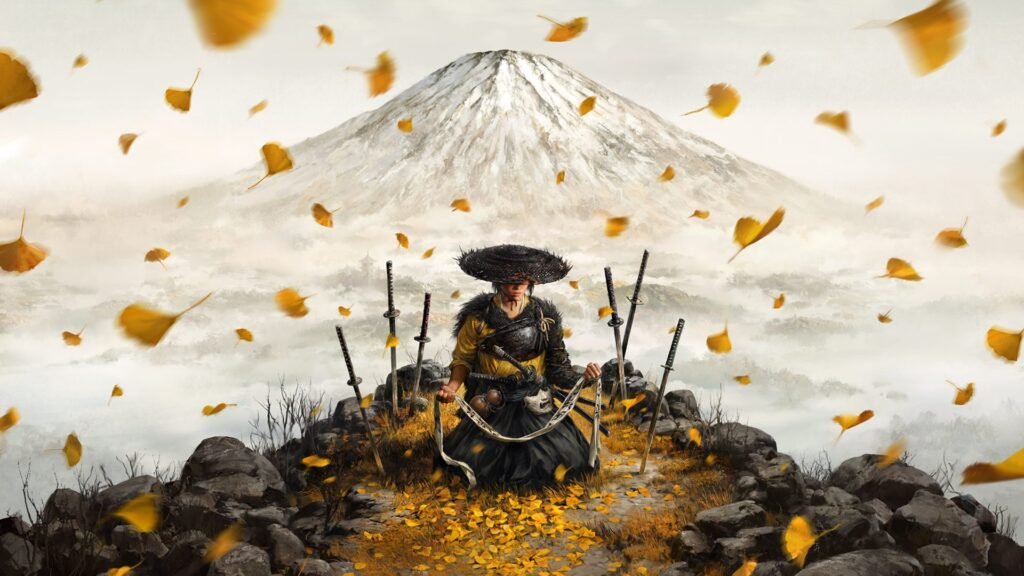
The concept art emphasizes serene, rugged landscapes of northern Japan with carefully crafted environmental details like drifting petals, dynamic weather, and subtle lighting effects that create a haunting, immersive atmosphere. The visuals balance a refined, artistic approach with the technical power of the PS5, resulting in a world that feels alive and emotionally evocative.
Ghost of Yōtei’s concept art not only captures the beautiful, painterly landscapes but also intricately designs its characters and non-playable characters, giving each a distinctive silhouette, personality, and cultural authenticity. The lead character, Atsu, features a memorable, bold design with elements like a straw hat and a half-oni mask, while the antagonistic Yōtei Six gang members showcase diverse, intimidating appearances reflecting their unique traits and roles within the story.
Visual Art & Technical Integration on PS5
The following sections detail the advanced 3D art development and visual features enabled by the PS5 hardware, along with the technical engine integration and immersive technologies that bring Ghost of Yōtei’s world to life:
1. 3D Art Development & Visual Features
The team leveraged the PS5 hardware upgrade from the PS4 to greatly expand the draw distance and the number of assets that could be loaded and visible simultaneously. They rendered millions of assets, with tens of thousands visible on screen at once, including hundreds of thousands of real-time particles such as leaves, snow, and fog.
Environmental effects such as dynamic skies, auroras, time-of-day transitions, terrain deformation, and detailed grass rendering all contributed to making the world feel alive and immersive. The rendering system, denoising process, lighting, skies, and cloud effects combined to create a cohesive and visually rich experience powered by the PS5.
2. PS5 Engine Integration & Immersive Technologies
The art and technical teams collaborated closely to integrate high-fidelity 3D art assets into a custom rendering pipeline optimized specifically for the PS5. Their focus was on balancing visual beauty with smooth performance to ensure seamless gameplay within a large, dynamic world. Additionally, they utilized PS5-specific features such as haptic feedback and the DualSense controller’s speaker to enhance player immersion.
This allowed elements like combat sounds and traditional shamisen music to be felt and heard directly through the controller. The harmonious blend of lighting, skies, cloud effects, and artistic elements effectively reflects the natural beauty of the Hokkaido-inspired setting, highlighting a strong synergy between advanced technology and meticulous art direction.
Lessons for AAA & Indie Studios
AAA and indie studios developing games in similar action-adventure or open-world samurai genres can learn valuable lessons from Ghost of Yōtei’s development:
- First, investing deeply in cultural authenticity and real-world research not only enriches world-building but also elevates player engagement by creating immersive, believable narratives.
- Secondly, harmonizing artistic vision with next-generation technology, such as leveraging hardware capabilities for detailed environments and enhancing immersion through controller features, can make gameplay both visually stunning and emotionally resonant.
- Finally, studios should balance expansive open worlds with meaningful, varied content to avoid repetitiveness, offering players novel experiences that encourage exploration and replayability.
FAQs
1. What genre is Ghost of Yōtei?
Ghost of Yōtei is an action-adventure samurai-themed open-world game blending sword combat, stealth, and exploration in a rich Japanese cultural setting.
2. Who is the protagonist in Ghost of Yōtei?
The player controls Atsu, a solitary mercenary on a quest for vengeance in 1600s northern Japan.
3. What platforms is Ghost of Yōtei available on?
Ghost of Yōtei is a PlayStation 5 exclusive, leveraging the console’s advanced hardware capabilities.
4. When is the release date for Ghost of Yōtei?
Ghost of Yōtei is officially released on October 2, 2025, with some regions gaining access slightly earlier due to time zone differences.
5. How does the art style of Ghost of Yōtei contribute to the game?
The painterly art style, combined with natural realism and meticulous cultural research, creates an emotionally immersive and visually cohesive world.